



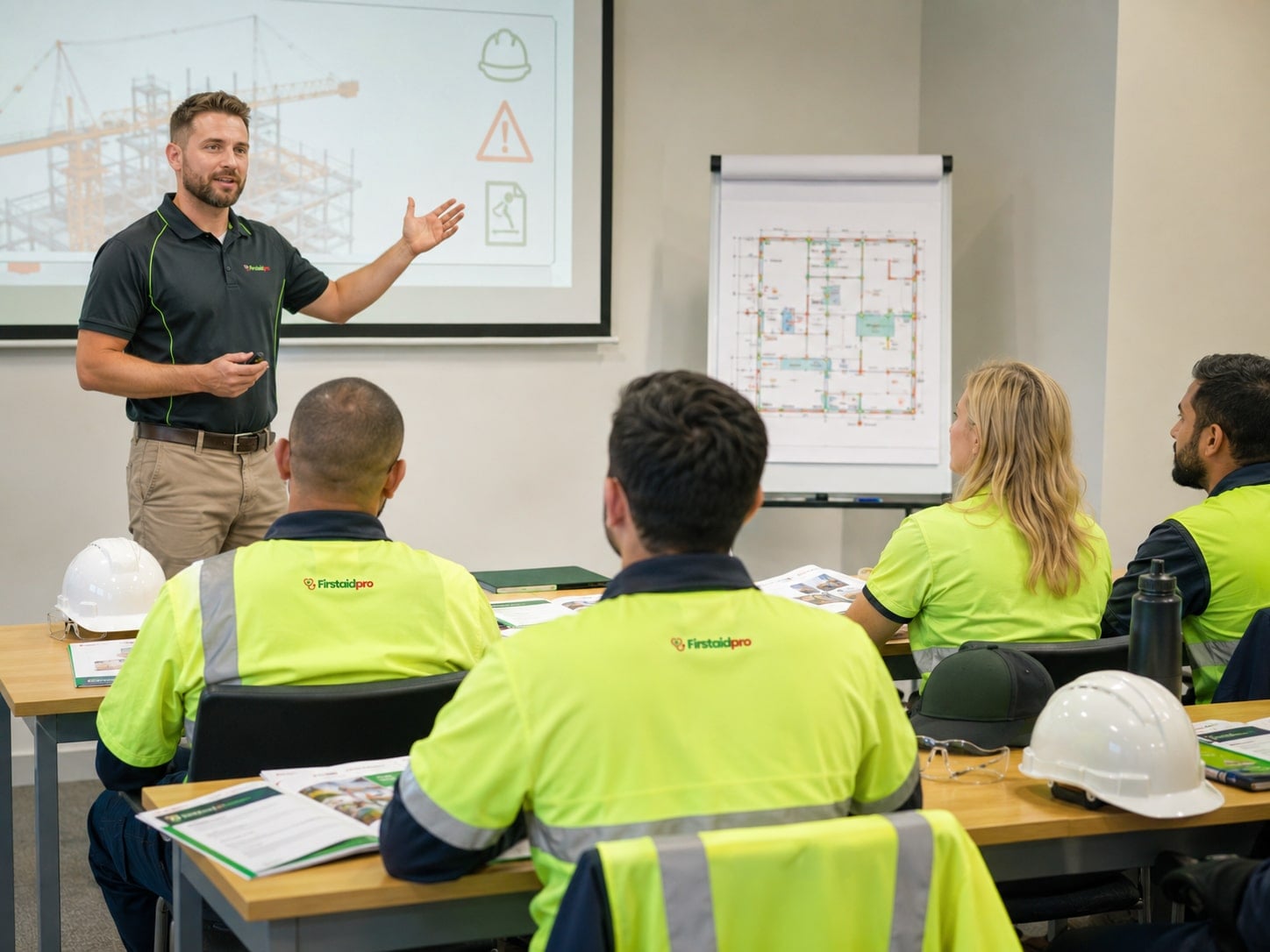

Walking onto a construction site without a White Card is a bit like showing up to a job interview without your resume—you’re not getting through the gate. The White Card assessment is the final step between you and legal access to worksites across Australia, and knowing what questions to expect can take the edge off.
The test covers six core topics: WHS legislation, hazard identification, the hierarchy of control, PPE, emergency procedures, and incident reporting. Below, you’ll find the exact question types you’ll face, sample questions with model answers, and practical tips to help you pass on your first attempt.
Key Takeaways
- The White Card assessment uses multiple-choice questions, short answers, and photo-based hazard identification to check your understanding of construction site safety.
- Six main topics appear on the test: WHS legislation, hazard identification, the hierarchy of control, PPE, emergency procedures, and incident reporting.
- The hierarchy of control is the most frequently tested concept—know the order from elimination down to PPE.
- Photo-based questions ask you to spot dangers like missing guardrails, cluttered walkways, or workers without protective gear.
- Passing the assessment earns you a Statement of Attainment for CPCWHS1001, which you then use to apply for your nationally recognised White Card.
Ready to get started? Book a White Card course with FirstAidPro and complete your training in a single day.

What Is the White Card Assessment
The White Card assessment is the knowledge test at the end of the CPCWHS1001 Prepare to Work Safely in the Construction Industry course. The test typically uses multiple-choice questions and photo-based hazard identification to confirm you understand how to stay safe on Australian construction sites.
Think of it as a competency check rather than a traditional exam. The questions aren’t designed to trick you—they’re there to make sure you’ve absorbed what your trainer covered during the day.
Without passing, you won’t receive your Statement of Attainment. And without that document, you can’t legally set foot on most construction sites in Australia.
Who Needs to Pass a White Card Assessment
Anyone planning to work on—or regularly visit—an Australian construction site will need a White Card. With the industry employing 1.36 million workers, the list is broader than you might expect:
- Construction workers: labourers, apprentices, electricians, plumbers, carpenters, site supervisors, plant operators
- Site visitors: engineers, architects, surveyors, delivery drivers entering active zones
- Adjacent industries: mining, demolition, civil infrastructure, oil and gas, film or event set construction
The requirement applies nationally. Whether you’re working in Queensland, South Australia, or the Northern Territory, the same CPCWHS1001 unit covers you everywhere.

What to Expect on White Card Assessment Day
Walking into your first White Card course can feel a bit uncertain, so here’s how a typical day runs.
You’ll spend most of the morning and early afternoon learning about construction safety—WHS laws, hazard identification, emergency procedures, and how to use personal protective equipment. The assessment comes toward the end, after you’ve had time to absorb the material.
Bring with you:
- Valid photo ID (driver’s licence or passport)
- Your 10-digit Unique Student Identifier (USI)
- A pen if you like taking notes
The atmosphere is usually relaxed. Trainers want you to pass, and you’re encouraged to ask questions throughout the day if anything is unclear.
How the White Card Assessment Is Structured
The format varies slightly between training providers, but most White Card assessments combine a few different question types.
Question Type | What It Tests |
Multiple choice | Knowledge recall of WHS terms and procedures |
Short answer | Your ability to explain hazards and controls in your own words |
Scenario-based | Applying safety knowledge to realistic worksite situations |
Some RTOs also include practical activities or video-based questions where you identify hazards in images or footage. Again, the goal isn’t to catch you out—it’s to check that you can recognise real-world dangers.
Topics Covered in the White Card Assessment
Six main topic areas appear on the assessment. Each one connects directly to keeping yourself and others safe on site.
WHS Legislation and Duty of Care
Work Health and Safety (WHS) legislation sets out the legal framework for workplace safety in Australia, with regulators issuing 674 notices across 213 site audits in a single SafeWork SA campaign. You’ll see questions asking who holds responsibilities under WHS law.
- PCBU: Person Conducting a Business or Undertaking—typically the employer or principal contractor
- Duty of care: The legal obligation to take reasonable steps to protect the health and safety of yourself and others
A common question: “Who has a duty of care on a construction site?” The answer includes PCBUs, workers, and visitors.
Hazard Identification on Construction Sites
A hazard is anything with the potential to cause harm. On construction sites, hazards are everywhere—and spotting dangers quickly is a fundamental skill.
Common hazards you might be asked about:
- Working at heights (scaffolding, ladders, roofs) — falls accounted for 24 workplace fatalities in 2024
- Electrical risks (exposed wiring, overhead power lines)
- Falling objects (tools, materials, debris)
- Hazardous substances (asbestos, chemicals, dust)
- Mobile plant (forklifts, excavators, cranes)
Photo-based questions often show a worksite image and ask you to identify what’s dangerous. Look for missing guardrails, cluttered walkways, or workers without PPE.
Risk Management and the Hierarchy of Control
A hazard is something that could cause harm. A risk is the likelihood that harm will actually occur. Understanding the difference matters.
The hierarchy of control is the standard approach to managing risks, and it’s one of the most frequently tested topics. The controls are listed in order of effectiveness:
- Elimination: Remove the hazard completely (most effective)
- Substitution: Replace with something safer
- Isolation: Separate people from the hazard
- Engineering controls: Physical changes like guardrails or ventilation
- Administrative controls: Safe work procedures, training, signage
- PPE: Personal protective equipment (least effective, last resort)
If a question asks “What is the most effective way to control a hazard?”—the answer is always elimination.

Personal Protective Equipment and Safety Signage
PPE is your last line of defence when other controls aren’t enough. Common protective equipment in construction tested on the assessment includes hard hats, high-visibility clothing, steel-cap boots, safety glasses, hearing protection, and gloves.
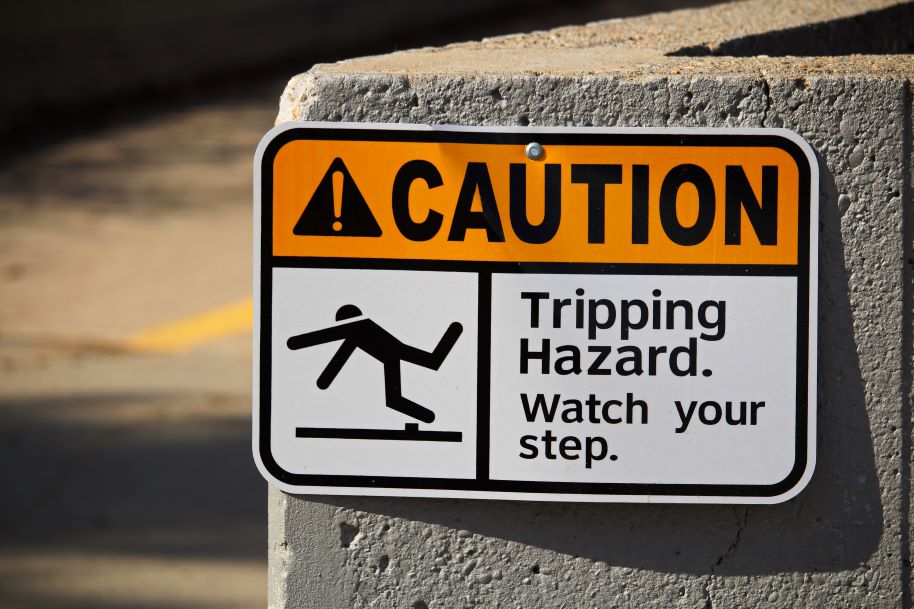
Safety signage and gear follows a colour-coded system worth memorising:
- Prohibition signs (red circle): Tell you what NOT to do
- Mandatory signs (blue circle): Tell you what you MUST do
- Warning signs (yellow triangle): Alert you to hazards
- Emergency signs (green rectangle): Show safety equipment and exits
Emergency Response and Incident Reporting
Knowing what to do in an emergency could save your life—or someone else’s.
Key points to remember:
- Know where your site’s emergency assembly point is located
- Report all incidents, injuries, and near-misses to your supervisor
- Call 000 for life-threatening emergencies
- Don’t attempt rescues unless you’re trained and it’s safe to do so
Near-miss reporting often gets overlooked, but it’s critical. A near-miss today could be a serious injury tomorrow.
Communication and Safe Work Method Statements
A Safe Work Method Statement (SWMS) is a document outlining how high-risk construction work will be carried out safely. You might be asked what a SWMS is for or when one is required.
Communication questions often focus on how to report hazards to supervisors and coworkers. The key principle? If you see something unsafe, say something.

Sample White Card Assessment Questions and Answers
Seeing example questions helps you understand what to expect. Here are realistic samples across different question types.
Multiple Choice Sample Questions
Question 1: What is the most effective way to control a hazard?
- A) Use PPE
- B) Put up warning signs
- C) Eliminate the hazard ✓
- D) Train workers to avoid it
Question 2: What colour is a mandatory safety sign?
- A) Red
- B) Blue ✓
- C) Yellow
- D) Green
Question 3: Who has a duty of care on a construction site?
- A) Only the site supervisor
- B) Only the workers
- C) Everyone on site, including visitors ✓
- D) Only the PCBU
Short Answer Sample Questions
Question: What is a hazard? Give two examples of hazards found on a construction site.
Model answer: A hazard is anything that has the potential to cause harm. Examples include working at heights without fall protection and exposure to asbestos dust.
Scenario Based Sample Questions
Scenario: You arrive at a construction site and notice a power cord running across a walkway. Workers are stepping over it to access the building. What action would you take?
Model answer: Report the hazard to your supervisor immediately. The cord creates a trip hazard and potential electrical risk. Warn other workers and suggest the cord be relocated or covered with a cable protector.

How Hard Is the White Card Test
Here’s the honest answer: the White Card assessment is achievable for most people who pay attention during training. It’s a competency check, not an exam designed to fail you.
The questions test understanding rather than memorisation. If you can explain why something is dangerous and what you’d do about it, you’re on the right track.
You can ask your trainer for clarification during the course if anything is unclear. Most trainers actively encourage questions—they’d rather you understand the material than struggle through the assessment.
What to Study Before Your White Card Assessment
A little preparation can improve your confidence. You do not need to cram like it is a university exam—focus on the core safety concepts covered during your training.
Concentrate your review on these four essential areas:
The Hierarchy of Control
Know the correct order of controls, beginning with elimination and ending with personal protective equipment (PPE).
WHS Terminology
Understand important terms such as PCBU, duty of care, hazard and risk.
Safety Signage Colours
Review what red, blue, yellow and green safety signs communicate on a construction site.
Emergency Procedures
Know what action to take, who should be contacted and when workers may need to evacuate the site.
What Happens If You Fail the White Card Assessment
First, don’t panic—failing is uncommon, and it’s not the end of the road.
If you don’t pass on your first attempt, most RTOs offer a re-assessment opportunity. This might involve additional study time, a review session with your trainer, and then another attempt at the questions you struggled with.
The goal is to get you competent, not to gatekeep.
Tips to Pass Your White Card Assessment First Time
The assessment is designed to confirm that you understand essential construction safety concepts. Careful reading, active participation and focused preparation can help you approach it with confidence.
Read Every Question Carefully
Some questions test specific details. Read the entire question, including every answer option, before selecting your response.
Focus on Hazard and Risk Terminology
A hazard is something that could cause harm. A risk is the likelihood that the harm will occur.
Memorise the Hierarchy of Control
This is one of the most frequently tested topics. Know all six control levels in the correct order:
Know Common Construction Signage
Learn what the main safety sign colours and shapes communicate before assessment day.
Stay Engaged During Practical Activities
Active participation helps information stick. Get involved when your trainer demonstrates a procedure or runs a group activity.
What Happens After You Pass Your White Card Assessment
Once you pass, your RTO will issue a Statement of Attainment for CPCWHS1001. This document proves you’ve completed the nationally recognised construction induction training.
With your Statement of Attainment, you can apply for your White Card through your state or territory’s safety regulator. In some states—like South Australia—cards are issued on the same day as your course.
Your White Card is valid nationally, meaning you can use it on construction sites anywhere in Australia. If you ever misplace your card details, you can find your white card number online.
Book Your White Card Course With FirstAidPro
FirstAidPro delivers fully face-to-face, SafeWork-approved White Card courses across South Australia, Queensland, and the Northern Territory.
- Same-day White Card issuance in SA
- Experienced construction trainers with real industry backgrounds
- No online pre-learning—everything is covered on the day
- Flexible scheduling including weekday and weekend options
Book your White Card course today and walk onto your first construction site with confidence.
Related Reading
- Safe Work Australia – Legislation
Training .gov.au – CPCWHS1001 Prepare to work safely in the construction industry
Frequently Asked Questions About the White Card Assessment
How long does the White Card assessment take?
The assessment itself typically takes 30 to 60 minutes. Most of your training day is spent learning the content before you’re assessed.
Do I need a Unique Student Identifier to sit the White Card assessment?
Yes. You’ll need a valid 10-digit USI before your RTO can issue your Statement of Attainment. You can create one for free at usi.gov.au.
Can I complete the White Card assessment online?
Some RTOs offer online or blended delivery options, though many require face-to-face practical components to meet SafeWork requirements.
Is the White Card valid in every Australian state and territory?
Yes. The White Card (CPCWHS1001) is nationally recognised and accepted on construction sites across Australia.
How old do I need to be to sit the White Card assessment?
You can complete the White Card course from age 14, though workplace restrictions may apply for younger workers.
Does the White Card expire?
The White Card itself does not expire. However, some employers or sites may require refresher training after a certain period.
Disclaimer
The content on this website offers general insights regarding the White Card assessment and construction safety training. It is not intended as, and should not be construed as, legal or regulatory advice. For specific guidance, contact your state’s safety regulator or your chosen RTO.