




Sharon has 21+ years of experience as a qualified Emergency Care Nurse registered with the Australian Health Practitioner Regulation Agency (APHRA) and 12+ years as a First Aid Trainer.
She takes pride in FirstAidPro making first aid training available, comprehensive and affordable to everybody.
- World Children’s Day 2026: Child First Aid Skills Every Parent, Carer and Educator Should Know - 06/11/2026
- Face-to-Face vs Online White Card Training: The Real Differences - 06/11/2026
- World COPD Day 2026: Understanding COPD, Breathing Difficulties and the Importance of Respiratory Support - 05/11/2026
World Children’s Day 2026, celebrated on 20 November 2026, is an opportunity to highlight the importance of child safety, wellbeing, and first aid preparedness. Knowing how to respond when a child is choking, experiencing a severe asthma attack or suffering anaphylaxis could save their life. For Australian parents, carers and educators, learning basic child first aid skills means being better prepared to recognise medical emergencies, act quickly and provide potentially lifesaving assistance while waiting for professional help.
Children depend on adults for protection, particularly when they are too young, frightened or unwell to explain what is happening.
A toddler choking during lunch, a student struggling to breathe during sport or a child experiencing an unexpected allergic reaction can turn an ordinary day into a medical emergency.
The difference between recognising the danger immediately and hesitating because you’re unsure what to do can be significant.
This World Children’s Day, it’s worth asking a simple question: Would you know what to do if a child in your care suddenly needed first aid?
Key Takeaways
- World Children’s Day is 20 November 2026, highlighting children’s rights, safety and wellbeing.
- Choking requires immediate recognition, with back blows and chest thrusts used for severe airway obstruction.
- Asthma attacks can become life-threatening, making early recognition and appropriate reliever treatment essential.
- Anaphylaxis requires immediate adrenaline, correct positioning and an emergency ambulance response.
- HLTAID012 childcare first aid training teaches practical emergency response skills relevant to parents, carers and educators.

Why World Children's Day 2026 Is a Reminder to Learn Child First Aid
World Children’s Day 2026marks the anniversary of the adoption of the United Nations Convention on the Rights of the Child in 1989.
The occasion draws attention to children’s rights, including their right to health, protection and a safe environment in which to grow.
UNICEF’s World Children’s Day campaign encourages governments, communities and individuals to consider how their decisions affect children’s lives and futures. UNICEF Global
For many Australian families and educators, protecting children often involves ordinary precautions: supervising play, maintaining safe environments, managing allergies and ensuring appropriate medical information is available.
However, even careful supervision cannot eliminate every risk.
Young children explore their surroundings through touch and taste. They may put unfamiliar objects into their mouths, encounter foods they have never eaten or develop breathing difficulties without understanding what is happening.
Older children face different risks through sport, outdoor activities and increasing independence.
First aid training helps adults recognise when something is seriously wrong and respond before an emergency becomes more dangerous. It doesn’t replace medical treatment. Rather, it provides the immediate assistance that may be needed until paramedics or other healthcare professionals take over.
For those who regularly care for children, First Aid Pro’s HLTAID012 Provide First Aid in an Education and Care Setting course offers nationally recognised training covering childhood emergencies, including choking, asthma, anaphylaxis and CPR.
Choking First Aid: Would You Recognise a Blocked Airway?
Imagine a toddler sitting at the kitchen table, happily eating lunch. Suddenly, the child stops making noise. Their expression changes, and they appear distressed. They may be trying to cough but cannot produce a sound. These are warning signs of a potentially life-threatening airway obstruction.
Choking occurs when food or another object becomes lodged in the airway, restricting or preventing normal breathing. Young children are particularly vulnerable because they are still developing their chewing and swallowing abilities and may place small objects in their mouths.
Recognising the Signs of Choking
A child experiencing mild airway obstruction may still be able to cough effectively, breathe and make sounds. In this situation, encourage them to continue coughing and watch closely.
Severe airway obstruction is different.
- The child may be unable to speak, cry or cough effectively. Breathing may become extremely difficult, and they may appear increasingly distressed. A completely obstructed airway can prevent oxygen from reaching the lungs.
A child who suddenly becomes silent and cannot breathe normally needs immediate assistance.
What Should You Do When a Child Is Choking?
Australian and New Zealand Committee on Resuscitation (ANZCOR) guidance recommends the following response when a conscious child has a severe airway obstruction:
- Call Triple Zero (000) or direct someone else to call for an ambulance.
- Give up to five sharp back blows between the shoulder blades, checking after each blow whether the obstruction has cleared.
- If unsuccessful, give up to five chest thrusts, checking after each thrust.
- Continue alternating back blows and chest thrusts while the child remains conscious and the obstruction persists.
- If the child becomes unresponsive and is not breathing normally, begin CPR and follow emergency dispatcher instructions.
For infants, positioning and support are particularly important. An infant can be supported face down across the rescuer’s lap for back blows, with the head supported and positioned lower than the body.
Chest thrusts require appropriate infant techniques.
- ANZCOR does not recommend abdominal thrusts, commonly called the Heimlich manoeuvre, because of the potential for serious injury.
- Blind finger sweeps should also be avoided.
Knowing these instructions is useful, but physically practising the techniques during first aid training can make a considerable difference to your ability to respond.
Asthma Attacks in Children: Knowing When Breathing Difficulties Become Dangerous
Asthma is a chronic respiratory condition affecting the airways. During an asthma attack, the airways become narrowed, making breathing difficult.
Some children experience occasional symptoms, while others require regular medication and ongoing management. An attack may be triggered by respiratory infections, exercise, allergens, smoke or other environmental factors. Although many children manage their asthma successfully, severe attacks can develop rapidly and require emergency medical assistance.
Recognising an Asthma Attack
Common warning signs include coughing, wheezing, chest tightness and shortness of breath.
A younger child may struggle to describe these sensations.
Instead, they might become unusually quiet, distressed or reluctant to participate in activities. More serious warning signs include difficulty speaking normally, severe breathlessness, rapidly worsening symptoms or blue discolouration around the lips.
Importantly, the absence of an obvious wheeze does not mean a child is breathing safely.
Asthma First Aid: Understanding the 4 × 4 × 4 Method
For children under 12 using a blue or grey salbutamol reliever puffer, the National Asthma Council Australia recommends the following first aid approach:
- Sit the child comfortably upright and reassure them.
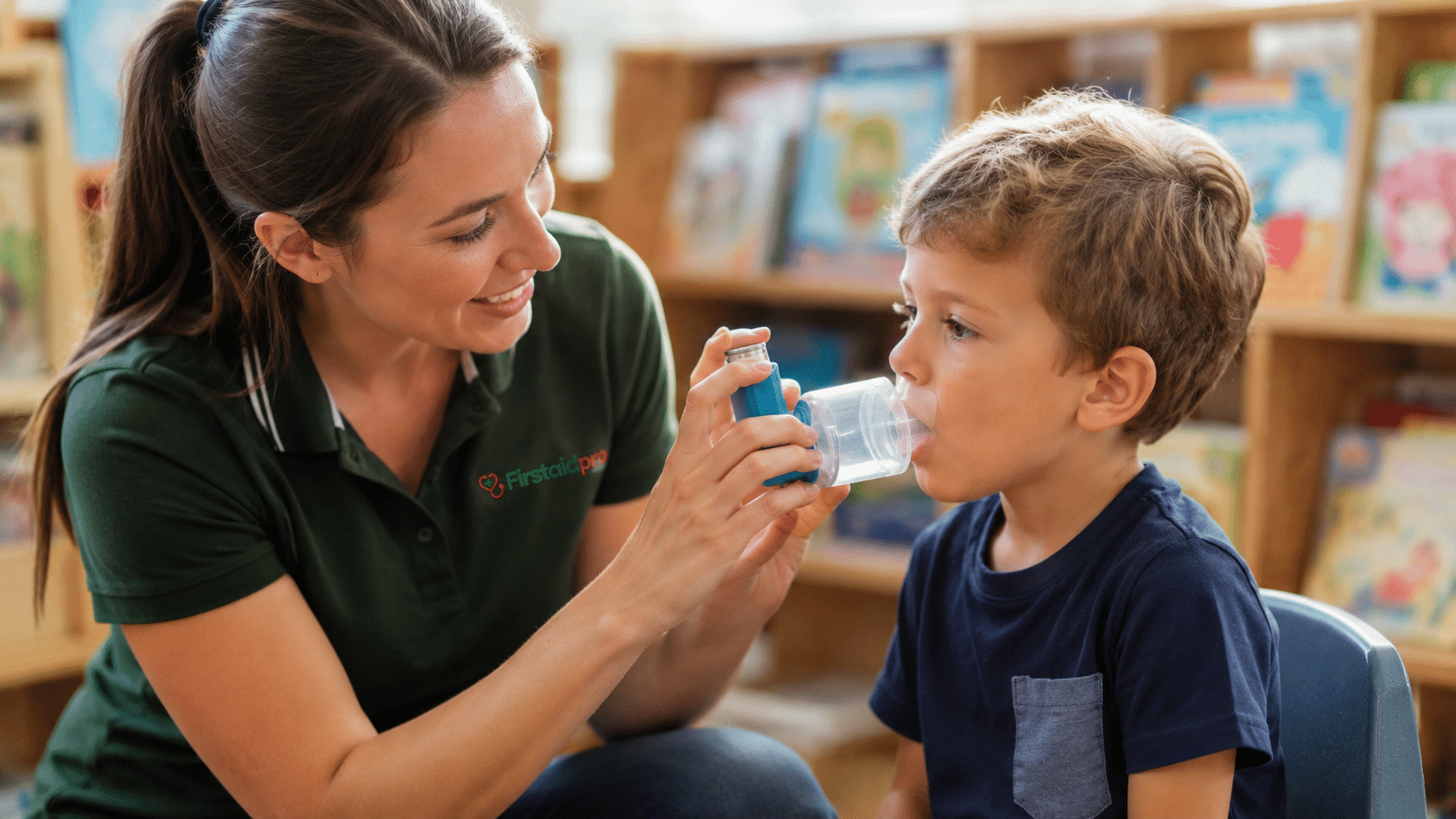
- Give four separate puffs of the blue or grey reliever through a spacer, allowing four breaths after each puff.
- Wait four minutes, remaining with the child and monitoring their breathing.
- Reassess and repeat treatment as directed. If symptoms are severe or worsening, call 000 immediately. If breathing remains abnormal after further treatment, call 000 and continue reliever treatment according to asthma first aid instructions until help arrives.
The child’s individual Asthma Action Plan should guide their management where available.
Some children use different reliever medications, so the familiar 4 × 4 × 4 method is not appropriate for every inhaler.
Never delay calling 000 when a child is experiencing severe breathing difficulties. National Asthma Council Australia
In childcare centres and schools, educators should know which children have asthma, where their medication is stored and how to access their emergency management plans. This is one reason asthma first aid forms an important component of child-focused emergency training.
Give Yourself the Skills to Respond
Would you feel confident recognising a serious asthma attack or helping a choking child?
First Aid Pro’s HLTAID012 Provide First Aid in an Education and Care Setting course covers these emergencies through child-focused first aid training.
Explore the HLTAID012 childcare first aid course and learn how to respond when a child needs urgent assistance.
Anaphylaxis in Children: Why Every Second Matters
Food allergies are a familiar concern for many Australian families, schools and early childhood education services. Peanuts, tree nuts, eggs, milk and other foods can trigger allergic reactions. Insect stings and certain medications may also cause serious reactions.
While some allergic reactions produce relatively mild symptoms, anaphylaxis is a severe, potentially life-threatening allergic reaction requiring immediate treatment. It can affect breathing and circulation, sometimes progressing rapidly.
A child experiencing anaphylaxis may develop swelling of the tongue or throat, breathing difficulties, persistent coughing, a hoarse voice or sudden collapse. Young children may become pale and floppy. Importantly, anaphylaxis does not always involve a visible rash or hives.
What Should You Do if a Child Experiences Anaphylaxis?
The Australasian Society of Clinical Immunology and Allergy (ASCIA) provides clear emergency guidance.
If anaphylaxis is suspected:
- Lay the child flat. Never allow them to stand or walk. If breathing is difficult, they may sit with their legs outstretched. Hold young children flat rather than upright.
- Administer an adrenaline autoinjector immediately, following the instructions for the particular device.
- Call Triple Zero (000) and request an ambulance.
- Give further adrenaline after five minutes if there is no response and another device is available.
- Begin CPR if the child becomes unresponsive and is not breathing normally.
Every child treated for anaphylaxis requires hospital assessment and observation, even if their symptoms improve.
Adrenaline is the first-line treatment. Antihistamines and asthma relievers are not substitutes. If a child with a known allergy develops sudden severe breathing difficulties, give adrenaline first, even when there are no skin symptoms. Allergy Australia
For educators, knowing where adrenaline devices and ASCIA Action Plans are stored is essential. However, knowing their location is only part of emergency preparedness. Staff must also understand how to recognise anaphylaxis and use the relevant device correctly.
Why Child First Aid Training Matters for Parents, Carers and Educators
A medical emergency involving a child can be frightening, particularly when several adults are present but nobody is certain what to do. Someone may recognise the symptoms but hesitate. Another person might attempt an inappropriate treatment based on outdated advice.
First aid training provides a structured approach to assessing an emergency, calling for assistance and delivering appropriate care. It also helps people understand the differences between responding to infants, older children and adults. These differences matter when performing CPR, managing choking or recognising signs of serious illness.
For early childhood educators, there are additional professional responsibilities.
Under the Education and Care Services National Regulations, centre-based services must have appropriately trained personnel in attendance and immediately available during operating hours.
These requirements include approved first aid qualifications, anaphylaxis management training and emergency asthma management training. The required competencies may be held by the same person.
ACECQA also specifies currency requirements, including annual CPR training and three-year currency periods for relevant approved first aid, asthma and anaphylaxis training. ACECQA
Parents may not face the same regulatory obligations, but the practical value of these skills is no less significant. After all, childhood emergencies are not confined to classrooms and childcare centres. They can happen at home, during family celebrations, at sporting events or while travelling.

What Does the HLTAID012 Childcare First Aid Course Cover?
HLTAID012 Provide First Aid in an Education and Care Setting is a nationally recognised unit of competency designed for people who provide first aid in environments involving children and infants.
First Aid Pro delivers training covering a broad range of emergencies, including choking, asthma, anaphylaxis, CPR and other injuries or medical conditions.
Participants learn to assess emergencies, recognise when professional assistance is required, provide appropriate first aid and communicate effectively with emergency services. Training also addresses emergency procedures and reporting responsibilities relevant to education and care environments.
First Aid Pro offers several delivery options, including fully face-to-face training and blended learning with practical assessment.
Successful completion provides a Statement of Attainment for HLTAID012, incorporating HLTAID011, HLTAID010 and HLTAID009.
For educators, maintaining current competencies is particularly important. CPR training must be refreshed annually to remain current under the applicable education and care requirements.
Parents and carers can also benefit from developing these practical skills, even when they do not require certification for employment.
Consider making child first aid training part of your World Children’s Day commitment. Explore First Aid Pro’s HLTAID012 course options and enrolment information to find training that suits your circumstances.
Making Child Safety a Priority Beyond World Children's Day
World Children’s Day provides an opportunity to reflect on the responsibilities adults share in protecting children. However, child safety depends on everyday decisions rather than a single annual awareness campaign.
Parents can reduce choking risks by supervising young children during meals, preparing age-appropriate foods and keeping small objects out of reach.
Schools and childcare services can regularly review emergency procedures, check first aid equipment and ensure staff know how to access children’s medical management plans.
Families can also discuss emergency arrangements with grandparents, babysitters and other people who regularly care for their children.
These precautions cannot prevent every emergency. But combining sensible prevention measures with appropriate first aid training can improve the chances of recognising danger and responding effectively.
A child experiencing a medical emergency needs more than reassurance. They need someone who understands what is happening, knows when to call for help and can provide appropriate assistance.
This World Children's Day 2026, Be Ready When a Child Needs You
Children deserve safe environments, attentive care and adults who can recognise when something is seriously wrong.
While nobody can predict every emergency, learning child first aid skills is a practical way to prepare for situations that might otherwise leave you feeling helpless.
Whether you’re a parent, grandparent, childcare educator or someone who regularly supervises children, knowing how to respond to choking, asthma and anaphylaxis could make an enormous difference.
This World Children’s Day, consider taking that next step.
First Aid Pro’s HLTAID012 Provide First Aid in an Education and Care Setting course provides nationally recognised training designed around the emergencies that can affect children.
Because when a child suddenly needs help, knowing what to do matters.
Related Reading
- UNICEF – World Children’s Day 2026
Background on World Children’s Day, its significance and the Convention on the Rights of the Child. - ANZCOR – Guideline 4: Airway
Australian guidance on recognising and managing choking, including back blows, chest thrusts and airway obstruction. - National Asthma Council Australia – Asthma First Aid
Recognising asthma emergencies and providing appropriate first aid, including guidance for children under 12. - ASCIA – First Aid Plan for Anaphylaxis
Recognising anaphylaxis, administering adrenaline, correct positioning and emergency procedures. - ACECQA – First Aid Qualifications and Training
Approved first aid qualifications, asthma and anaphylaxis training requirements, and currency periods for education and care services.
FAQs
. When is World Children's Day 2026?
World Children’s Day is observed internationally on 20 November each year. In 2026, it falls on Friday, 20 November. The occasion promotes children’s rights, wellbeing, protection and opportunities for a healthy future.
What are the most important first aid skills for parents?
Parents should know how to recognise choking, respond to asthma attacks and anaphylaxis, perform age-appropriate CPR and manage common injuries. Understanding when to call Triple Zero (000) is equally important.
What should I do if a baby is choking?
If a baby cannot cough or breathe effectively, call 000 and follow Australian choking first aid guidance, using appropriately performed back blows and chest thrusts. Never use abdominal thrusts or blind finger sweeps. If the baby becomes unresponsive and is not breathing normally, begin CPR.
Does HLTAID012 include asthma and anaphylaxis training?
Yes. HLTAID012 Provide First Aid in an Education and Care Setting includes responding to asthma and anaphylaxis emergencies, alongside CPR, choking management and other first aid skills relevant to children and infants.
How often should childcare educators renew their first aid training?
Under ACECQA’s education and care requirements, relevant approved first aid, asthma and anaphylaxis training generally has a three-year currency period. CPR training must be completed within the previous 12 months to remain current. Educators should also check their employer’s requirements.