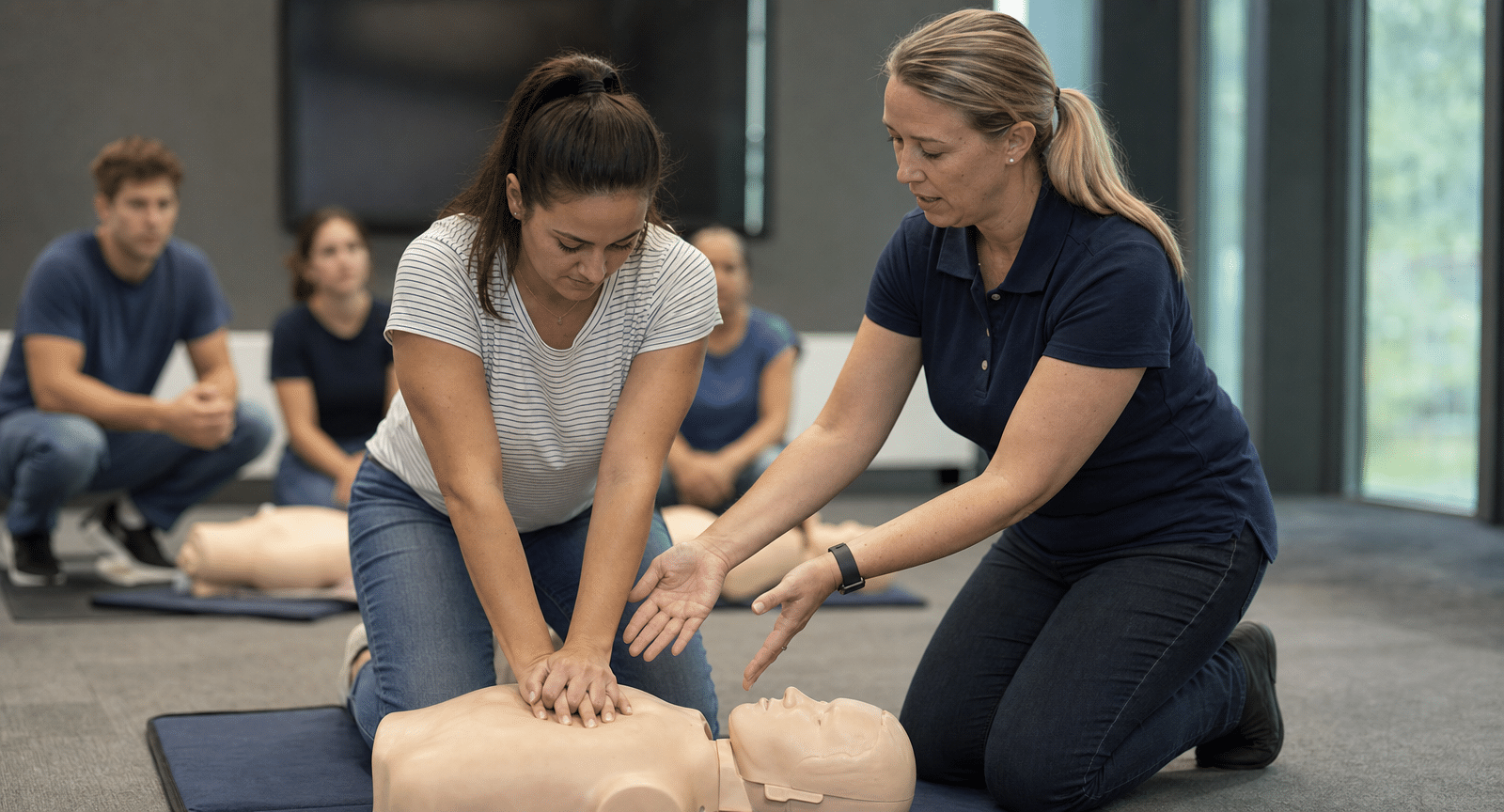





Sharon has 21+ years of experience as a qualified Emergency Care Nurse registered with the Australian Health Practitioner Regulation Agency (APHRA) and 12+ years as a First Aid Trainer.
She takes pride in FirstAidPro making first aid training available, comprehensive and affordable to everybody.
Key Takeaways from Manual Handling Myths
- Back belts are not proven to prevent injury — WorkSafe Victoria states there is little evidence they reduce injuries at work.
- “Lift with your legs” alone is not enough — no single posture is suitable for all tasks, according to the Queensland Hazardous Manual Tasks Code of Practice 2021.
- There is no legal maximum lifting weight in Australia — risk depends on many factors beyond weight.
- Manual handling injury isn’t only heavy lifting — repetitive, sustained, awkward and push/pull forces all contribute.
- A quick lifting demo is the lowest-order control — it cannot replace redesigning the task itself.
- Body stressing caused 50,326 serious claims in 2023–24 (Safe Work Australia; serious claims = at least one week off work).
Myth 1 — “A Back Belt Will Protect Your Back”
The verdict: no strong evidence that back belts prevent injury.
Back belts — sometimes called lifting belts or lumbar support belts — are still common in warehouses, retail stockrooms and logistics. Many workers assume they provide meaningful protection. Regulators disagree.
WorkSafe Victoria reviewed the evidence and concluded: “There is little evidence wearing a back belt can reduce injuries at work.” Their guidance goes further: “Published research shows no evidence that back belts reduce the risk of worker injuries.”
Why don’t they work? Back belts provide only a minimal reduction in compressive force on the spine. More concerning, they can encourage stiff or exaggerated postures that may actually increase injury risk. They can also raise blood pressure and affect respiration during lifting.
Perhaps the biggest risk is psychological. As WorkSafe Victoria notes, a belt “may encourage the lifting of heavier weights if the user wrongly thinks they have greater lifting ability.” That false confidence can lead workers into tasks their body isn’t prepared for.
International research supports this. NIOSH (the US National Institute for Occupational Safety and Health) found insufficient evidence to recommend back belts as early as 1994. A large JAMA study in 2000 found no association between belt use and reduced back-injury claims or pain.
Important distinction: back braces prescribed by a doctor or physiotherapist after an injury are different. Those are rehabilitation devices with a clinical purpose. A generic lifting belt worn by healthy workers is not the same thing and is not recommended as an injury-prevention device.
The bottom line: if your workplace provides back belts, they should not be relied upon as a control measure. Focus on task design, mechanical aids and proper risk assessment instead.

Myth 2 — “Just Lift With Your Legs And Keep Your Back Straight”
The verdict: a useful cue, but not a safety system on its own.
“Bend your knees, not your back” is probably the most repeated piece of manual handling advice in Australian workplaces. It’s not wrong — but it’s not enough.
The Queensland Hazardous Manual Tasks Code of Practice 2021 is clear: “no one posture is suitable for all tasks or positions.” A squat lift works well for a compact box on the floor, but it’s impractical for a long object, an awkward space, or a task that requires reaching.
More importantly, posture instruction cannot offset a task that is inherently hazardous. If a worker is repeating the same lift dozens of times per shift, or holding an awkward position for minutes at a time, a “correct” posture won’t prevent cumulative strain.
Australian WHS Regulations (s60(2)) require employers to consider multiple factors when managing manual handling risk: postures, movements, forces, vibration, duration and frequency, environmental conditions, work-area design, workplace layout, systems of work, and the nature, size, weight and number of items handled.
A poster about leg position addresses one factor. It does not address duration, frequency, load characteristics or task design — all of which contribute to injury risk.
WorkSafe Queensland reinforced this in 2025, noting that a “how to lift” demonstration is not itself the legal requirement. The duty is to identify hazards, assess risks and implement controls across the full range of factors.
The bottom line: teach good posture principles, but don’t treat them as a substitute for assessing and redesigning the task itself.
Myth 3 — “There’s A Safe Maximum Weight You Can Lift”
The verdict: there is no legal maximum lifting weight in Australia.
Workers and supervisors often ask: “What’s the limit? How many kilograms can I legally lift?” The answer surprises many people: Australian WHS law sets no fixed maximum.
The Queensland Hazardous Manual Tasks Code of Practice 2021 explains why: “There is no safe weight set for all workers in all circumstances because there are too many factors contributing to the risk, not just the weight of the item.”
This isn’t a loophole — it’s a recognition that weight alone doesn’t determine risk. A 10 kg load lifted once in ideal conditions is very different from a 10 kg load lifted repeatedly, at arm’s length, above shoulder height, in a cramped space, at the end of an eight-hour shift.
All harmonised Australian jurisdictions follow the same Code of Practice text. Whether you’re in Queensland, Victoria, New South Wales or elsewhere, the principle is the same: assess the task, not just the weight.
What this means in practice: instead of looking for a magic number, assess the full context of the task. Consider the load’s size, shape and grip points. Consider the worker’s posture, the frequency of the task, the distance carried, and whether mechanical aids are available. A risk assessment that addresses these factors is what the law requires — not a weight limit.

Myth 4 — “Manual Handling Injuries Only Happen When You Lift Something Heavy”
The verdict: false. Repetitive, sustained, awkward and push/pull forces all cause injury.
When people think of manual handling injuries, they often picture a worker straining to lift a heavy load. But many injuries have nothing to do with heavy lifting.
The Queensland Hazardous Manual Tasks Code of Practice 2021 defines a hazardous manual task as one that involves lifting, lowering, pushing, pulling, carrying, holding or restraining — combined with one or more of these characteristics:
- Repetitive or sustained force
- High or sudden force
- Repetitive movement
- Sustained or awkward posture
- Exposure to vibration
This is why aged-care workers repositioning patients (see our guide to patient manual handling techniques), supermarket staff scanning items, warehouse workers pushing trolleys, and office workers holding a phone between ear and shoulder can all develop musculoskeletal disorders — even if they never lift anything “heavy.”
The Code of Practice confirms that musculoskeletal disorders (MSDs) “are the most common workplace injuries across Australia.” Body stressing accounted for approximately 34.5% of serious claims in 2023–24 (Safe Work Australia), more than any other mechanism.
The bottom line: any task involving force, repetition, sustained posture or awkward positions can cause injury. Don’t wait for a heavy load to assess manual handling risk.
Myth 5 — “A Quick Lifting Demo Keeps Everyone Safe”
The verdict: training is the lowest-order control and cannot replace fixing the task.
Many workplaces rely on a brief lifting demonstration during induction. It ticks a box, but it doesn’t address the root cause of most manual handling injuries.
The Queensland Hazardous Manual Tasks Code of Practice 2021 places administrative controls — including training — at the bottom of the hierarchy. The Code states that administrative controls and PPE “do not control the hazard at the source… tend to be the least effective” and “should only be used when there are no other reasonably practicable control measures available… or to supplement higher level control measures.”
Higher-order controls come first: eliminate the hazardous task if possible; substitute with a less hazardous method; use engineering controls like trolleys, hoists, conveyor systems or slide sheets. Training supports these controls — it doesn’t replace them.
International peer-reviewed research reinforces this, finding that training alone is largely ineffective at preventing back pain or injury. Technique instruction helps, but it cannot compensate for a poorly designed task.
What accredited training actually teaches: the real value of a course like HLTWHS005 Conduct Manual Tasks Safely is not the lifting demonstration. It’s hazard identification, risk assessment and understanding how to apply the hierarchy of controls. Workers learn to recognise what makes a task hazardous and advocate for safer systems — not just how to bend their knees.
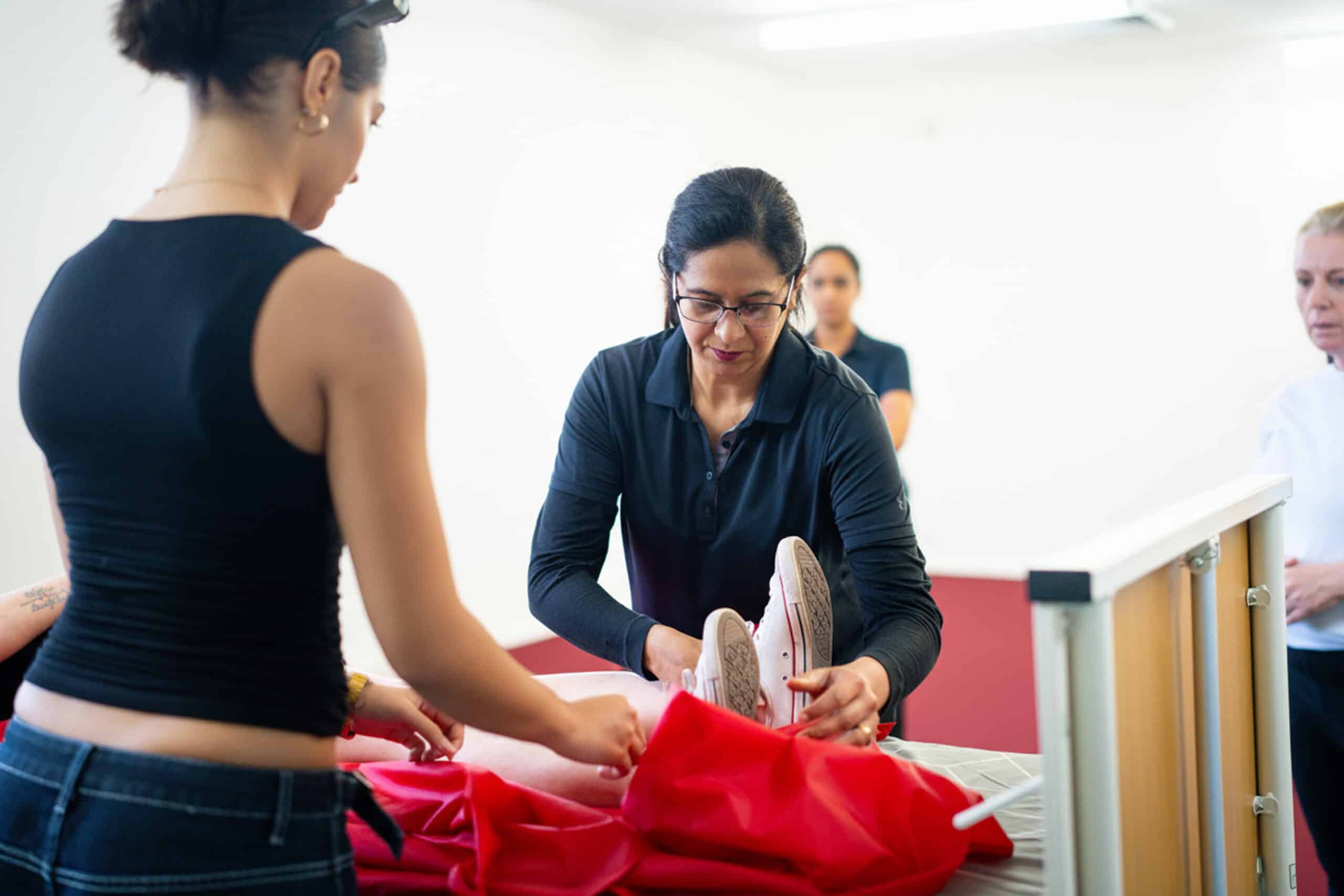
What Good Manual Handling Actually Looks Like
Retiring these myths leaves a practical question: what should you do instead?
- Risk-assess the task. Before anyone lifts, pushes or carries, identify the hazards. Consider force, posture, repetition, duration, load characteristics and the work environment.
- Eliminate or redesign. Can you remove the manual task entirely? Can you reduce the weight, change the height, shorten the distance, or break the task into smaller parts?
- Use mechanical aids. Trolleys, hoists, pallet jacks, slide sheets and conveyor systems reduce the physical demands on workers. Our overview of manual handling courses explains how these higher-order controls address the hazard at the source.
- Apply the Four P’s as one layer. When manual handling is necessary, plan the lift, position yourself and the load, pick up with good technique, and proceed with care. This is a useful framework — but it’s one layer of control, not the whole system.
- Refresh skills regularly. Accredited training builds hazard-identification and risk-assessment skills that workers can apply across tasks. If your team is already certified, our manual handling refresher training keeps those skills current.
At FirstAidPro, we deliver HLTWHS005 Conduct Manual Tasks Safely as a blended course: online theory followed by approximately three hours of face-to-face practical training. You receive your Statement of Attainment on the same day. We’re a Registered Training Organisation (RTO 31124) with 170+ locations across Australia.
Disclaimer
This article provides general information only and is not a substitute for medical or legal advice. Always follow your workplace WHS procedures and current guidance from your state or territory regulator. If you have a specific injury or condition, consult a qualified health professional.
Recent Posts
Manual Handling Training — Tips, Techniques & Guidelines
Manual Handling Courses: What You Need To Know
FAQ
Do Back Belts Prevent Manual Handling Injuries?
No. WorkSafe Victoria states there is little evidence that back belts reduce injuries at work, and published research shows no evidence they reduce the risk of worker injuries. Back belts may give wearers false confidence, encouraging them to lift heavier loads than they should.
Is There A Legal Maximum Weight You Can Lift At Work In Australia?
No. Australian WHS law sets no fixed maximum lifting weight. The Queensland Hazardous Manual Tasks Code of Practice 2021 explains that no safe weight applies to all workers in all circumstances because too many factors contribute to risk beyond the weight alone.
Is “Lift With Your Legs” Correct?
It’s a useful cue, but not a complete control. The Queensland Hazardous Manual Tasks Code of Practice 2021 states that no single posture is suitable for all tasks. WHS Regulations require employers to consider force, duration, frequency, posture and task design — not just lifting technique.
What Actually Causes Manual Handling Injuries?
Manual handling injuries result from repetitive or sustained force, high or sudden force, repetitive movement, sustained or awkward posture, and vibration — not only heavy lifting. The Queensland Hazardous Manual Tasks Code of Practice 2021 confirms that musculoskeletal disorders are Australia’s most common workplace injuries.
Does Manual Handling Training Stop Injuries On Its Own?
No. Training is the lowest-order control in the hierarchy. The Queensland Hazardous Manual Tasks Code of Practice 2021 states that administrative controls do not control the hazard at the source and are the least effective. Accredited training like HLTWHS005 Conduct Manual Tasks Safely focuses on hazard identification and risk assessment — skills that support higher-order controls.
How Often Should Manual Handling Training Be Refreshed?
Certificate validity varies by state and employer requirements. Safe Work Australia and many employers recommend annual refresher training to maintain skills and keep up with workplace changes. Check your state regulator and workplace policy for specific requirements.