




Sharon has 21+ years of experience as a qualified Emergency Care Nurse registered with the Australian Health Practitioner Regulation Agency (APHRA) and 12+ years as a First Aid Trainer.
She takes pride in FirstAidPro making first aid training available, comprehensive and affordable to everybody.
Key Takeaways
- Every White Card course delivers CPCWHS1001 Prepare to Work Safely in the Construction Industry. Your state regulator decides how it’s delivered.
- Self-paced online, live video (connected real-time delivery) and face-to-face classroom training are three different formats, and regulators treat them differently.
- NSW and Victoria don’t accept online delivery. Queensland and, from 1 July 2026, the Northern Territory accept approved live-video delivery.
- In SA, your RTO issues the card, and SafeWork SA publishes no online route. A November 2023 Queensland government review lists SA online as “No”.
- Other states recognise your card, and that recognition doesn’t extend to how you were trained.
- Working in SA? Book face-to-face with our CPCWHS1001 White Card course or read Can You Do Your White Card Online?.
Online or Face-to-Face: Why the Question Matters
If you’re weighing up a White Card online vs face to face, the real question is simple. Which format will your state, and your site, accept?
This guide is for jobseekers, apprentices, tradies and employers booking crews in South Australia, Queensland and the Northern Territory. The common trap is paying for a cheap “online White Card” that doesn’t meet the rules where you work.
We’ll compare self-paced online, live-video and classroom training fairly, then explain what SA’s regulator does and doesn’t say. In full transparency, we deliver our White Card course fully face-to-face. We’ve still set out the honest case for online delivery, because in some states it’s a legitimate option.
What Every White Card Course Has in Common
Every nationally recognised White Card course delivers CPCWHS1001 Prepare to Work Safely in the Construction Industry. The unit on training.gov.au specifies “the mandatory work health and safety training required prior to undertaking construction work”. It also meets the general construction induction training requirements of Part 6.5 of the Model WHS Regulations.
So the content is the same in every format. What changes is how you’re taught and how your assessor sees you perform.
The unit requires direct observation by an assessor, either physically or via audio and visual media in real time. That wording is quoted in the Queensland Training Ombudsman’s review (November 2023). The unit’s release notes add that assessment must include practical demonstration, plus oral and written reporting.
Safe Work Australia’s 2020 guidance for RTOs noted the model WHS laws don’t specify a delivery method. In practice, most WHS regulators require face-to-face training. That guidance dates from the COVID-19 period, so treat it as background only.
Regulation 317 sets the rule that keeps your card current, as WorkSafe ACT explains. If you trained more than 2 years ago, you must have done construction work in the preceding 2 years. SafeWork SA says your card remains valid while you’ve worked in construction within the last 2 years.

White Card Online vs Face to Face: Side-by-Side Comparison
Here’s how the three formats compare on the points that matter on site.
| Self-paced online | Live video (connected real-time) | Face-to-face classroom | |
|---|---|---|---|
| How it’s delivered | You work through modules alone, at your own pace | A trainer runs a live class over video and you join on camera | You and the trainer are in the same room |
| Who watches the assessment | No trainer watches in real time while you study | An assessor watches you live on screen | An assessor watches you in person |
| PPE demonstration | Depends on the provider; check before you pay | PPE handling is harder to check on camera; the Ombudsman’s review notes PPE cost and access concerns for online learners | You fit PPE in front of the assessor |
| ID checks | Set by the provider | Set by the provider and state conditions | In person, such as NSW’s 100-point check before training |
| Duration benchmarks | Victoria warns about courses under 6 hours | Queensland minimum of 4.5 hours | 6 hours in NSW and Victoria; 6 hours listed for SA |
| When you get the card | Depends on who issues cards in your state | In Queensland, the RTO issues it | In SA, the RTO issues it; we issue same day* (T&Cs apply) |
| Where it’s accepted | Not accepted in NSW, Victoria, Queensland or the NT | Approved RTOs in Queensland, and the NT from 1 July 2026 | Accepted in every state’s framework; the only accepted format in NSW and Victoria |
| Best for | Only learners whose state regulator accepts it | Remote Queensland and NT learners with good internet | NSW and Victorian learners, hands-on learners, and SA learners who want no format ambiguity |
Self-Paced Online
You read, watch and answer questions on your own schedule. NT WorkSafe is clear that connected real-time delivery “is not self-paced online e-learning”. That distinction is where most confusion starts.
Live Video Delivery
This is a scheduled class run by a trainer over video, often called a Zoom White Card. The Queensland Training Ombudsman describes it as face-to-face training via connected real-time delivery (CRTD). Only approved RTOs can run it: at 30 September 2023, 10 of 215 RTOs approved by Workplace Health and Safety Queensland (WHSQ) could.
Face-to-Face Classroom
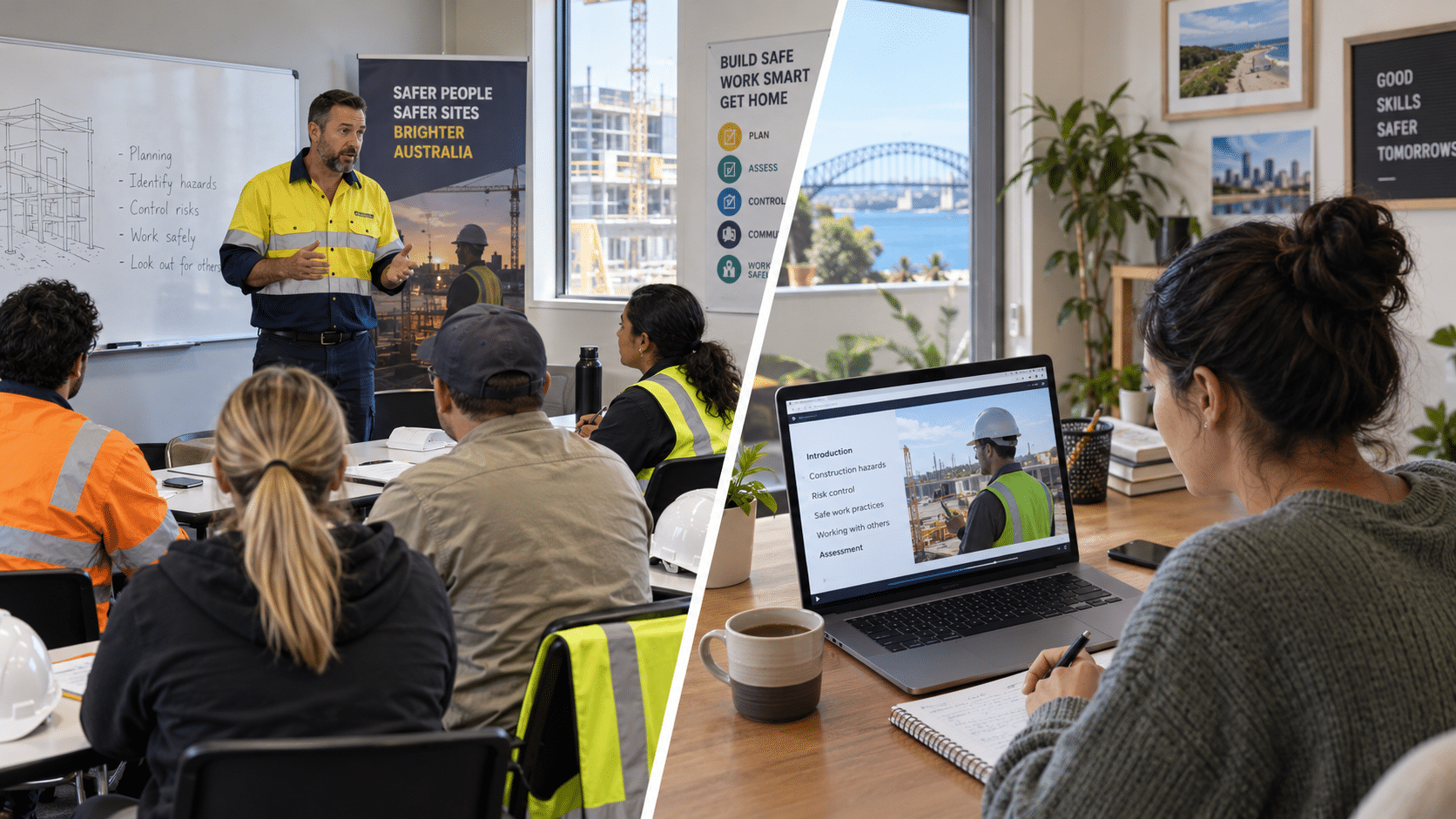
A face to face White Card course puts you, the trainer and your classmates in one room. You ask questions, practise with real equipment and complete your assessment in person.

The Fair Case for Online and Live-Video Training
Online formats have real strengths, and it’s worth saying so plainly. You don’t travel, you can train from a regional town, and you fit study around work or family.
Queensland moved to face-to-face training on 1 February 2019, according to the Queensland Training Ombudsman’s review. It made an exception for rural residents living more than 100 km from an RTO. Stakeholders in that review valued online access for rural and remote learners.
The same review reports a WHSQ survey of 1,920 students that found no differences reported between CRTD and face-to-face delivery. It doesn’t describe how respondents were chosen, and it covers live video, not self-paced online.
The review also heard complaints such as “course was rushed” and “poor quality trainers”. Those comments point to provider quality, which varies in every format.
If your state accepts live video and you have a quiet space, a reliable connection and your own PPE, it can be a sound choice.
The Fair Case for Face-to-Face Training
The strongest case for the classroom comes from how assessment and identity checks work. The evidence we reviewed doesn’t show that people learn more in a room.
PPE Fitted in Front of the Assessor
In a classroom, you put on and fit PPE while the assessor watches. The same Queensland review recorded concerns about PPE access and cost for online learners.
ID Checked in Person
Regulators build identity checks into their rules. The SafeWork NSW conditions for RTOs (October 2022) require a 100-point evidence of identity check before training starts. WorkSafe Victoria (last reviewed October 2023) asks for photo ID at registration and on the day.
Questions Answered on the Spot
In our classes, you can stop the trainer and ask how a hazard applies to your trade. Our trainers draw on real construction experience, so the examples sound like your next site. If reading or language is a hurdle, it’s easier to get help in person.
Fewer Surprises at the Site Gate
Face-to-face is accepted in every state’s framework, and it’s the only accepted format in NSW and Victoria. WorkSafe Victoria warns that courses advertised as an “online White Card”, often under $30, aren’t accepted. It also flags courses under 6 hours as a warning sign.
Our trainers see how much people gain from practising a skill with their own hands. That practical demonstration is also what the unit asks assessors to see.
State by State: Where Online White Cards Are Accepted
Rules change, so always confirm with your state regulator before you book.
- In New South Wales, the SafeWork NSW conditions (October 2022) don’t permit online or distance learning. Training must run at least 6 hours.
- In Victoria, WorkSafe Victoria (last reviewed October 2023) requires a face-to-face classroom and doesn’t permit online delivery. Courses must run for a minimum of 6 hours.
- In Queensland, the Ombudsman’s review (November 2023) confirms WHSQ accepts face-to-face training and approved CRTD, with a 4.5-hour minimum.
- In the NT, NT WorkSafe approves connected real-time delivery from 1 July 2026, but not self-paced e-learning. Check your provider is on its list.
- In Tasmania, WA and the ACT, check with your regulator. A November 2023 Queensland review listed Tasmania online as “Allowed”, and WA and the ACT as “No”.
Your card travels with you. Under regulation 318, WorkSafe ACT recognises cards issued in other jurisdictions. But NT WorkSafe (October 2022) notes recognition “is of white cards only” and doesn’t extend to how training is delivered.
For fees and live-video details by state, read our White Card online rules for QLD, NT and Tasmania.

What SA’s Regulator Does and Doesn’t Say
For South Australian workers, the comparison comes down to what the regulator publishes.
What SafeWork SA Says
SafeWork SA’s White Card page tells you to complete CPCWHS1001 with an RTO. It states that “SafeWork SA does not issue white cards”; the RTO issues your card once you pass.
What SafeWork SA Doesn’t Say
The page doesn’t set out a delivery format. It mentions no online, classroom or live-video option, so the regulator publishes no online pathway for an SA White Card.
What a Government Comparison Says
The Queensland Training Ombudsman’s review (November 2023) includes a table provided by WHSQ and endorsed by other jurisdictions. For SA, it lists online delivery as “No”, approved RTOs only, a 6-hour duration and the RTO as card issuer.
The practical upshot: SafeWork SA publishes no online pathway, and the Queensland review lists SA online as “No”.
If you see a course advertised as an “online SA White Card”, call SafeWork SA on 1300 365 255 before you pay. Ask whether it meets SA requirements.
Because the RTO issues the card in SA, we can hand it over on the day you pass: Certificates Issued Same Day* (T&Cs Apply). We run sessions across Adelaide, including Salisbury, Morphett Vale and Port Adelaide. See dates for White Card training in Adelaide.
How to Check a White Card Course Before You Pay
Run through these six checks before you book any White Card course.
- Check the course code. It must be CPCWHS1001 Prepare to Work Safely in the Construction Industry.
- Check the RTO. Search the provider’s name or RTO code on training.gov.au.
- Check the format. Confirm your state accepts it: self-paced, live video or face-to-face.
- Check the duration. Be wary of anything under 6 hours in SA, NSW or Victoria, or under 4.5 hours in Queensland.
- Check ID requirements. Bring the photo ID and USI your provider asks for.
- Check who issues the card and when. In SA, your RTO issues it, so ask how soon you’ll have it.
If any answer is vague, ask the provider in writing or call your state regulator.

Book a Face-to-Face White Card Course
Our CPCWHS1001 White Card course gives you a clear, compliant path onto site in one day.
- Fully face-to-face training over one 6-hour day
- Venues across SA, QLD and the NT
- Certificates Issued Same Day* (T&Cs Apply) for SA White Cards
- Price-beat guarantee on White Card training
- Onsite corporate group training tailored to your site’s risks
- Delivered by FirstAidPro, a Registered Training Organisation (RTO 31124)
Find a course near you: White Card training in Brisbane or White Card training in Darwin. Pick a date and book a course today.
Ready to get on site? Book your course
Frequently Asked Questions
Is an Online White Card Valid in Australia?
SafeWork NSW and WorkSafe Victoria don’t accept online delivery. Workplace Health and Safety Queensland, and NT WorkSafe from 1 July 2026, accept approved live video but not self-paced e-learning. Check with your state regulator before you pay.
Can I Do My White Card Online in SA?
SafeWork SA publishes no online pathway: you complete CPCWHS1001 with an RTO, and the RTO issues your card. A Queensland Training Ombudsman review from November 2023 lists online delivery in South Australia as ‘No’. If a course is advertised as an online SA White Card, call SafeWork SA on 1300 365 255 before you book.
Can I Do My White Card on Zoom?
In Queensland, yes, if Workplace Health and Safety Queensland has approved the RTO for connected real-time delivery. In the Northern Territory, NT WorkSafe approves connected real-time delivery from 1 July 2026 through providers listed on its website. WorkSafe Victoria requires a face-to-face classroom, so Zoom courses aren’t accepted there.
Is a White Card From Another State Accepted in South Australia?
Yes. A Queensland Training Ombudsman review notes that all jurisdictions recognise a White Card issued in another state or territory. Under SafeWork SA’s guidance, your card stays valid while you’ve worked in construction within the last 2 years.
How Long Does a Face-to-Face White Card Course Take?
Our face-to-face CPCWHS1001 course runs over one 6-hour day. SafeWork NSW and WorkSafe Victoria set a 6-hour minimum, and a Queensland Training Ombudsman review lists 6 hours for South Australia. Workplace Health and Safety Queensland sets a 4.5-hour minimum.
Does a White Card Expire?
A White Card doesn’t have a set expiry date. Under regulation 317 of the WHS Regulations, if you trained over 2 years ago, you must have done construction work in the last 2 years. SafeWork SA says your card stays valid while you’ve worked in construction within the last 2 years.