



Sharon has 21+ years of experience as a qualified Emergency Care Nurse registered with the Australian Health Practitioner Regulation Agency (APHRA) and 12+ years as a First Aid Trainer.
She takes pride in FirstAidPro making first aid training available, comprehensive and affordable to everybody.
- DRSABCD Explained: The Action Plan Step-by-Step - 11/11/2026
- Remote CPR Training and Certification - 10/11/2026
- How to Choose a Manual Handling Training Provider: A 10-Point Checklist - 09/11/2026
DRSABCD stands for Danger, Response, Send for help, Airway, Breathing, CPR and Defibrillation. It is the 7-step Basic Life Support action plan set by the Australian and New Zealand Committee on Resuscitation (ANZCOR). You use it for anyone who has collapsed or is unresponsive.
The sequence comes from ANZCOR Guideline 8 (approved April 2021 and current at the time of writing). ANZCOR words the first two steps as “Dangers” and “Responsiveness”, but the actions are the same. Our trainers walk you through every step below, plus what changes for children and infants and when you can stop CPR.
Want it on your fridge or staffroom wall? Download the free DRSABCD chart (PDF).
Key Takeaways
- DRSABCD means Danger, Response, Send for help, Airway, Breathing, CPR, Defibrillation.
- Call Triple Zero (000) or 112 from a mobile phone.
- Gasping is not normal breathing. If the person is unresponsive and gasping, start CPR.
- Give 30 compressions to 2 breaths at 100–120 compressions per minute.
- Attach an AED as soon as one arrives and follow the prompts. You don’t need training to use one.
- Only stop CPR for one of ANZCOR’s four reasons. There is no set time limit.

The DRSABCD Action Plan at a Glance
Here is the whole DRSABCD action plan in one table. Each step leads to the next, so work through them in order.
| Letter | Step | What you do |
|---|---|---|
| D | Danger | Check for danger to yourself, bystanders and the casualty. |
| R | Response | Use “talk and touch”: give a simple command, then squeeze the shoulders. |
| S | Send for help | Call Triple Zero (000) and ask someone to bring an AED. |
| A | Airway | Open the mouth, let visible material drain, then open the airway. |
| B | Breathing | Look, listen and feel for normal breathing. |
| C | CPR | Give 30 chest compressions, then 2 breaths, at 100–120 per minute. |
| D | Defibrillation | Attach an AED as soon as it arrives and follow the prompts. |
Our free DRSABCD poster (linked above) shows the same sequence as a printable PDF.
What Does DRSABCD Stand For?
Step-by-Step: How to Follow DRSABCD
D — Check for Danger
Check for danger to yourself, bystanders and the casualty before you go any closer.
ANZCOR describes this step as assessing and managing risks to the rescuer and others. Look for traffic, electricity, fire, water and sharps such as needles or broken glass.
If the scene isn’t safe, stay back. Don’t become a second casualty. A hurt rescuer can’t help anyone. Make the area safe if you can, such as turning off a power source or setting up hazard lights. If you can’t, wait for emergency services to arrive.

R — Check for a Response
Check whether the person responds to your voice and your touch.
ANZCOR calls this “talk and touch”. Give a simple command such as “open your eyes; squeeze my hand; let it go”. Then grasp and squeeze the shoulders firmly.
A person who doesn’t respond, or only groans without opening their eyes, should be managed as unconscious. Move straight on to the next step.
Many trainers, including ours, teach the memory aid COWS: Can you hear me? Open your eyes. What’s your name? Squeeze my hand. COWS is a teaching tool, and it covers the same talk-and-touch check.

S — Send for Help
Call Triple Zero (000) and get an AED on the way.
Triple Zero (000) is Australia’s main emergency number, according to the federal Department of Infrastructure. Keep these points in mind:
- 112 can only be called from a mobile phone. It reaches the same services as 000 and gives no priority.
- 112 calls don’t work via satellite.
- 106 is a TTY service that connects people who are deaf or have a hearing or speech difficulty to the National Relay Service.
Put your phone on speaker so your hands stay free. If someone else is nearby, send them to find an AED while you keep going.

A — Open the Airway
Open the mouth, let any visible material drain, then open the airway.
ANZCOR advises opening the mouth and turning the head slightly downwards. This lets obvious material such as food, vomit, blood or secretions drain out. Don’t do blind finger sweeps.
Leave the person in the position you found them. ANZCOR says not to roll them onto their side routinely to check the airway and breathing. Roll them only if fluid or matter is blocking the airway.
Next, open the airway:
- Adults and children: use the head tilt–chin lift.
- Infants (under 1 year): place the head in a neutral position and support the jaw from falling back.
Our trainers show you the exact hand position on a manikin, which is much easier to learn in person.
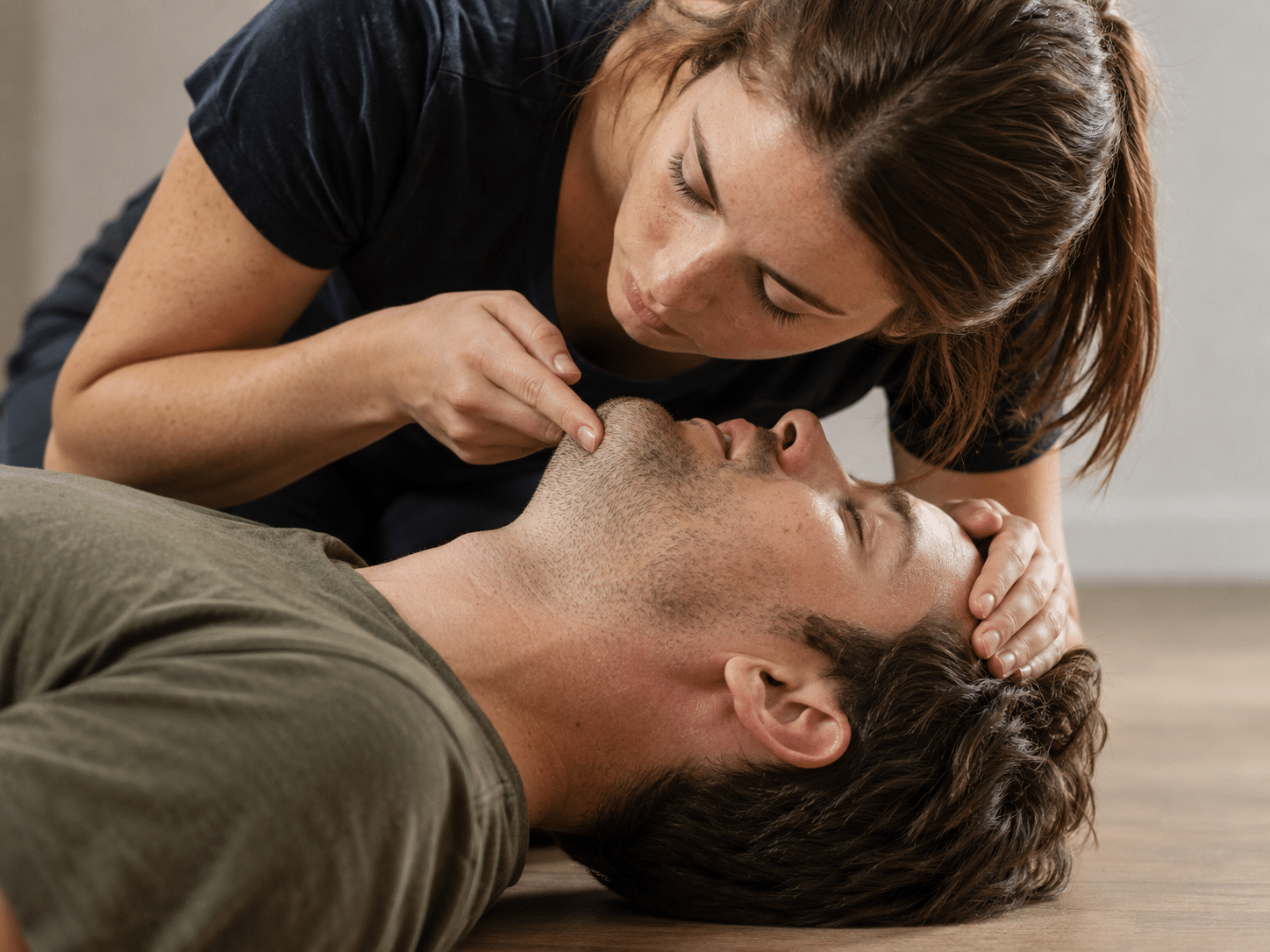
B — Check Breathing
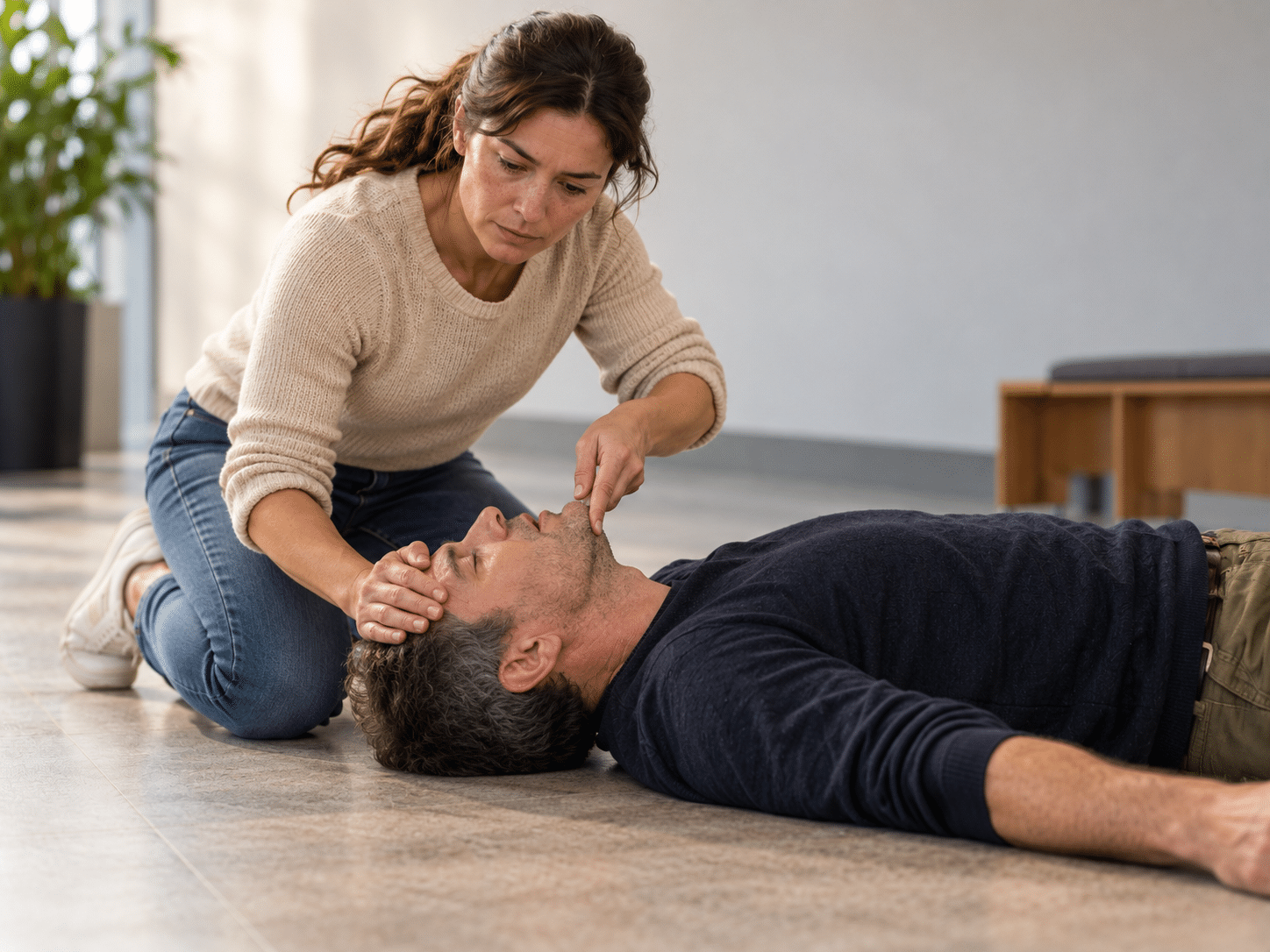
Look, listen and feel for normal breathing.
ANZCOR Guideline 5 sets out three checks:
- Look for movement of the upper abdomen or lower chest.
- Listen for air escaping from the nose and mouth.
- Feel for air moving at the mouth and nose.
Gasping is common after cardiac arrest. These agonal gasps are not normal breathing. ANZCOR is clear that rescuers should start CPR even if the person takes occasional gasps.
If the person is unresponsive but breathing normally, ANZCOR suggests placing them in the side-lying recovery position. Call an ambulance if no one has yet, and keep re-checking their condition. Learn the technique in our recovery position guide.
C — Start CPR
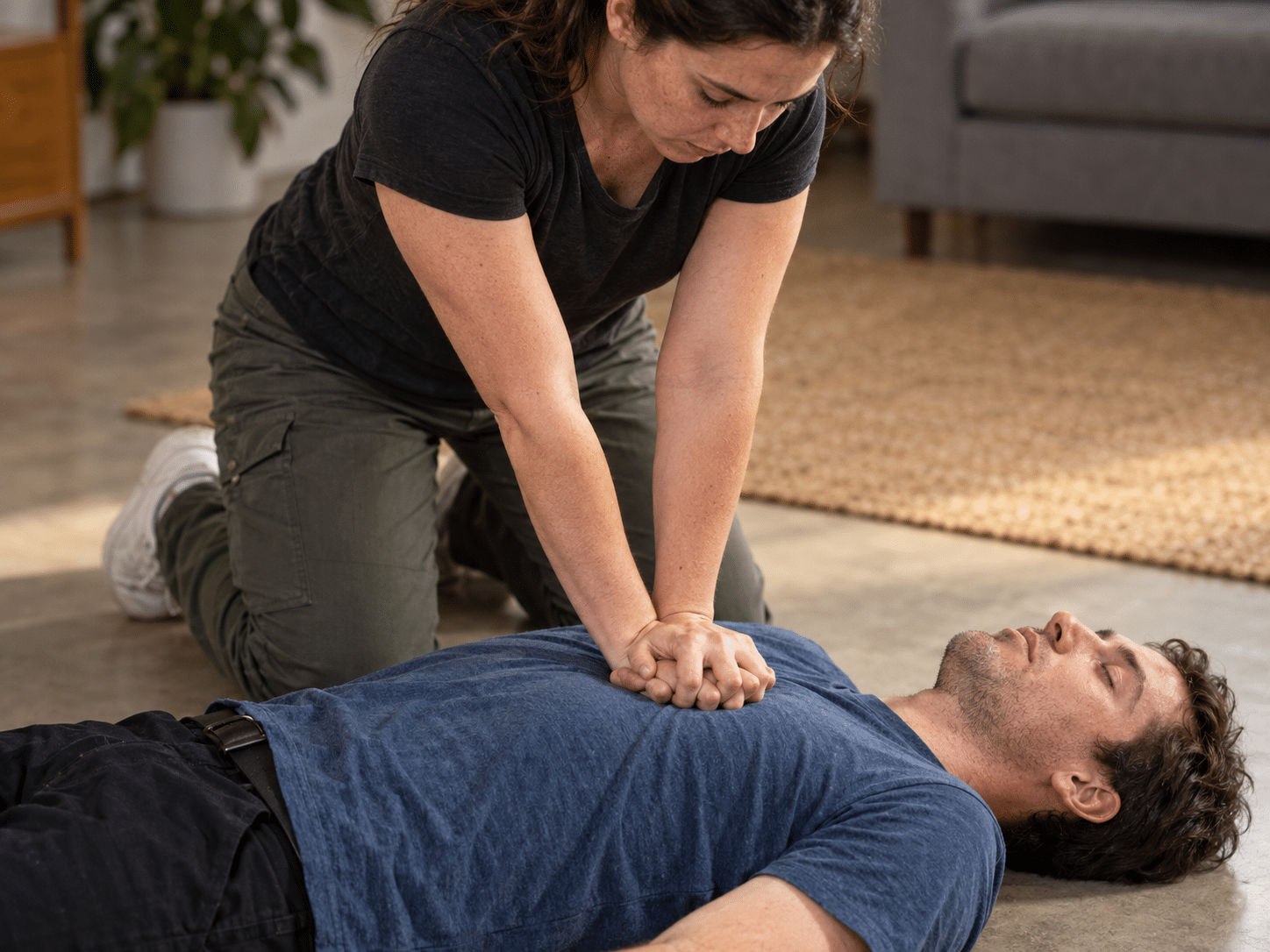
Give 30 chest compressions followed by 2 breaths, and keep going.
Lay the person on their back on a firm surface. Place the heel of one hand in the centre of the chest, on the lower half of the breastbone. Put your other hand on top.
ANZCOR Guideline 6 sets the key numbers:
- Depth: about one-third of the chest, which is more than 5 cm in adults.
- Recoil: let the chest come back up fully after each compression.
- Swaps: change rescuers at least every 2 minutes.
ANZCOR Guideline 8 adds the rest:
- Ratio: 30 compressions to 2 breaths, for all ages.
- Rate: approximately 100–120 compressions per minute.
- Order: start with compressions, not breaths.
Not trained in rescue breaths, or not willing to give them? Give compressions only. ANZCOR says all rescuers should give compressions, and those trained and willing should add breaths.
Don’t stop to check for a response or breathing. Keep going until an AED is ready or one of the stop conditions below applies.
D — Attach a Defibrillator (AED)
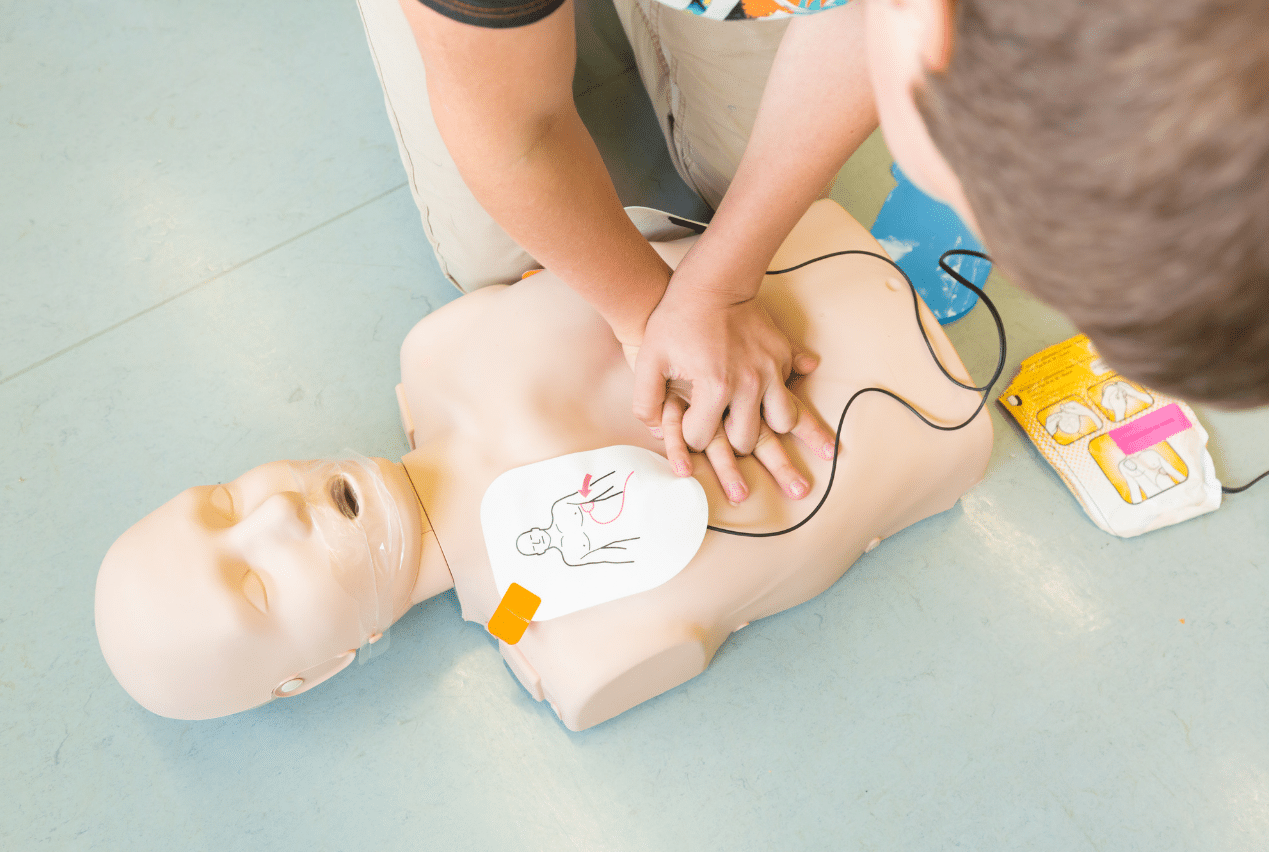
Attach an AED as soon as one is available and follow its voice prompts.
Keep compressions going until the AED pads are on. Then follow the prompts, which will tell you when to resume CPR.
- Anyone can use an AED. ANZCOR says AED use should not be restricted to trained people.
- Don’t touch the person while the AED delivers a shock.
- AEDs can and should be used on pregnant women.
Speed matters. ANZCOR states that for every minute defibrillation is delayed, survival falls by approximately 10% in cardiac arrest caused by ventricular fibrillation (VF). For pad placement and how the device works, read our AED explainer guide.
When Can You Stop CPR?
ANZCOR Guideline 8 lists only four reasons to stop CPR:
- The person responds or begins breathing normally.
- It’s impossible to continue, for example because you’re exhausted.
- A health care professional arrives and takes over CPR.
- A health care professional directs that CPR be stopped.
ANZCOR sets no time limit. If none of these apply, keep going. This is why swapping rescuers every 2 minutes matters so much.
DRSABCD for Children and Infants: What Changes
ANZCOR defines an infant as younger than 1 year. A child is 1 to 18 years, or up to the onset of puberty if you don’t know their age.
| Adult | Child (1–18 or puberty) | Infant (under 1) | |
|---|---|---|---|
| Open the airway | Head tilt–chin lift | Head tilt–chin lift | Neutral head, support the jaw |
| Compressions | Heel of hand, other hand on top | One or two hands | Two fingers (lay rescuers) |
| Depth | One-third of chest, more than 5 cm | One-third of chest, about 5 cm | One-third of chest, about 4 cm |
| Ratio | 30:2 | 30:2 | 30:2 |
| AED pads | Adult pads | Over 8: adult pads. Under 8: paediatric pads if available | Paediatric pads if available |
If the AED has no paediatric pads or mode, use the standard adult pads. Make sure the pads don’t touch each other. For infants and small children, you can give breaths mouth-to-nose. This table is for lay rescuers. Health professionals trained in paediatric life support follow ANZCOR’s separate paediatric guidelines.
Work in a childcare Centre or at a school? Our HLTAID012 Childcare First Aid course covers child and infant first aid in depth.
Why DRSABCD Matters: The Australian Numbers
Ambulance Victoria’s VACAR Annual Report 2024/25 was released in March 2026. It states that more than 30,000 people in Australia have an out-of-hospital cardiac arrest each year. Only around one in 10 survives to hospital discharge.
The Victorian figures for 2024/25 show why bystanders matter:
- 17% of patients who received bystander CPR survived to discharge, compared with 7% who didn’t.
- 63% of patients who received bystander defibrillation survived, compared with 35% defibrillated by first responders or paramedics.
These figures cover Victoria only and are observational. They show an association and don’t prove cause. For example, the report notes that bystander CPR patients are more often in a shockable rhythm.
From DRABC to DRSABCD: Why the Letters Changed
You may have learnt DRABC or DRSABC at school or work. These older, shorter mnemonics are still widely searched in Australia.
The current ANZCOR sequence adds two steps to DRABC: S for Send for help and a final D for Defibrillation. Send for help now comes before the airway check, and Defibrillation closes the sequence.
If you trained under an older version, a refresher course brings you up to date. Some people remember the full sequence as “Doctors ABCD”.

Will I Get In Trouble For Helping?
ANZCOR Guidance Statement 10.5.1 states that all Australian jurisdictions have legal protections for Good Samaritans. It also says no Good Samaritan in Australia has ever been successfully sued for helping a person in need.
Protection generally applies when you act in good faith and aren’t reckless. Laws differ between states and territories. Only the Northern Territory has legislation imposing a duty to assist in an emergency. *Please Note: This is general information, not legal advice.
Learn DRSABCD Hands-On
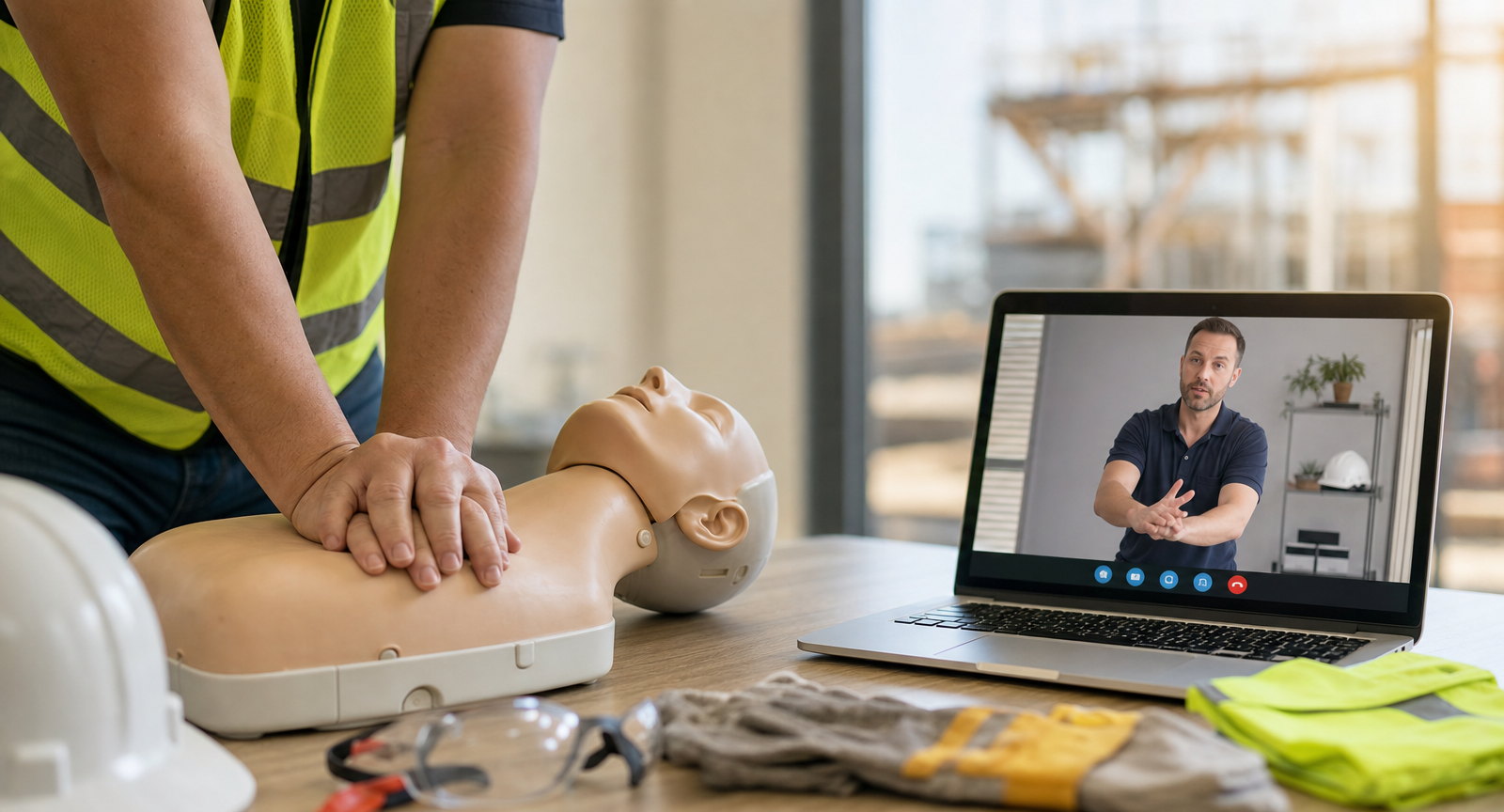
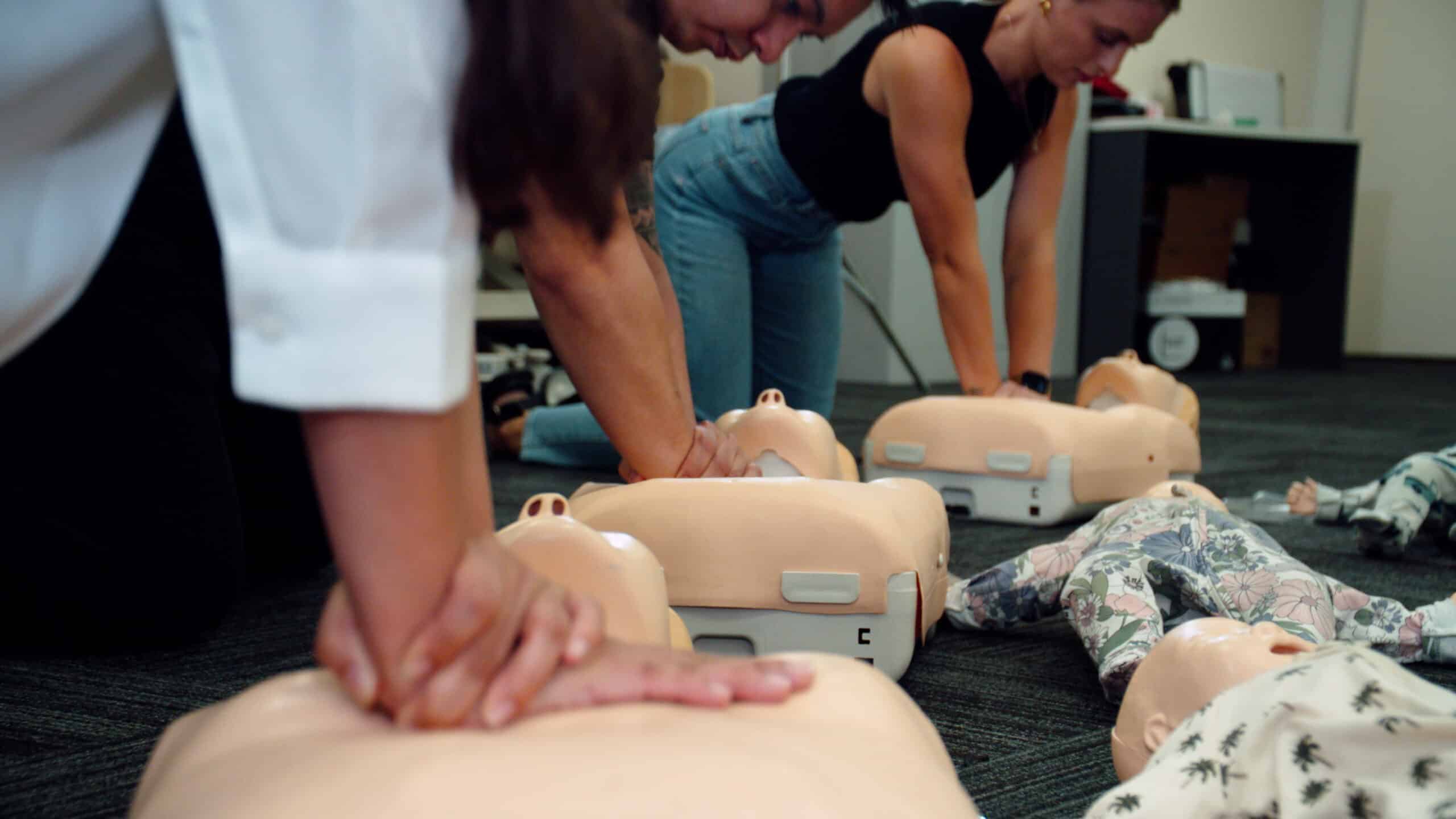
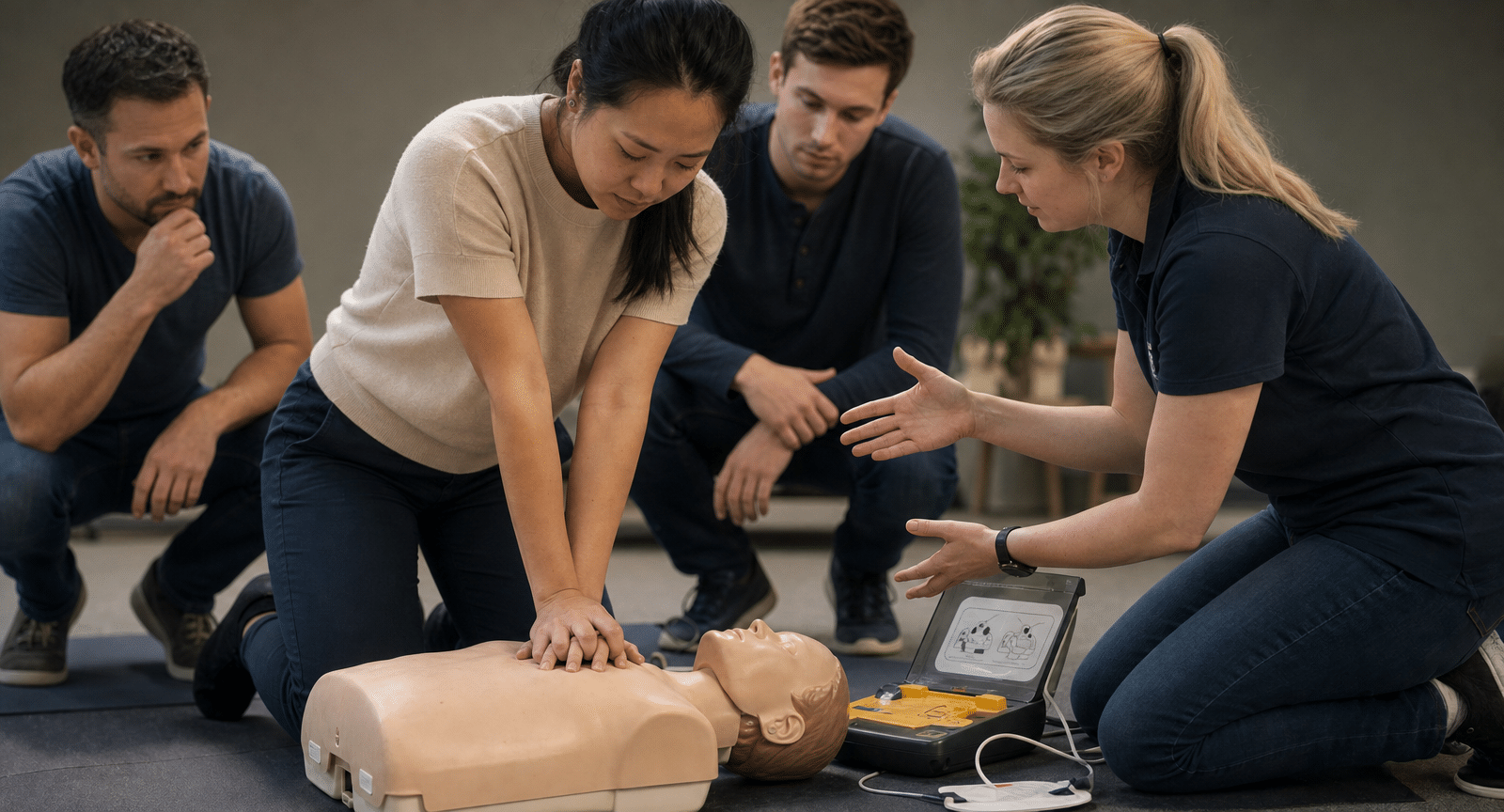
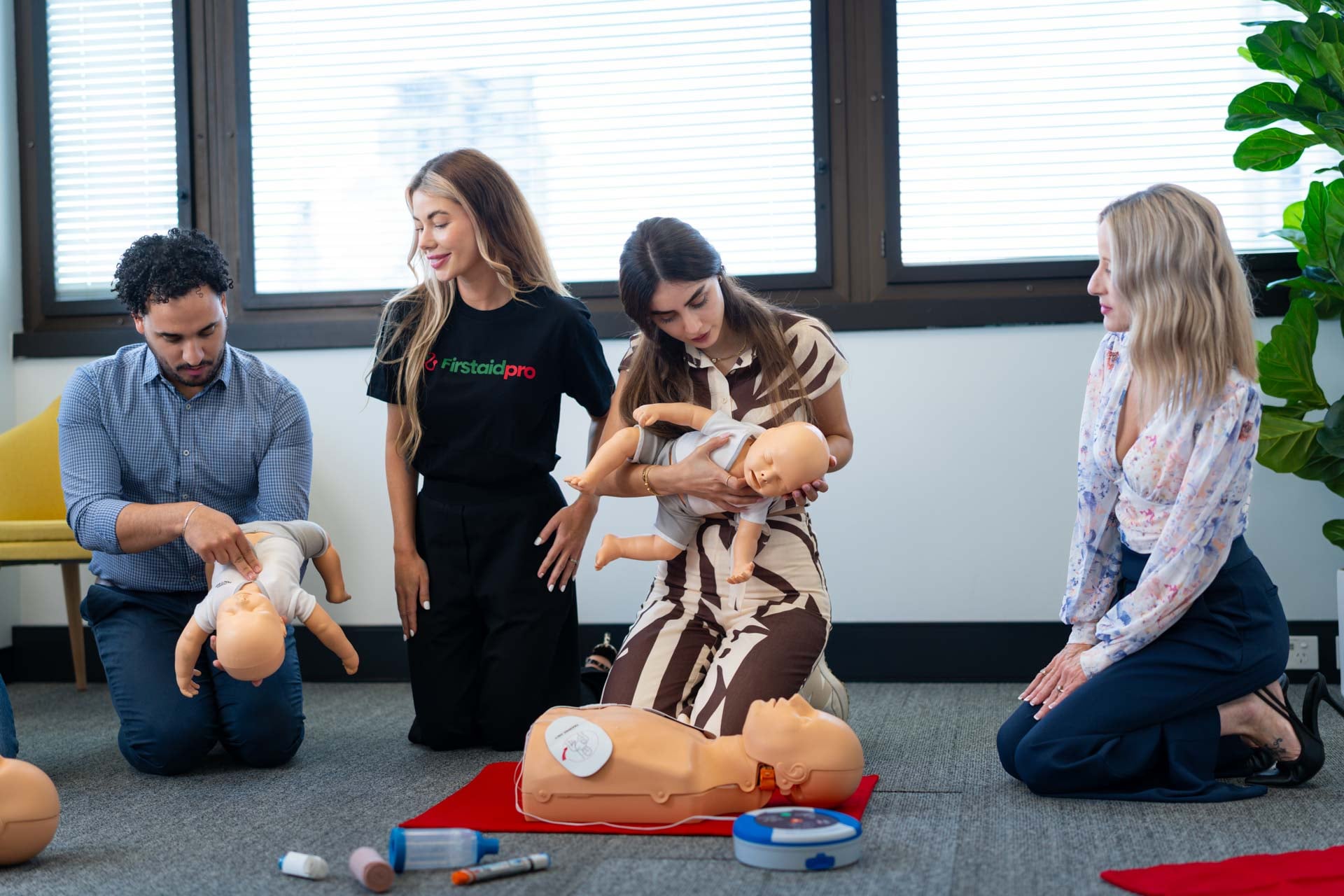
Reading the steps helps. Practising them on a manikin, with a trainer correcting your technique, is what builds real confidence.
The HLTAID009 assessment requirements on training.gov.au ask you to:
- Perform at least 2 minutes of uninterrupted single-rescuer CPR on an adult manikin placed on the floor.
- Perform at least 2 minutes of uninterrupted CPR on an infant manikin on a firm surface.
- Follow the prompts of an AED to deliver at least one shock.
The unit requires CPR performed “in accordance with the ARC guidelines”, meaning the Australian Resuscitation Council. Our trainers teach the DRSABCD action plan as part of that.
Here’s how to get started with us:
- CPR only: We deliver HLTAID009 Provide CPR courses from $45.
- Full first aid: Our HLTAID011 Provide First Aid courses start from $97 & HLTAID012 Provide First Aid in an Education and Care Setting courses are priced from $119.
- Flexible delivery modes to suit your schedule: Fully face-to-face (No Online), Blended, Express and 100% Online.
- Daily Deals & Price Beat Guarantee available!
- Certificates Issued Same Day* (T&Cs Apply), with courses available 7 days.
- Venues Australia-wide, including Adelaide, Brisbane, Sydney, Melbourne, Hobart, Canberra, Darwin, Perth, surrounding suburbs and regional areas.
- Free Downloads: Visit our free first aid charts hub for DRSABCD, CPR and more.
See the steps in action first: watch our DRSABCD demo video.
Ready to book a course? Find a course near you now!
Medical disclaimer:
This article is general information for education only. It doesn’t replace accredited first aid training or medical advice. In an emergency, call Triple Zero (000).

Frequently Asked Questions
What does DRSABCD stand for?
DRSABCD stands for Danger, Response, Send for help, Airway, Breathing, CPR and Defibrillation. It is ANZCOR’s Basic Life Support sequence, set out in ANZCOR Guideline 8. ANZCOR words the first two steps as “Dangers” and “Responsiveness”.
What are the 7 stages of the DRSABCD action plan?
The seven stages are: check for danger, check for a response, send for help, open the airway, check breathing, start CPR and attach an AED. ANZCOR Guideline 8 lists them in this order. You work through them one after another for anyone who is unresponsive.
Is CPR still 30 to 2?
Yes. ANZCOR Guideline 8 recommends 30 compressions to 2 breaths for all ages, at approximately 100–120 compressions per minute. If you’re untrained or unwilling to give breaths, ANZCOR supports giving compressions only.
What is the difference between DRABC and DRSABCD?
DRABC is an older, shorter version of the action plan. The current ANZCOR sequence adds Send for help and Defibrillation to make DRSABCD. If you learnt DRABC, a refresher course will bring your skills in line with current ANZCOR guidelines.
Can I use an AED if I’m not trained?
Yes. ANZCOR Guideline 7 states that AED use should not be restricted to trained personnel. The AED gives voice prompts, and you should not touch the person while it delivers a shock.
When should you stop CPR?
ANZCOR Guideline 8 gives four reasons only. Stop if the person responds or breathes normally, or you can’t physically continue. Also stop if a health care professional takes over or tells you to stop. There is no fixed time limit.
How do I get a first aid certificate in Australia?
You complete a nationally recognised unit, such as HLTAID011 Provide First Aid or HLTAID009 Provide CPR, with a Registered Training Organisation. The units and their assessment requirements are published on training.gov.au. First Aid Pro (RTO 31124) runs both, with certificates issued same day* (T&Cs Apply). Enrol in one of our upcoming sessions today!