



Sharon has 21+ years of experience as a qualified Emergency Care Nurse registered with the Australian Health Practitioner Regulation Agency (APHRA) and 12+ years as a First Aid Trainer.
She takes pride in FirstAidPro making first aid training available, comprehensive and affordable to everybody.
Key Takeaways
- HLTAID009 Provide Cardiopulmonary Resuscitation is a nationally recognised, CPR-only unit of competency on the national register.
- It trains you to perform CPR in line with Australian Resuscitation Council (ARC) guidelines.
- HLTAID009 supersedes HLTAID001 and is not equivalent — it is the current CPR unit.
- It suits anyone who may need to provide CPR, in community or workplace settings.
- Assessment includes at least 2 minutes of uninterrupted single-rescuer CPR plus safe AED use.
- Safe Work Australia recommends refreshing CPR every 12 months. See our guide on how long a CPR certificate lasts, or view our HLTAID009 CPR course.
What HLTAID009 Means
HLTAID009 is a nationally recognised unit of competency. Its official title is HLTAID009 Provide Cardiopulmonary Resuscitation, and it is a CPR-only unit. That means it focuses purely on cardiopulmonary resuscitation, not the broader skills found in a full first aid course.
According to training.gov.au, the national register of vocational training, HLTAID009 is current and has been so since 16 October 2020. The register describes the unit as covering the skills and knowledge required to perform CPR in line with Australian Resuscitation Council (ARC) guidelines.
In short, HLTAID009 is the current national benchmark for CPR competency in Australia. When an employer asks for a CPR certificate, this is the unit they usually mean. The code appears on your Statement of Attainment, so you can show exactly which unit you completed. Because it sits on the national register, the certificate is recognised by employers and regulators right across the country.
HLTAID009 vs HLTAID001 — Why the Code Changed
You may still see the older code HLTAID001 on certificates issued before the change. According to training.gov.au, HLTAID009 supersedes HLTAID001, and the two units are not equivalent.
“Not equivalent” is an important detail. It means the content was reviewed and reworded, so an HLTAID001 certificate is not simply swapped for an HLTAID009 one. HLTAID009 is the current standard.
If your existing certificate names HLTAID001, it reflects an earlier version of the unit. When you next renew your CPR training, you will be assessed against HLTAID009, the current CPR unit on the national register.
What HLTAID009 Covers
HLTAID009 is built around four elements on the national register. In plain terms, they are:
- Respond to an emergency situation — assess the scene, check for danger, and follow DRSABCD.
- Perform CPR procedures — deliver compressions and breaths, and operate an AED per the manufacturer’s instructions.
- Communicate details of the incident — hand over clearly to emergency services and give an accurate report.
- Review the incident — reflect on your response and your own wellbeing afterwards.
Within these elements, you learn practical, hands-on skills. According to training.gov.au, the unit covers adult, child and infant CPR and the safe use of an AED (automated external defibrillator). You also learn how to manage an unconscious casualty who is breathing.
The unit covers infection control and the use of PPE as well. You practise positioning a casualty to protect the airway, and how to respond if someone vomits during CPR. Finally, it builds the habits around handover, incident reporting and rescuer wellbeing that matter in a real emergency. If you want to see how the technique looks in practice, our guide on how to do CPR walks through the steps.
These skills are taught and assessed against a national standard, so the certificate means the same thing wherever you earn it in Australia.
HLTAID009 Assessment Requirements
HLTAID009 is assessed practically, not by theory alone. This is where the unit shows its rigour, and the specific requirements are worth knowing before you enrol. The following performance evidence comes directly from training.gov.au.
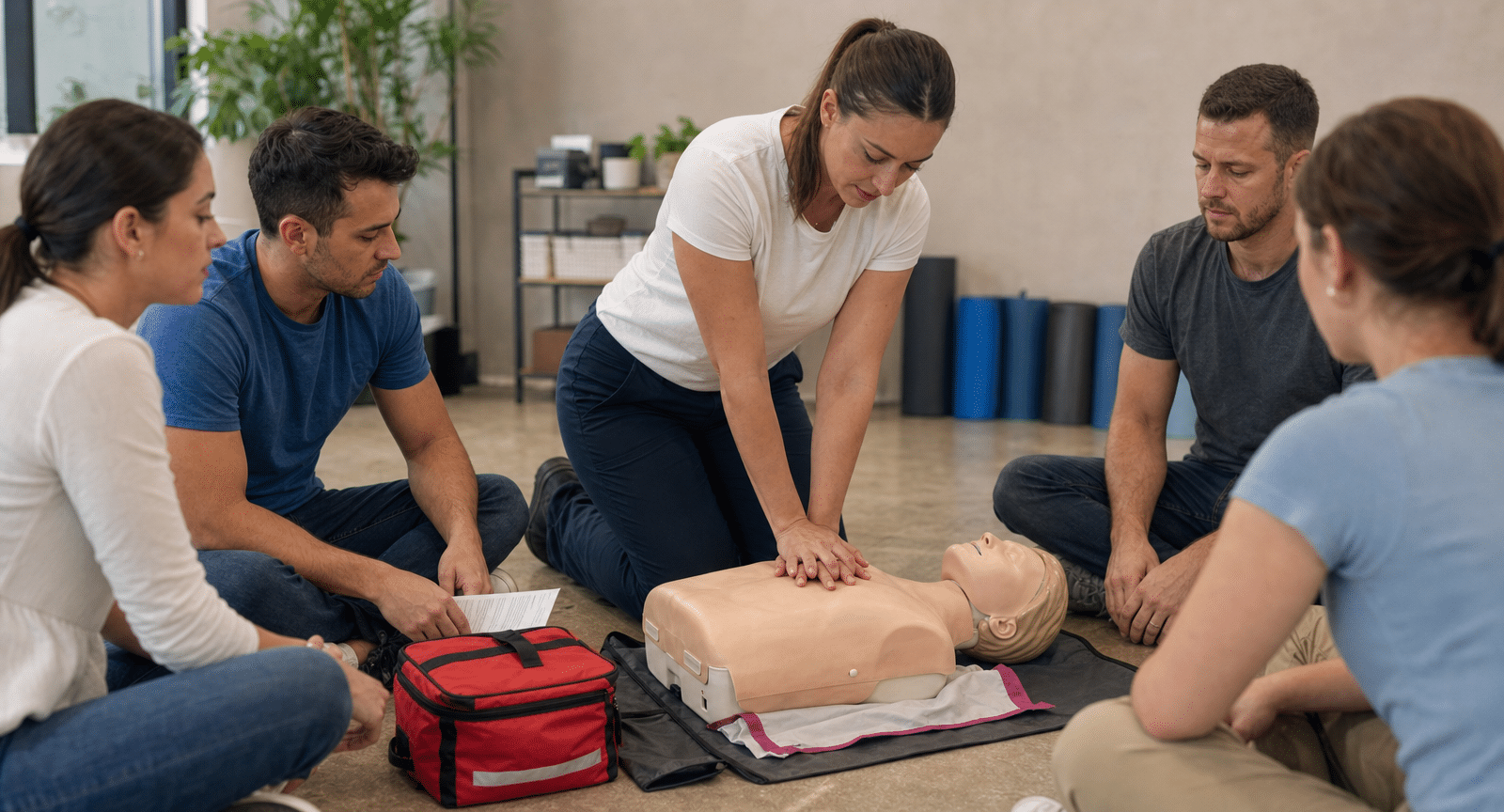
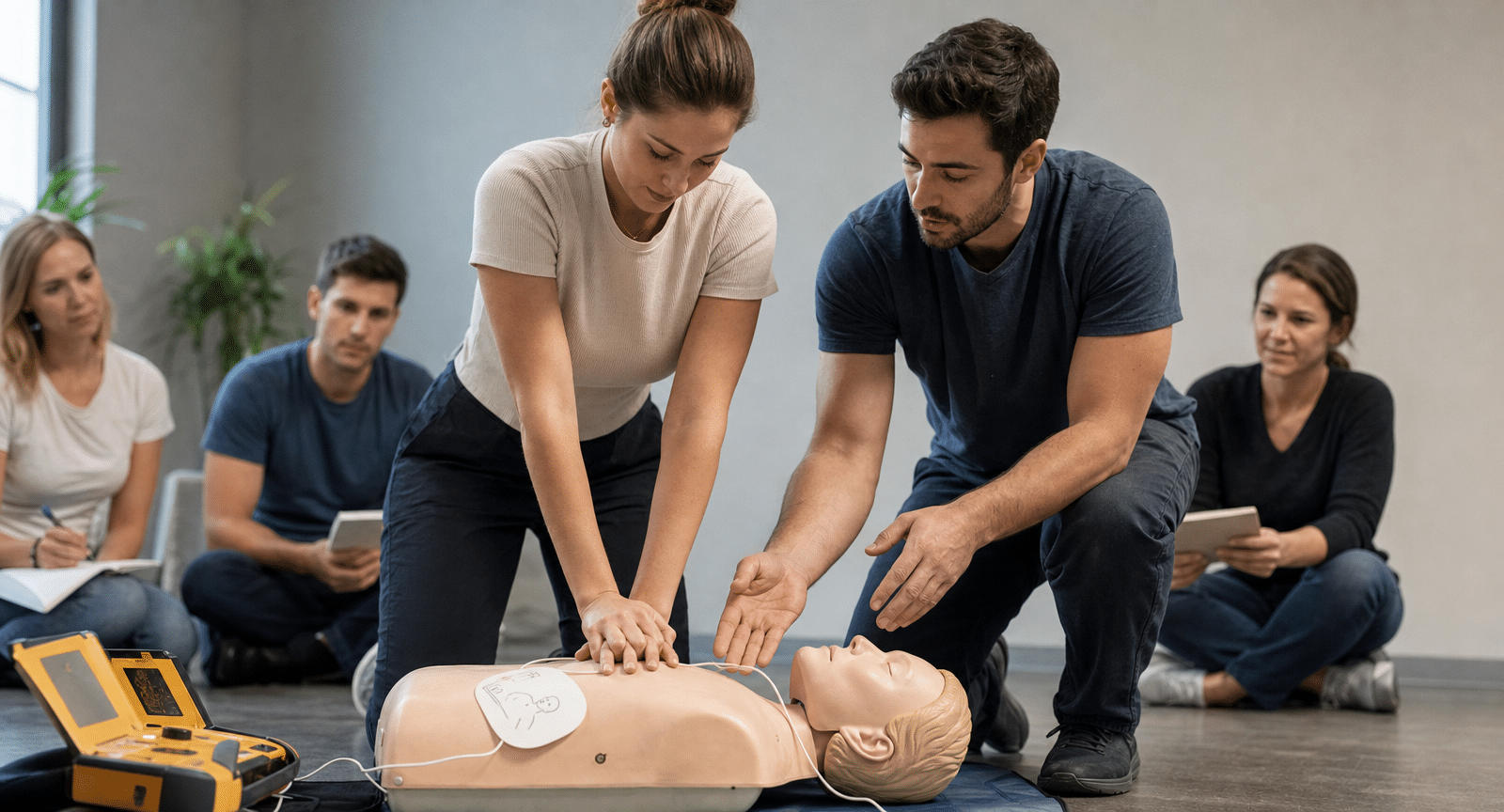
To be assessed as competent, you must demonstrate at least 2 minutes of uninterrupted single-rescuer CPR (5 cycles of both compressions and ventilations) on an adult manikin placed on the floor. Doing this on the floor matters, because it reflects how CPR is performed in a real emergency.
You must also follow the prompts of an AED to deliver at least one shock. Beyond that, you demonstrate the rotation of single-rescuer operators with minimal interruptions to compressions. You respond appropriately to regurgitation or vomiting, hand over to emergency services, give an accurate verbal report, and review the incident.
Infant CPR is assessed separately. You must show at least 2 minutes of uninterrupted single-rescuer CPR on an infant manikin placed on a firm surface.
The assessment conditions are set too. You need access to adult and infant resuscitation manikins, an AED training device, and PPE, with realistic simulated scenarios. Our trainers set these scenarios up so you practise the skills the way you would use them.
Who Needs HLTAID009
According to training.gov.au, HLTAID009 applies to all persons who may be required to provide CPR, across community and workplace settings. That is a broad group, and it likely includes you if your role or life could put you near a cardiac emergency.
In practice, we see HLTAID009 requested for:
- Workplace first aid officers and safety officers meeting compliance duties.
- Healthcare and aged care workers who support vulnerable people.
- Childcare and education staff responsible for children’s safety.
- Fitness professionals, sports coaches and gym staff.
- Security and crowd control personnel.
- Construction and mining workers on higher-risk sites.
- Parents and community members who simply want the confidence to act.
HLTAID009 can be taken as a standalone CPR certificate. It is also embedded as a component within HLTAID011 Provide First Aid, the broader first aid unit. If your workplace requires full first aid, you cover CPR as part of that course. If you only need CPR, HLTAID009 on its own is the right fit. Your state or territory WHS regulator and your employer can confirm what your role requires.
How Long Does HLTAID009 Last?
The unit itself carries no legislated expiry date. In practice, though, CPR skills fade quickly, so regular refreshing is the accepted standard.
The Safe Work Australia First Aid in the Workplace Code of Practice recommends refreshing CPR every 12 months, with broader first aid renewed every 3 years. State and territory WHS regulators reflect this guidance. It is corroborated on qld.gov.au.
Treat the annual refresher as a minimum floor, not a ceiling. CPR is a physical skill, and confidence drops between sessions, so more frequent practice is sensible — the Australian Resuscitation Council notes that retraining cycles of 12 to 24 months are likely insufficient and recommends frequent refresher practice. For a fuller explanation, see our article on how long a CPR certificate lasts.
How to Get Your HLTAID009 Certificate
You earn HLTAID009 by training with a Registered Training Organisation (RTO). We are RTO 31124, and we deliver HLTAID009 Provide Cardiopulmonary Resuscitation across Australia at 170+ locations, as well as onsite for workplace groups.
We offer four delivery modes, so you can pick what fits your schedule and learning style:
- Traditional — a 2-hour fully face-to-face class, with no online component.
- Blended — online theory plus a 1.5-hour practical session.
- Express — online theory plus a 1-hour assessment-only refresher.
- 100% online Zoom — a 1-hour live virtual class, with equipment provided.
On successful completion, you receive a nationally recognised Statement of Attainment for HLTAID009, valid for 12 months. We issue Certificates Issued Same Day* (T&Cs Apply), and CPR courses start from $45.
When you are ready, you can book a course through our calendar and choose a venue near you.
Book a First Aid Course
Disclaimer
This article is general information only and is not medical advice. Always follow current ARC guidelines, your training, and the direction of emergency services. For personal or clinical advice, consult a qualified health professional.
Recent Posts
How Long Does a CPR Certificate Last?
How to Do CPR: A Step-by-Step Guide
HLTAID011 Provide First Aid Explained
Frequently Asked Questions
What is HLTAID009?
HLTAID009 is the nationally recognised CPR unit, formally titled Provide Cardiopulmonary Resuscitation. According to training.gov.au, it teaches you to perform CPR in line with ARC guidelines. It is a CPR-only unit, separate from broader first aid training.
What’s the difference between HLTAID009 and HLTAID011?
HLTAID009 is CPR only. HLTAID011 Provide First Aid is broader and includes CPR as one component. Per training.gov.au, if you need full first aid, choose HLTAID011; if you only need CPR, HLTAID009 is the right unit.
Does HLTAID009 replace HLTAID001?
Yes. According to training.gov.au, HLTAID009 supersedes HLTAID001 and the two are not equivalent. HLTAID009 is the current CPR unit, so your next renewal will be assessed against it.
How long does HLTAID009 take?
This depends on the delivery mode. Face-to-face training typically runs 1 to 2 hours. The assessment itself requires at least 2 minutes of uninterrupted CPR, as set out on training.gov.au.
How often should I renew my CPR certificate?
The Safe Work Australia First Aid in the Workplace Code of Practice recommends renewing CPR every 12 months. State and territory WHS regulators reflect this. Because skills fade, we suggest treating annual refreshing as a minimum.
Do I need HLTAID009 for work?
If your role may require you to provide CPR, then usually yes. Requirements vary by role and state, so check with your state WHS regulator and your employer, alongside the unit application on training.gov.au.