



Sharon has 21+ years of experience as a qualified Emergency Care Nurse registered with the Australian Health Practitioner Regulation Agency (APHRA) and 12+ years as a First Aid Trainer.
She takes pride in FirstAidPro making first aid training available, comprehensive and affordable to everybody.
What Is CPR and Low Voltage Rescue (UETDRMP018)?
CPR LVR is a combined training session that delivers two nationally recognised units in one short, practical course. Together they prepare you to respond when someone is in contact with a live electrical panel.
UETDRMP018 Perform Rescue From a Live Low Voltage Panel is the low voltage rescue unit. It covers rescuing a person from fixed low voltage panels and switchboards operating up to roughly 1,000 V AC or 1,500 V DC. It excludes overhead lines and underground cables, which require separate training, so if your work involves those higher-risk assets you need additional units.
HLTAID009 Provide CPR is the resuscitation unit, and it is co-delivered with the rescue unit. A Statement of Attainment for LVR cannot be issued without current CPR. Freeing someone from a live panel only saves a life if the rescuer can immediately start effective compressions, so the two skills are trained and assessed together.
It is worth checking the code on your current certificate. UETDRMP018 is the current unit registered on training.gov.au, and it supersedes UETDRMP007 and the earlier UETDRRF004, with UETDRMP007 deliverable during the transition period. You can confirm the unit is current on the national training register, and our unit transition explainer covers the differences if you are unsure. Because low voltage rescue and CPR are hands-on skills, they are assessed in person on floor manikins and rescue equipment.

Why Electricians Need It: The Risk and the Law
Electrical contact can trigger cardiac arrest almost instantly. A shock can throw the heart into ventricular fibrillation, an irregular rhythm that stops it pumping blood. In that moment a trained rescuer who can safely isolate the hazard and start CPR is the difference between life and death, because effective compressions in the first minutes keep the brain and heart supplied until help arrives.
That risk is why the law places clear duties on your workplace. Under Australia’s model WHS framework, a person conducting a business or undertaking must ensure that workers doing or assisting with electrical work are competent in rescue and resuscitation. For energised or live work, a safety observer — a second competent worker positioned to rescue and resuscitate you — is the standard control.
This is where the legal picture splits, and where most confusion comes from. In some jurisdictions, resuscitation competency is written directly into the electrical licence. In others, no licence clause names CPR or LVR, yet the same obligation reaches you through employer WHS duties and network-operator site-access rules. Both routes end in the same place: you need current CPR and low voltage rescue to work safely and lawfully. The difference is who sets the rule, which the next section maps out state by state.
CPR and LVR Requirements by State and Territory
The table below summarises where CPR and LVR is a formal licence condition, where it flows from WHS and site rules, and how often you need to renew. Short notes follow with the detail for each jurisdiction. Where a state is not a formal licence condition, treat the renewal cadence as the practical industry standard rather than a licensing rule.
| State / Territory | Licence condition? | What sets the rule | Renewal cadence |
|---|---|---|---|
| QLD | Yes | Electrical Safety Regulation 2013 (s42, s55); PCBU duty s28 | Annual (safety observer) |
| WA | Yes (CPR only) | Electricity (Licensing) Regulations 1991, amended 17 Oct 2024 | CPR every ≤3 years; LVR per site |
| SA | Regulator expectation | Office of the Technical Regulator + SafeWork SA (WHS) | 12 months (practical norm) |
| NSW | No (WHS duty) | WHS Act 2011 + network operators (Ausgrid, Endeavour, Essential Energy) | Annual (industry norm) |
| VIC | No (WHS duty) | OHS Act 2004 + electricity supply industry standard | Annual (industry norm) |
| TAS | No (WHS duty) | WHS duty + industry standard | Annual (industry norm) |
| NT | No (WHS duty) | Electrical Safety Act 2022 / Regs 2024 + WHS duty | Confirm with regulator/employer |
| ACT | No (WHS duty) | Construction Occupations (Licensing) Act 2004 + WHS duty | Confirm with regulator/employer |
Queensland. QLD is the clearest case. Resuscitation competency is required for licence issue under the Electrical Safety Regulation 2013 (s42) and renewal (s55), a safety observer must be assessed as competent to rescue and resuscitate within the previous 1 year, and the PCBU duty under s28 requires workers to be competent in rescue and resuscitation. In practice this makes annual renewal the rule. You can read the regulation on the Queensland legislation register.
Western Australia. Since the Electricity (Licensing) Regulations 1991 were amended on 17 October 2024, licensed electricians must complete an approved CPR course at intervals not exceeding 3 years, and LVR is not a WA licence condition but an industry and site standard. Details sit with WA’s Building and Energy division on the WA Commerce site. Many WA sites still ask for more frequent refreshers, so check your employer’s rules.
South Australia. SA sits between the two models. The Office of the Technical Regulator and SafeWork SA expect an electrical safety observer to hold current rescue and resuscitation competency, and 12 months is the working standard.
New South Wales. No licence clause names CPR or LVR in NSW. The obligation reaches you through the WHS Act 2011 and, in practice, through the network operators: Ausgrid, Endeavour Energy and Essential Energy require current CPR and LVR for site access, which makes annual renewal the norm.
Victoria. VIC works the same way, through employer duties under the OHS Act 2004 plus electricity supply industry standards. It is not verified as a licence condition, but annual renewal is the practical expectation.
Tasmania. TAS relies on WHS duties and industry standards rather than a licence clause, with annual renewal as the working norm.
Northern Territory and ACT. Neither the NT’s Electrical Safety Act 2022 and Regulations 2024 (commenced 1 July 2024) nor the ACT’s Construction Occupations (Licensing) Act 2004 sets out a specific CPR or LVR clause we could verify. In both, the obligation flows from WHS duties and site rules, so confirm the current requirement with your regulator and employer.
The bottom line: wherever you work, most electricians renew CPR and LVR every 12 months. QLD makes it a licence matter, and WA sets a three-year floor for CPR specifically.

How Often Must You Renew CPR and LVR?
For most electricians, the practical answer is every 12 months. Here is where that figure comes from, and why it holds even in states without a licence clause.
The 12-month CPR standard is industry convention drawn from the Safe Work Australia model Code of Practice: First Aid in the Workplace. That guidance treats HLTAID009 Provide CPR as current for 12 months, while first aid (HLTAID011) runs on a three-year cycle. The Code of Practice is guidance unless a state regulator adopts it, but it is the reference point most workplaces and RTOs use.
The clinical reasoning sits with the Australian and New Zealand Committee on Resuscitation. ANZCOR Guideline 10.1 (Basic Life Support Training, approved May 2025) notes that CPR skills deteriorate within weeks to months, that 12–24 month retraining cycles are likely insufficient, and it recommends more frequent practice rather than mandating a specific annual refresh. You can read it on the ANZCOR guidelines page. In plain terms, skills fade faster than people expect, so a yearly refresh is a sensible minimum.
Low voltage rescue is renewed alongside CPR in the same session. Networks and sites treat 12 months as current, and because a Statement of Attainment for LVR cannot be issued without current CPR, your CPR must be valid on the day your LVR is assessed. That is the simplest reason to book them together.
Two jurisdictions vary. QLD safety observers are on an annual cycle by regulation. WA sets a three-year maximum for approved CPR by regulation, though many WA sites still want an annual refresh for site access. The safe, simple rule for everyone: book the combined refresher every 12 months and you will meet the strictest common standard.
Booking Your CPR LVR Course With First Aid Pro
We deliver the combined UETDRMP018 Perform Rescue From a Live Low Voltage Panel and HLTAID009 Provide CPR in one in-person practical session. It is nationally recognised training delivered by our RTO (RTO 31124), with your certificate issued the same day* (T&Cs apply), from $99 (city offers may differ).
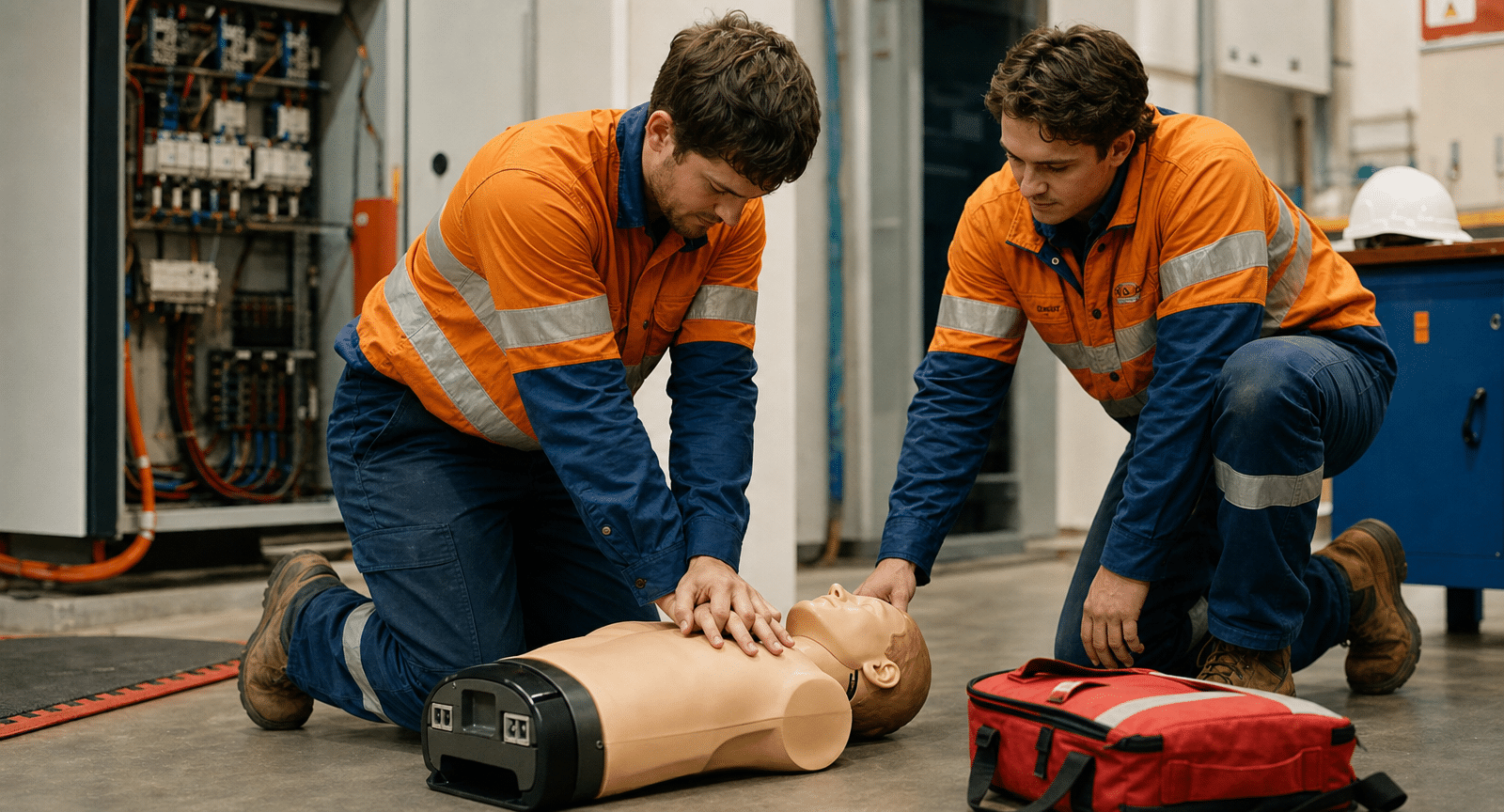
We run the course face-to-face across South Australia, Queensland, New South Wales and Tasmania, through both public sessions and onsite group bookings where our trainers come to you. Low voltage rescue is a hands-on skill, so it is trained and assessed in person on rescue equipment and floor manikins.
To get the most from your session, come prepared:
- Bring your 10-digit Unique Student Identifier (USI).
- Wear enclosed footwear suitable for practical rescue drills.
- Be ready to perform 2 minutes of CPR on manikins at floor level.
Find your city and dates, or go straight to a local session in CPR LVR course Brisbane, CPR LVR course Sydney or CPR LVR course Adelaide. Book a course today, or contact us to arrange onsite training for your team.
Frequently Asked Questions
Do electricians legally need CPR and LVR training in Australia?
In practice, yes. Everywhere in Australia, model WHS law places a duty on employers to ensure workers doing or assisting electrical work are competent in rescue and resuscitation. In Queensland it goes further: the Electrical Safety Regulation 2013 makes resuscitation competency a licence matter, and in Western Australia an approved CPR course is a licence condition under the Electricity (Licensing) Regulations 1991.
How often do I need to renew my LVR and CPR?
The working standard is every 12 months, which reflects the Safe Work Australia model Code of Practice treatment of HLTAID009 CPR as current for a year. Queensland safety observers must be reassessed within the previous 12 months by regulation, while Western Australia sets a maximum of three years for approved CPR. ANZCOR Guideline 10.1 adds that CPR skills fade well before the 12–24 month mark, so an annual refresh is a sensible minimum.
What is the difference between UETDRMP018, UETDRMP007 and UETDRRF004?
UETDRMP018 Perform Rescue From a Live Low Voltage Panel is the current unit on the national training register. It supersedes UETDRMP007, which in turn replaced the older UETDRRF004. If your certificate shows one of the earlier codes, check whether it is still accepted for your site and plan your next refresh under the current unit.
Do I need CPR before I can do LVR?
Yes. HLTAID009 Provide CPR is co-required with the low voltage rescue unit, which is why we deliver them in a single session. According to standard industry practice, a Statement of Attainment for LVR cannot be issued unless your CPR is current on the day of assessment.
Is UETDRMP018 recognised in every state?
Yes. UETDRMP018 is a nationally recognised unit under the Australian Qualifications Framework and is registered on training.gov.au, so it is valid across all states and territories. What differs is who mandates it and how — a licence condition in Queensland and Western Australia, and a WHS or site requirement elsewhere.
Does UETDRMP018 cover overhead lines or underground cables?
No. UETDRMP018 covers rescue from fixed low voltage panels and switchboards only, up to roughly 1,000 V AC or 1,500 V DC. Rescue from overhead lines or underground cables sits outside its scope and requires separate, higher-risk training.
Is CPR and LVR a licence condition in my state?
It depends on where you work. In Queensland, resuscitation competency is a licence condition under the Electrical Safety Regulation 2013, and in Western Australia CPR is a licence condition renewed at least every three years. In New South Wales, Victoria, South Australia, Tasmania, the Northern Territory and the ACT, the requirement flows from employer WHS duties and network-operator or site rules rather than a licence clause, so confirm the detail with your regulator and employer.