



Sharon has 21+ years of experience as a qualified Emergency Care Nurse registered with the Australian Health Practitioner Regulation Agency (APHRA) and 12+ years as a First Aid Trainer.
She takes pride in FirstAidPro making first aid training available, comprehensive and affordable to everybody.
Key Takeaways
- Every Australian workplace must provide at least one first aid kit. This is a legal duty under WHS Regulation 42, not an optional extra.
- Kit contents are risk-based. Use the Safe Work Australia Model Code of Practice: First aid in the workplace example list as your baseline, then tailor it to your hazards.
- A kit alone does not meet your duty. You also need trained first aiders, worker access to equipment and access to first aid facilities.
- As a guide, plan for roughly one first aider per 50 workers in low-risk workplaces and one per 25 in high-risk workplaces.
- Check and restock kits regularly and after every use. Use our workplace first aid kit checklist to audit each kit and keep a simple restock log.
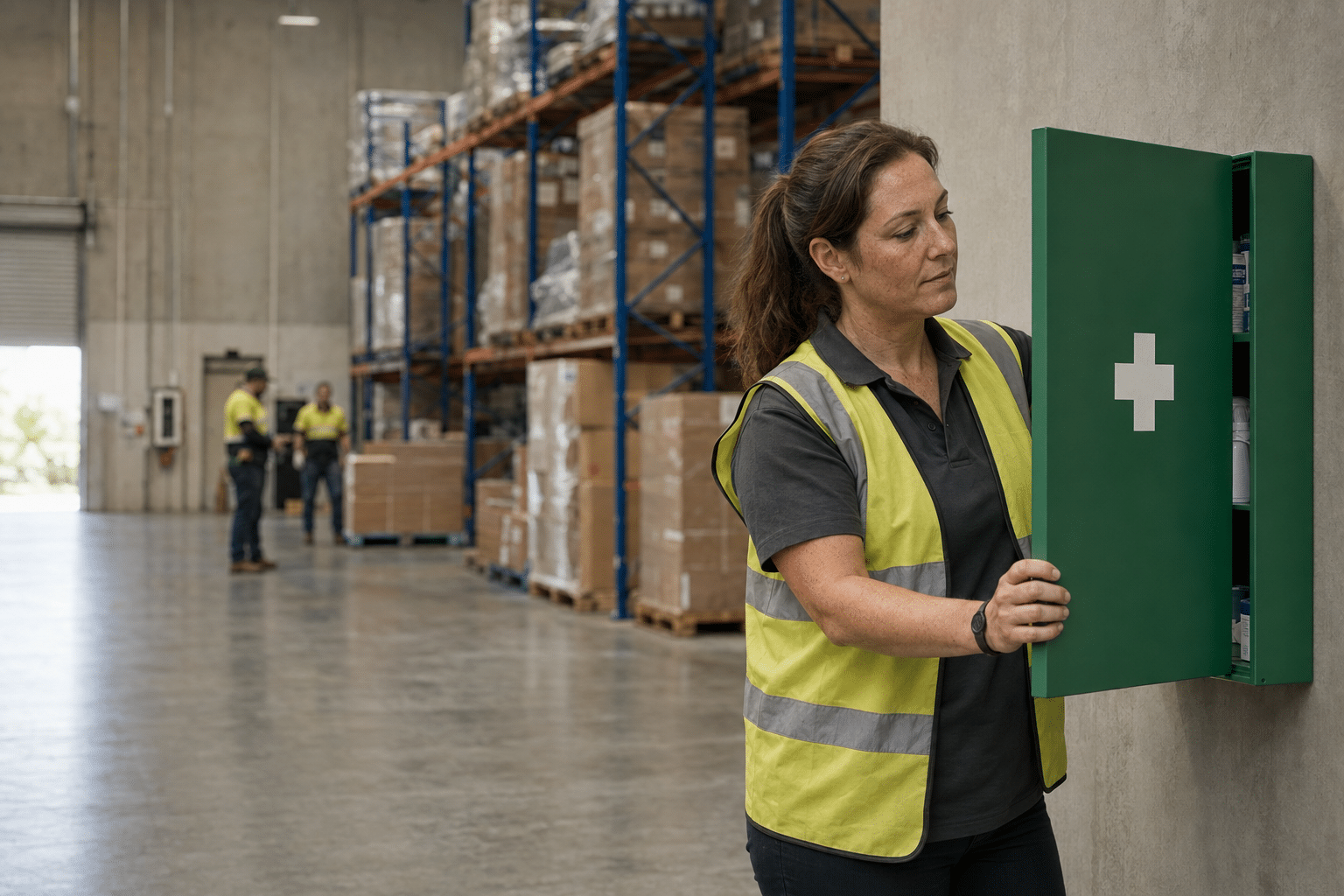
If you run or manage a business in Australia, providing a workplace first aid kit is a legal duty, not a nice-to-have. Under WHS Regulation 42, a person conducting a business or undertaking (a PCBU) must ensure workers have first aid equipment, access to that equipment, access to facilities for administering first aid, and an adequate number of trained first aiders. In plain terms, you must have at least one first aid kit, and it has to be genuinely fit for your workplace.
The tricky part is that “compliant” does not mean buying one specific product off a shelf. Your first aid kit workplace requirements depend on the size of your team, where they work and the hazards they face. A quiet office and a busy construction site do not need the same kit.
This guide walks you through it step by step: which laws and standards apply, how to choose the right kit for your risk level, a full Safe Work Australia example contents list in table form, how many kits and first aiders you need, and how to keep everything compliant over time. We finish with a downloadable checklist you can use straight away.
What the Law Actually Requires
The starting point for every workplace is WHS Regulation 42. It sets four connected duties on the PCBU: provide first aid equipment, ensure workers can access it, provide access to facilities for administering first aid, and ensure an adequate number of workers are trained to give first aid. Your kit is one piece of a bigger duty, and the four parts work together.
The practical detail sits in the Safe Work Australia Model Code of Practice: First aid in the workplace, an approved code of practice under the model WHS laws. It explains how to work out what “adequate” means for your workplace and gives worked examples, including an example kit contents list. Because it is an approved code, regulators and courts can use it to judge whether you have met your duty, so it is the document to build your compliance around.
One point trips people up: there is no single mandated first aid kit product you must buy. Compliance is about adequacy, decided through a risk assessment, not a particular SKU or brand. Australian Standards can be a helpful guide, but your legal obligation is anchored to the WHS Regulation and the Code of Practice.
Finally, check your state or territory, because the model laws are adopted locally and details vary. In Victoria, for example, WorkSafe Victoria’s First aid in the workplace compliance code 2021 applies, and its downloadable compliance code sets out both a prescribed pathway and a risk-assessment pathway. In New South Wales, SafeWork NSW sets out the same core PCBU duties. Always confirm the requirements with your own regulator.

How to Choose the Right Kit: A Risk-Based Buyer’s Guide
Choosing a workplace first aid kit is a decision, not a purchase. Safe Work Australia asks you to work it out through a risk assessment, so here is a simple five-step framework our trainers use with businesses.
Step 1: Run a risk assessment. Look at the nature of your work, the number and type of people on site, the hazards present and how remote or spread out your workplace is. Safe Work Australia’s approach is to identify hazards, assess the risk, provide the right equipment and training, then review it.
Step 2: Match the kit to your risk level. This is where kit tiering matters:
- Low-risk workplaces (offices, retail, general administration): a standard baseline kit covering common minor injuries such as cuts, grazes, sprains and minor burns.
- High-risk workplaces (construction, manufacturing, warehousing, remote or outdoor sites): a larger kit plus hazard-specific additions, because the injuries are more serious and help may be further away.
Step 3: Decide quantity and placement. You need at least one kit, but consider more if your workplace is large, spread across floors or split across sites. Keep kits visible, clearly signed and easy to reach, position them near higher-risk areas, and place a kit in any vehicle used by travelling workers.
Step 4: Add hazard-specific modules. Match extras to your actual risks: burns dressings for hot work, eyewash or saline for chemical and eye-injury risks, and extra supplies for remote or isolated sites where an ambulance is not minutes away.
Step 5: Assign responsibility and a review cadence. Name the person who owns each kit and set a schedule to check and restock it. A kit no one maintains will not be compliant when you need it.
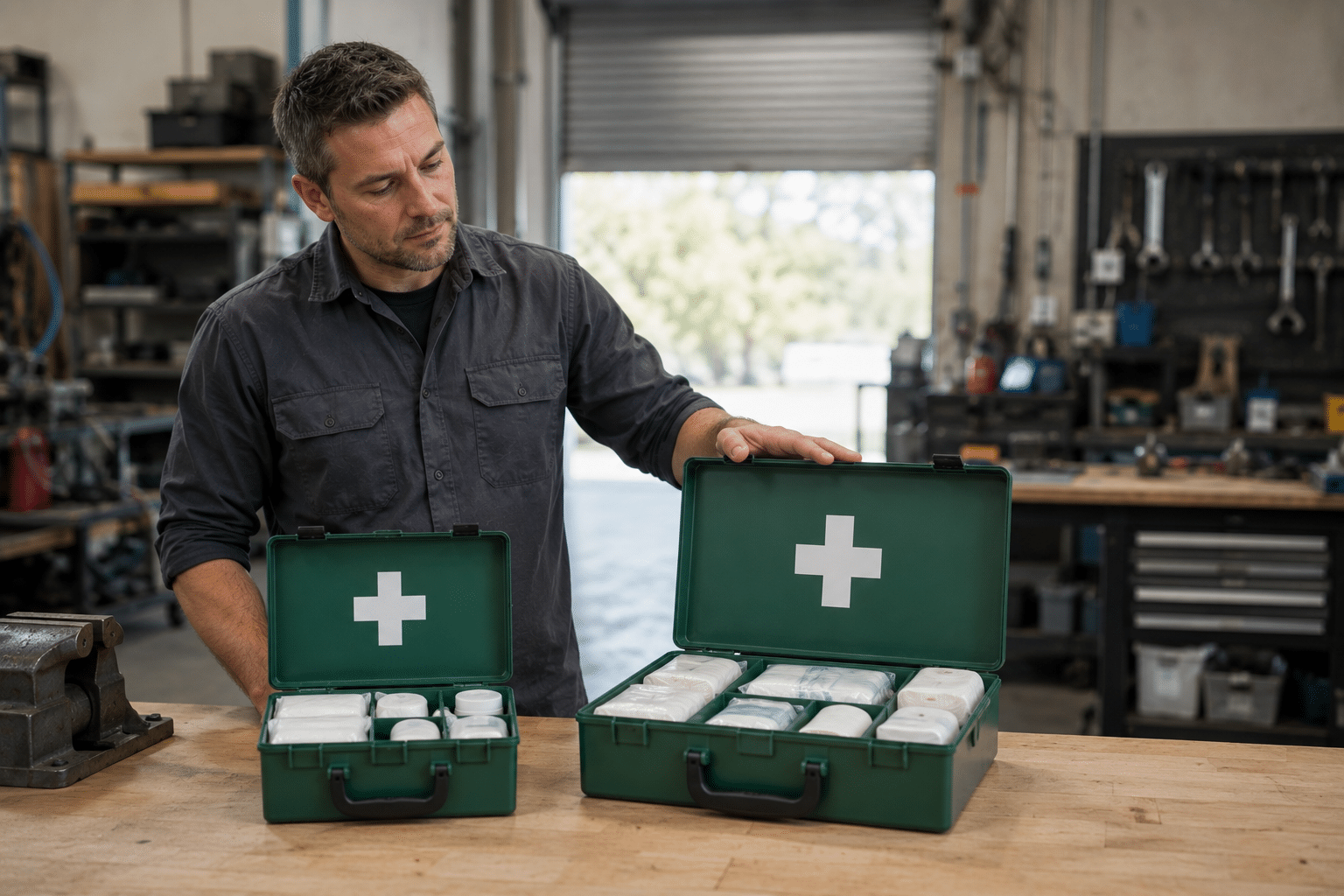
Workplace First Aid Kit Contents List
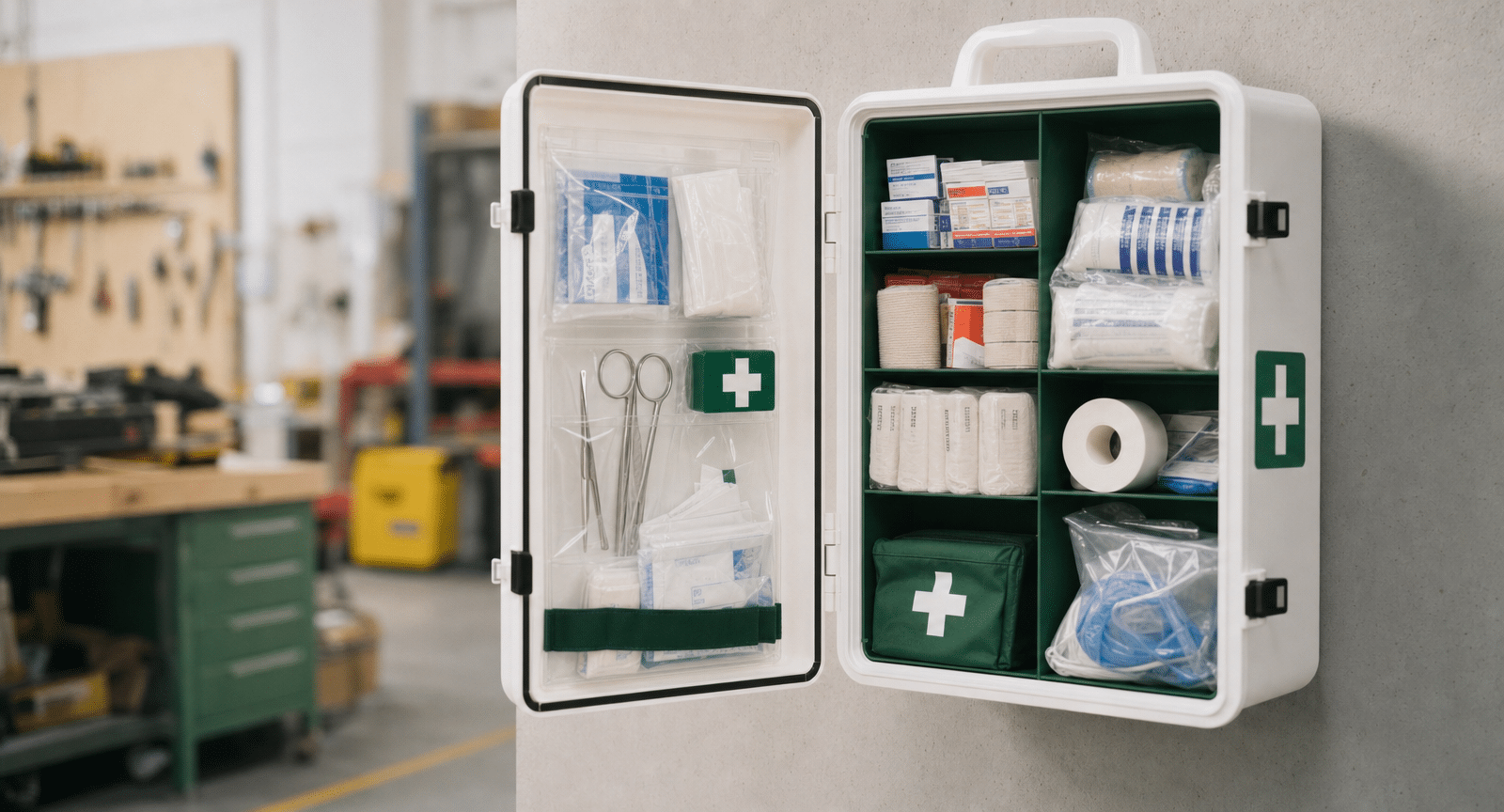
So what actually goes in the kit? The Safe Work Australia Model Code of Practice: First aid in the workplace (Appendix E) gives an example contents list you can use as your baseline. The table below sets out common items, an example low-risk quantity and why each item is included.
| Item | Example quantity (low-risk baseline) | Why it’s included |
|---|---|---|
| Adhesive plasters / strips | 1 pack | Cover small cuts, grazes and abrasions |
| Sterile wound dressings | 3 | Cover and protect larger wounds |
| Combine dressings | 1–2 | Manage heavier bleeding and larger injuries |
| Non-adherent dressings | 2–3 | Cover burns and weeping wounds without sticking |
| Triangular bandages | 2 | Make slings and immobilise or support limbs |
| Crepe / conforming (roller) bandages | 2 | Secure dressings and support sprains and strains |
| Heavy crepe bandage | 1 | Apply pressure for serious bleeding or snakebite |
| Disposable gloves | Several pairs | Protect the first aider and reduce infection risk |
| Scissors | 1 pair | Cut clothing, tape and dressings |
| Tweezers / forceps | 1 | Remove splinters and debris |
| Safety pins | 1 pack | Secure bandages and slings |
| Saline / eyewash | As needed | Irrigate eyes and clean wounds |
| Antiseptic | 1 | Clean minor wounds to reduce infection |
| CPR face shield / resuscitation mask | 1 | Give rescue breaths safely during CPR |
| Instant cold pack | 1–2 | Ease sprains, strains and bruising |
| First aid instructions booklet | 1 | Guide responders through common emergencies |
| Notebook and pen | 1 | Record what happened and what care was given |
| Emergency contact information | 1 | Speed up calls to emergency services and first aiders |
These quantities are examples from Appendix E and scale with your headcount and risk level, so a larger or higher-risk workplace will need more of most items. Between them, these supplies help your team respond to the injuries SafeWork NSW lists as common at work: cuts, scratches and grazes, muscular sprains and strains, minor burns, major bleeding, broken bones, eye injuries and shock. Use this as your workplace first aid kit contents list, then adjust it to the hazards your risk assessment identifies.
How Many Kits and First Aiders Do You Need?
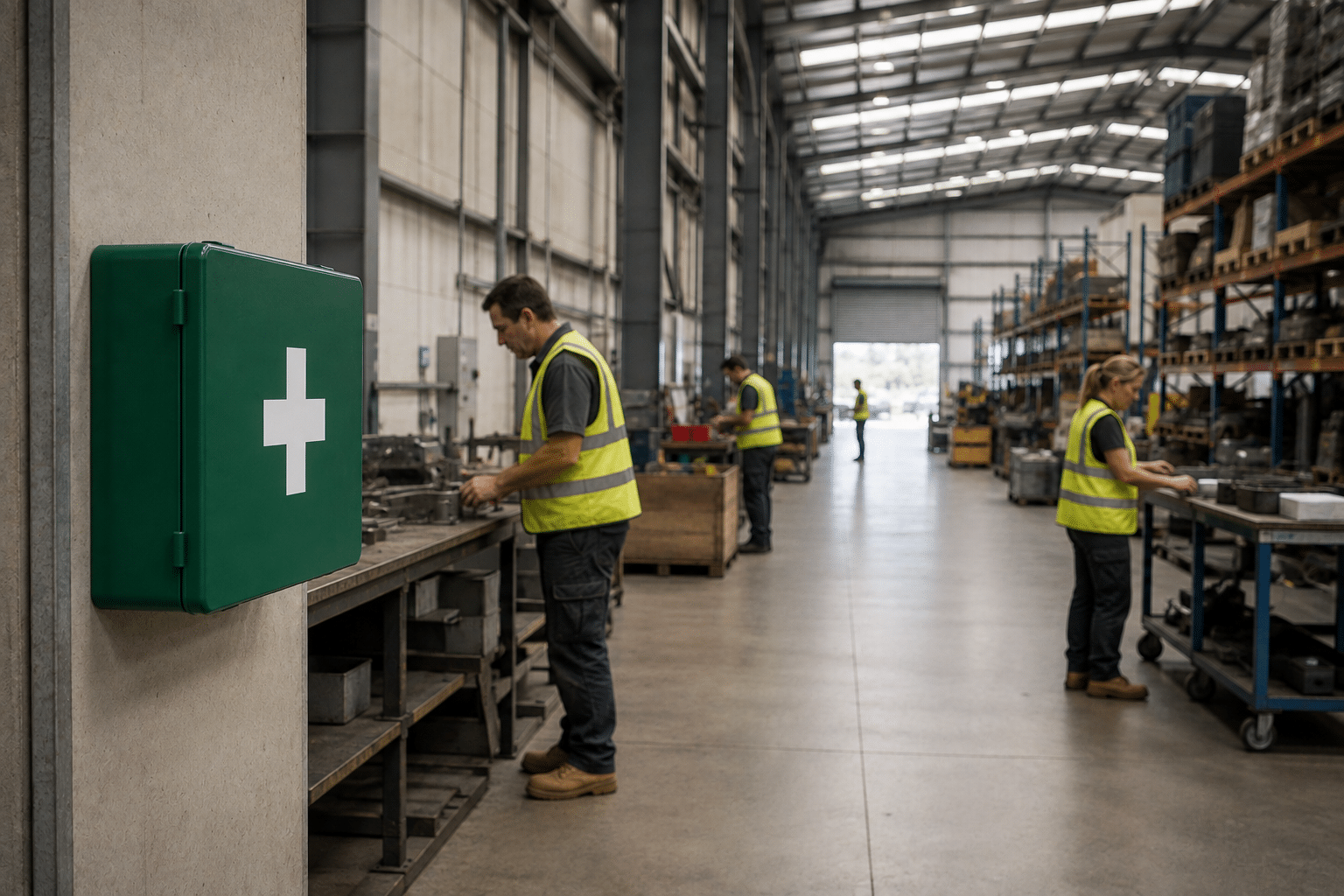
You must provide at least one first aid kit, but one is rarely enough for a spread-out workplace. Safe Work Australia advises considering more kits if your site is large, spread across multiple floors or buildings, or if workers travel, in which case each work vehicle should carry a kit. The aim is that anyone can reach a kit quickly, wherever an injury happens.
Kits are only half the picture. You also need enough trained first aiders. As a guide, Safe Work Australia suggests around one first aider per 50 workers in low-risk workplaces and one per 25 workers in high-risk workplaces. Treat these as a starting point and adjust for shift patterns, remoteness and your own risk assessment.
Those first aiders need current, nationally accredited training. The standard workplace qualification is HLTAID011 Provide First Aid, which includes CPR, and many roles also hold HLTAID009 Provide CPR for more frequent refreshers. A fully stocked kit with no trained responder does not meet your WHS duty, because the equipment and the trained person are both required parts of Regulation 42. If you need to certify a team, we can bring nationally accredited training to your site through our onsite workplace training.
Keeping Your Kit Compliant: Maintenance, Restocking and Your Checklist
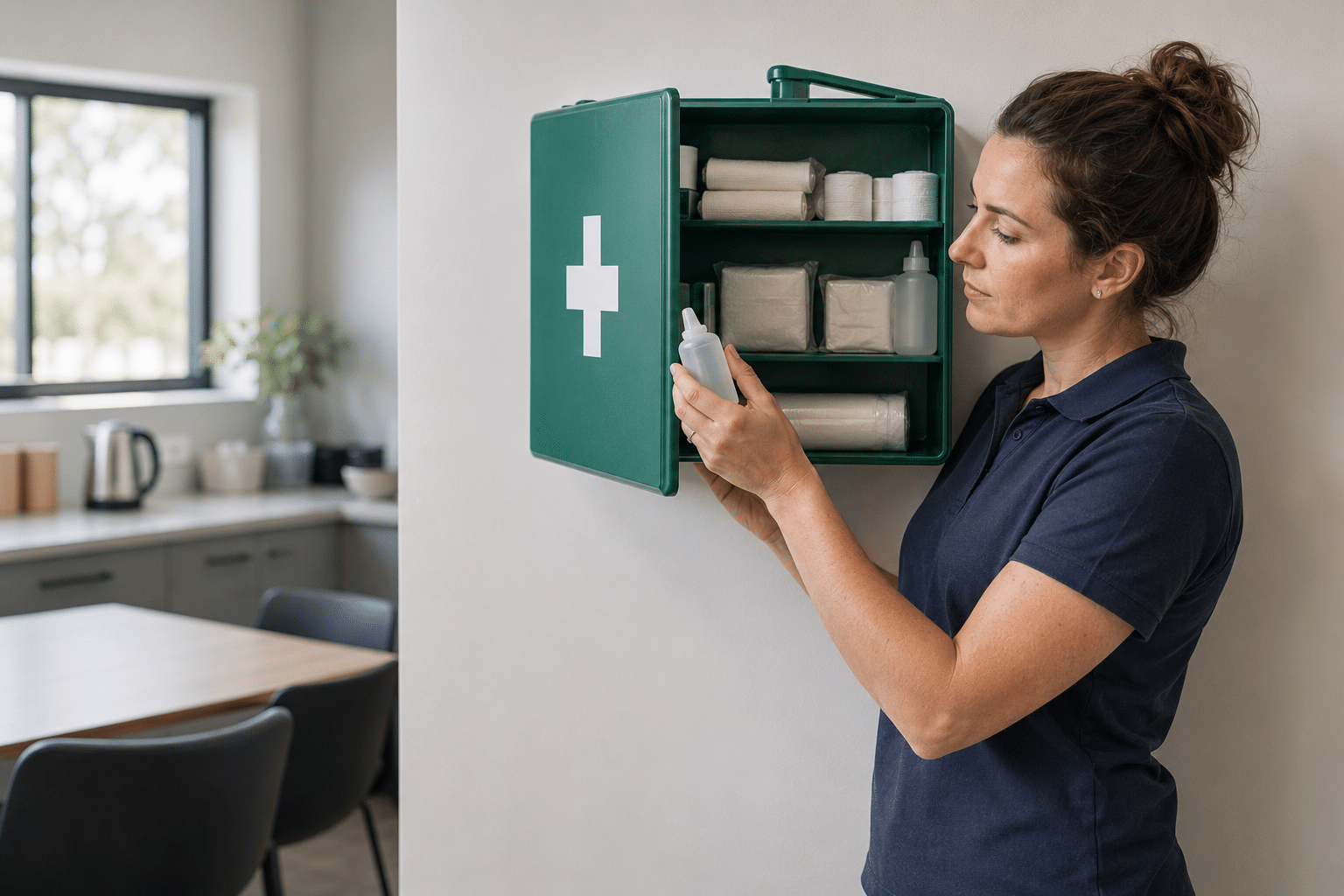
A compliant kit on day one can quietly fall out of compliance as items are used or expire. Keeping it right is an ongoing job, and Safe Work Australia expects kits to be maintained and checked regularly.
Here is a simple routine that works:
- Assign an owner. The PCBU holds the duty, but delegate day-to-day upkeep to a named first aid officer for each kit.
- Schedule checks. Inspect kits on a set cycle, such as monthly, and always after any use.
- Replace used and expired items. Restock anything used and check expiry dates on dressings, saline and antiseptic.
- Check signage and access. Confirm each kit is clearly signed, unlocked and easy to reach, and that nothing is blocking it.
- Keep a restock log. A short written record shows what was checked and when, which helps demonstrate compliance.
To make this easy, use our workplace first aid kit checklist to audit each kit against the Code of Practice baseline. Run through it on every scheduled check, tick off each item, and note anything that needs replacing so your kits stay ready before an emergency, not after.
A compliant workplace comes down to three things working together: the right first aid kit for your risk level, enough trained first aiders to use it, and regular checks that keep both current. Get those right and you move from ticking a box to genuine confidence that your team can respond if something goes wrong.
The kit is the easy part. The difference in a real emergency is having people who know exactly what to do. We train workplaces across Australia in nationally accredited first aid and CPR, with onsite delivery, NO UPFRONT Fees for workplace on-site training and Certificates Issued Same Day* (T&Cs Apply).
Frequently Asked Questions
What should a workplace first aid kit include?
As a baseline, follow the example contents in the Safe Work Australia Model Code of Practice: First aid in the workplace (Appendix E), which lists items such as sterile and non-adherent dressings, triangular and crepe bandages, gloves, scissors, saline, a CPR face shield and a first aid booklet. Then scale the quantities and add hazard-specific items based on your own risk assessment. There is no fixed product you must buy, only a kit adequate for your workplace.
How many first aid kits does a workplace need in Australia?
Safe Work Australia requires at least one first aid kit, and more if your workplace is large, spread across floors or sites, or if workers travel. Each work vehicle used by travelling workers should carry its own kit. The test is whether anyone can reach a kit quickly when an injury happens.
Are workplace first aid kit contents legally required in Australia?
WHS Regulation 42 requires a PCBU to provide adequate first aid equipment, but it does not prescribe one legal contents list. Instead, the contents are guided by the Safe Work Australia Code of Practice and your risk assessment, so an office and a construction site can be compliant with different kits.
Who is responsible for the first aid kit at work?
The legal duty sits with the PCBU, meaning the business or organisation, under WHS Regulation 42. In practice, most workplaces delegate day-to-day upkeep to a named first aid officer, but Safe Work Australia makes clear the overall responsibility remains with the business.
How often should a workplace first aid kit be checked?
Safe Work Australia expects kits to be maintained and checked regularly, and you should also check after every use. Replace any used or expired items, confirm the kit is signed and accessible, and keep a short restock log so you can show the kit has been maintained.
How many trained first aiders does a workplace need?
As a guide, Safe Work Australia suggests roughly one first aider per 50 workers in low-risk workplaces and one per 25 in high-risk workplaces, adjusted for your shifts and hazards. Those first aiders need current nationally accredited training such as HLTAID011 Provide First Aid or HLTAID009 Provide CPR.
Disclaimer
This article is general information only and is not medical or legal advice. First aid requirements vary by state and territory, so always confirm your obligations with your relevant WHS regulator and seek professional advice for your specific workplace.