



Sharon has 21+ years of experience as a qualified Emergency Care Nurse registered with the Australian Health Practitioner Regulation Agency (APHRA) and 12+ years as a First Aid Trainer.
She takes pride in FirstAidPro making first aid training available, comprehensive and affordable to everybody.
By Sharon McCulloch, Registered Nurse, CEO and Founder of First Aid Pro (RTO 31124). Last updated September 2026.
Key Takeaways
- Onsite CPR training means our trainers come to you and deliver the course at your workplace, in one or more sessions.
- The nationally accredited unit is HLTAID009 Provide CPR, aligned to Australian Resuscitation Council guidelines.
- Onsite delivery suits groups of roughly 7 to 70 staff, split across sessions for larger teams.
- Safe Work Australia recommends one first aider per 50 workers in low-risk workplaces and one per 25 in high-risk workplaces, as a guide.
- The Code of Practice recommends refreshing CPR annually and renewing full first aid every three years.
- Pricing follows two models: per person or a flat group rate, with CPR from $45 per person and NO UPFRONT Fees for workplace onsite training.
- Certificates are Issued Same Day* (T&Cs Apply), and we deliver at onsite workplace training venues Australia-wide.
Who This Guide Is For
This guide is for HR managers, WHS coordinators and business owners arranging onsite CPR training for a team. If you are weighing up how to certify staff without losing a full day to travel, you are in the right place.
We wrote it to answer three practical questions in order: how onsite delivery works, what it costs, and how to book it. Every compliance figure here comes from Safe Work Australia and the Australian Resuscitation Council, so you can plan with confidence.
First Aid Pro is a Registered Training Organisation (RTO 31124) with venues across Adelaide, Sydney, Melbourne, Brisbane, Perth and regional Australia. We also come to your site.
How Onsite CPR Training Works
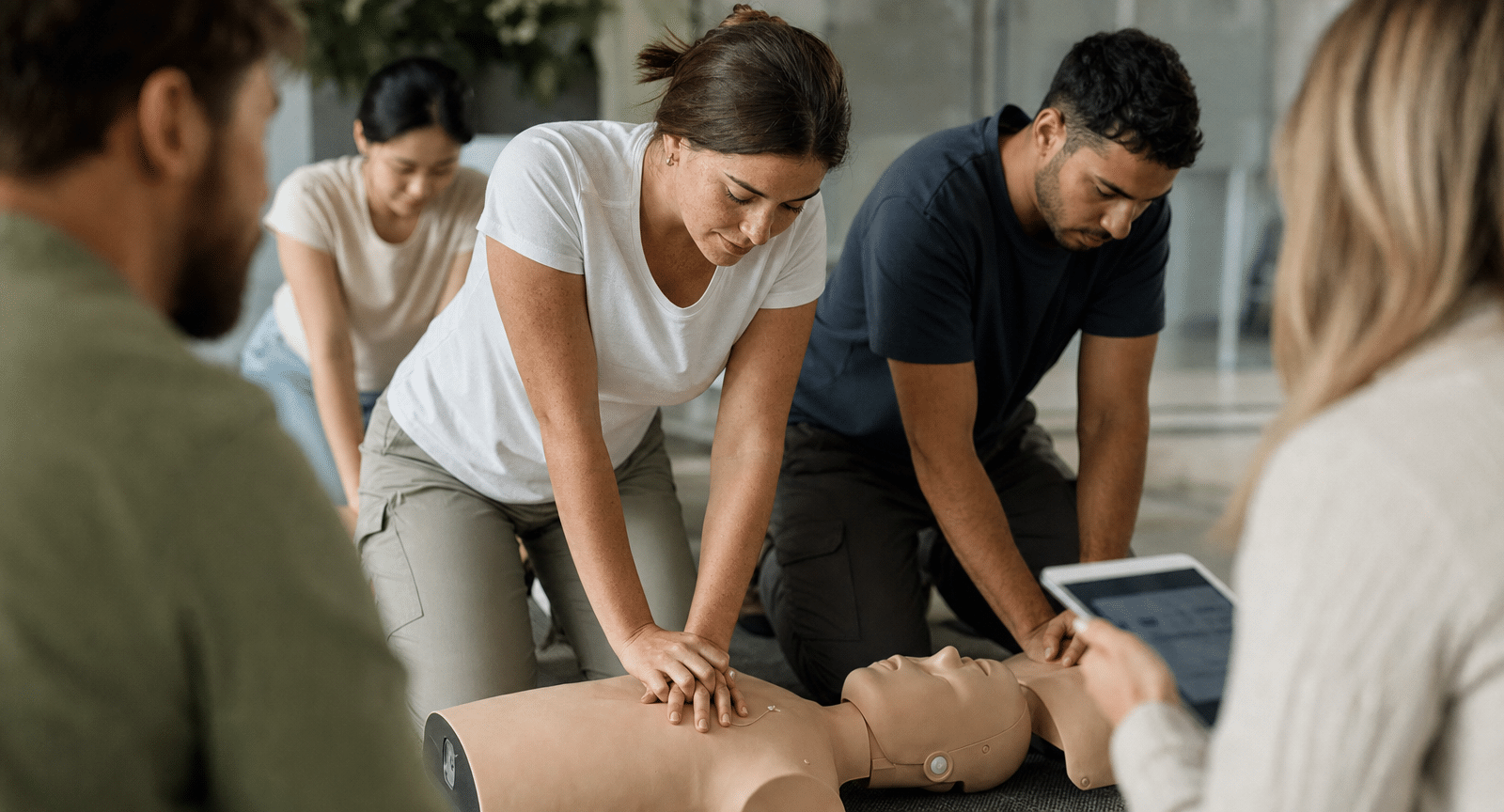
Onsite CPR training is simple: our trainers come to you and run the course at your workplace. You choose a date, we bring the equipment, and your team trains together without leaving the office or site.
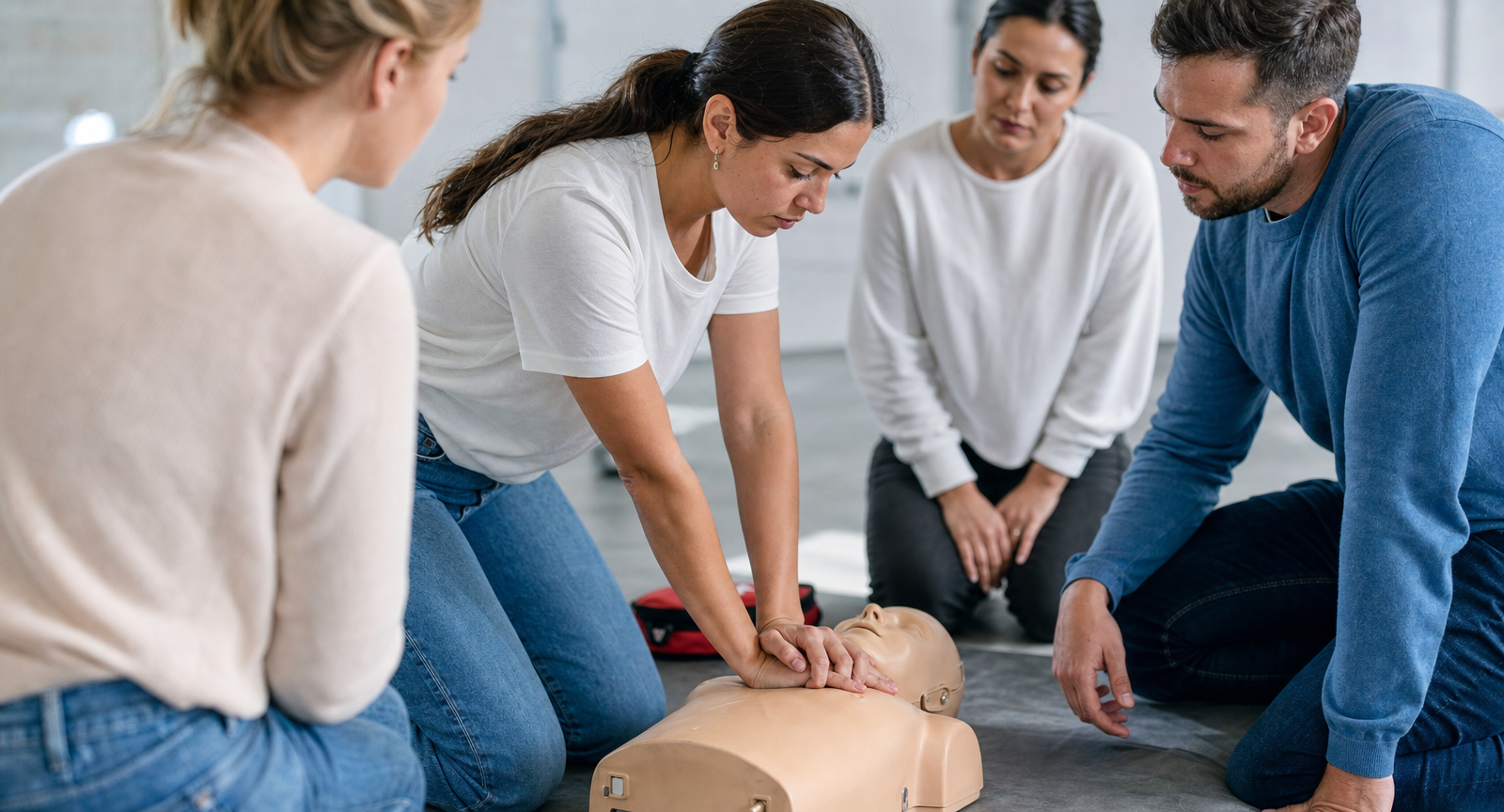
The course is HLTAID009 Provide CPR, a nationally accredited unit delivered under RTO 31124. It is hands-on and practical, so participants practise on manikins rather than watching a screen.
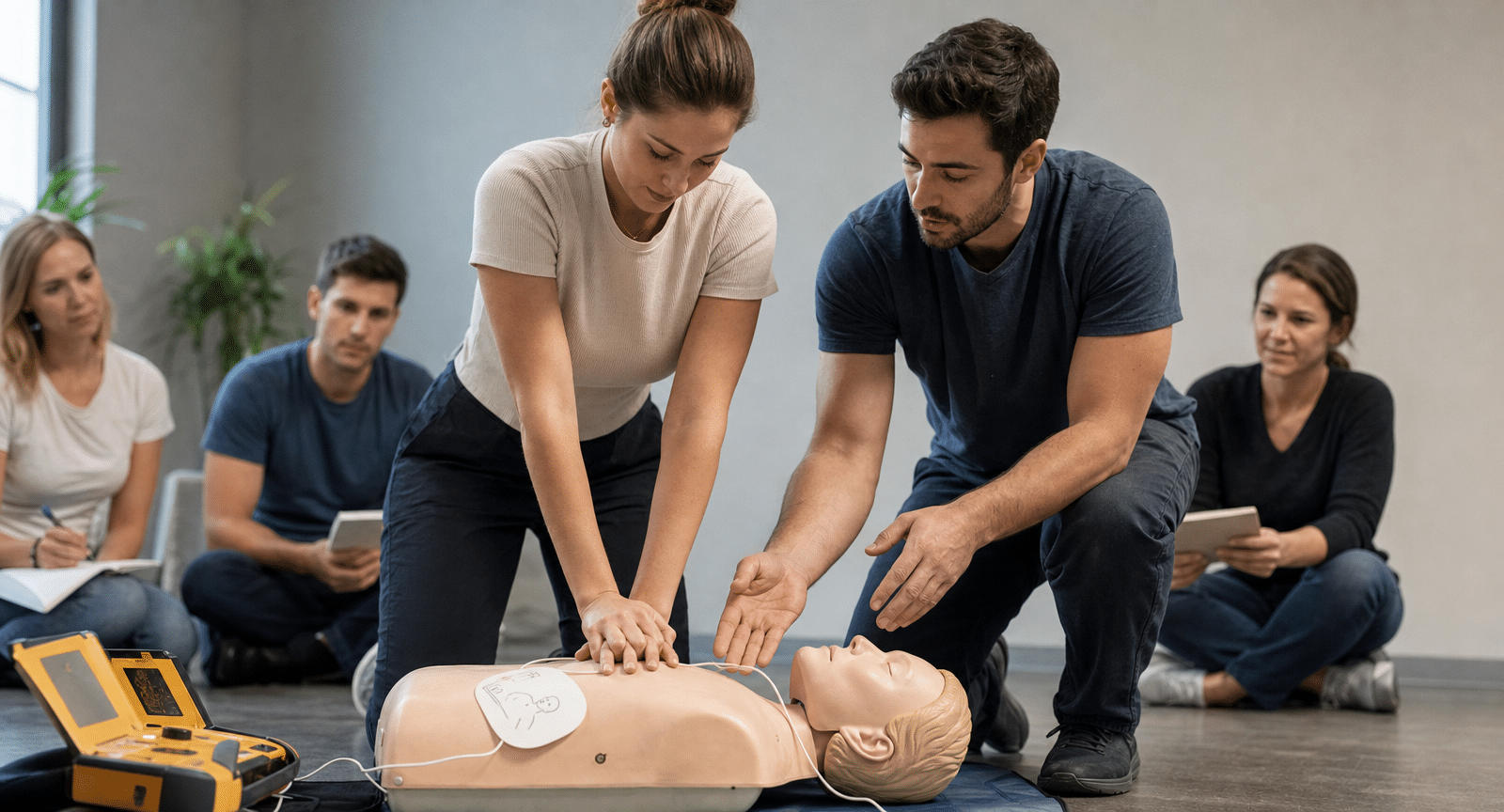
Your team learns the DRSABCD action plan, how to recognise an unconscious casualty, and adult, child and infant CPR. Trainers also cover safe use of an AED (automated external defibrillator) and when to attach it.
The clinical technique follows current guidance. Per ANZCOR Guideline 8, CPR uses a 30:2 compression-to-ventilation ratio for all ages, at 100 to 120 compressions per minute, with minimal interruptions.
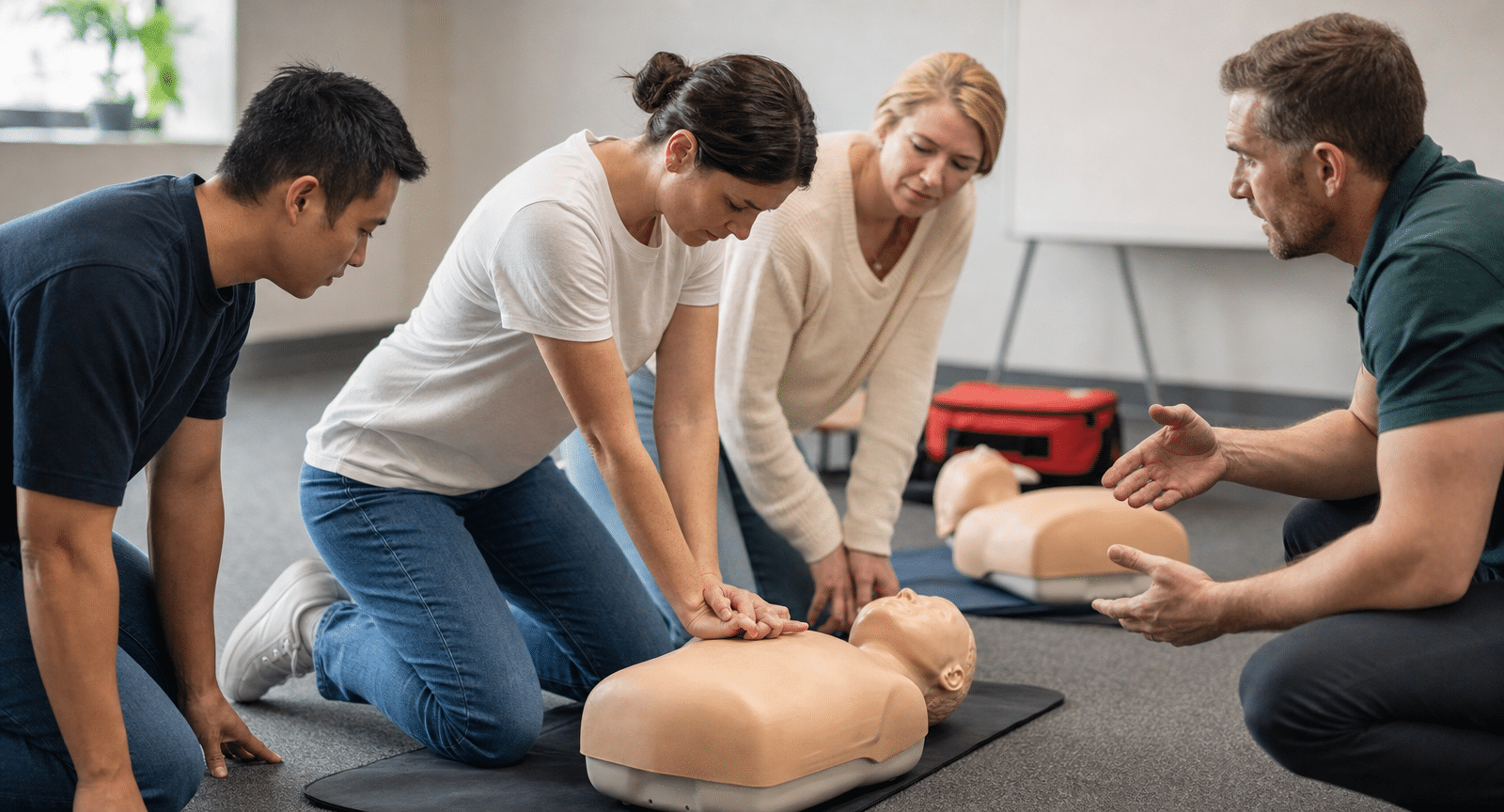
Assessment is practical and completed on the day. Each participant is assessed one-on-one on their compressions, ventilations and AED use, in line with national training standards.
On successful completion, participants receive a nationally recognised Statement of Attainment for HLTAID009, Issued Same Day* (T&Cs Apply). We recommend renewing it annually, in line with Safe Work Australia’s Code of Practice.
Onsite delivery suits groups of roughly 7 to 70 staff. Smaller teams train in a single session, and larger teams split across two or more sessions on the same day or across several days.
How Many Staff Should You Train?
Start with your legal duty, then size the group around it. Under WHS Regulation section 42, a PCBU must ensure an adequate number of workers are trained to provide first aid. It must also provide first aid equipment and facilities.
The number that counts as “adequate” comes from your risk assessment, not a fixed rule. To guide that assessment, Safe Work Australia publishes recommended ratios in its First Aid in the Workplace Code of Practice.
Safe Work Australia recommends the following first aider ratios as a guide:
- One first aider per 50 workers in low-risk workplaces, such as an office.
- One first aider per 25 workers in high-risk workplaces, such as a construction site.
- One first aider per 10 workers in remote high-risk workplaces, such as a mine.
These are recommendations, not legal minimums. They apply per shift, and contractors, subcontractors and volunteers count toward your worker numbers, so plan for the people actually on site.
Keeping first aiders current matters as much as the headcount. The Code of Practice recommends refreshing CPR annually and renewing the full first aid qualification every three years.
There is a clinical reason for the annual CPR refresh. ANZCOR Guideline 10.1 notes that CPR skills can decay within weeks to months without practice, well before longer retraining intervals.
First aiders should also hold a nationally recognised Statement of Attainment from a Registered Training Organisation. Non-accredited certificates do not meet the Code, so confirm your provider is an RTO before booking.
This is where onsite training earns its place. Booking one visit lets you certify a compliant number of staff together, refresh everyone on the same annual cycle, and keep records tidy.

What Onsite CPR Training Costs
Onsite CPR training is usually priced one of two ways, and knowing both helps you compare quotes fairly.
The first model is per person: you pay a set rate for each participant. With First Aid Pro, CPR starts from $45 per person, and the per-head model tends to suit smaller or variable groups.
The second model is a flat group rate, sometimes called a day rate. You pay one price to bring a trainer to your site for a set number of participants. This often works out lower per head for a full group.
Minimum numbers exist because a trainer travels to you and dedicates the session to your team. Reaching the minimum is what makes the per-head cost competitive against sending staff to public classes one at a time.
A few factors move the final quote. The table below shows what to check before you book.
| Cost Factor | What Affects the Price |
|---|---|
| Group size | More participants can lower the cost per person. |
| Delivery day | Weekday sessions are the standard rate. |
| Location and travel | Distance to your site can affect the quote. |
| Weekend or after-hours | These sessions can be arranged and may attract a surcharge. |
We keep two things clear so there are no surprises. Weekend and after-hours sessions can be arranged and may attract a surcharge. Workplace onsite training also carries NO UPFRONT Fees, so you can be invoiced after the session.
For businesses, we support invoice and purchase-order payment. You can see full delivery modes and the per-person entry price on our HLTAID009 Provide CPR course page. Then request an onsite quote for your group.
What Your Workplace Needs to Provide
Onsite CPR training needs a bit of space, and most workplaces already have what is required. Use the checklist below to get the room ready before the day.
- A room that allows about 2m² per participant for manikin practice.
- Clear floor space, because CPR practice is done on the floor.
- Chairs and tables for the short theory component.
- Power access for audio-visual equipment.
- Bathroom access for participants during breaks.
- Parking or site access for the trainer and training gear.
We handle the equipment. Our trainers bring the manikins, AEDs and all training gear, so you only need to provide the room and the people.
If your workplace does not have a suitable space, ask about free use of our training facility (T&C) as an alternative. It is a simple way to run the session without disrupting your floor.
How to Book Onsite CPR Training
Booking is straightforward, and you can have a date confirmed quickly. Follow these steps to arrange training for your team.
- Confirm your headcount and format. Count the staff who need CPR training, from about 7 to 70, and decide on one session or several.
- Request an onsite quote. Use our corporate group training enquiry form or call us with your group size and location.
- Choose a date. Pick a weekday, weekend or after-hours slot, noting that out-of-hours sessions may attract a surcharge.
- Check the room. Confirm your space meets the checklist above, or arrange to use our training facility instead.
- Share participant USIs. Send each participant’s 10-digit Unique Student Identifier (USI) ahead of the session.
- We deliver onsite. Our trainer runs the course at your workplace and assesses each participant one-on-one.
- Receive same-day certificates. Participants who complete the course receive a nationally recognised Statement of Attainment, Issued Same Day* (T&Cs Apply).
Because workplace onsite training carries NO UPFRONT Fees, you can be invoiced after the session rather than paying to lock in a date.
Book Onsite CPR Training for Your Team
Ready to certify your team without the travel? First Aid Pro delivers onsite CPR training Australia-wide, with trainers who bring the equipment to you and certificates Issued Same Day* (T&Cs Apply).
- Book a course or request an onsite quote through our onsite workplace training team.
- Compare delivery modes on the HLTAID009 Provide CPR course page.
- Find a course near you across our 170+ locations nationwide.
With CPR from $45 per person, NO UPFRONT Fees and same-day certification, it is a practical way to keep your workplace compliant and confident. Talk to our team about a date that suits your roster.
*Certificates Issued Same Day (T&Cs Apply). First aider ratios and renewal frequencies cited above are recommendations from the Safe Work Australia model Code of Practice and are applied through state and territory WHS laws; confirm the requirements for your workplace through a risk assessment.
Frequently Asked Questions
How many staff do I need to train in CPR?
Safe Work Australia’s Code of Practice recommends one first aider per 50 workers in low-risk workplaces and one per 25 in high-risk workplaces. Remote high-risk sites are one per 10. Confirm your own number through a workplace risk assessment.
How much does onsite CPR training cost?
Onsite training is priced per person or as a flat group rate. First Aid Pro CPR starts from $45 per person, with NO UPFRONT Fees for workplace onsite training. Weekend and after-hours sessions may attract a surcharge.
What is the minimum and maximum group size for onsite training?
Onsite CPR training suits groups of about 7 to 70 staff. Smaller teams train in one session. Larger teams are split across two or more sessions, on the same day or across several days.
How often does workplace CPR training need to be renewed?
The Safe Work Australia Code of Practice recommends refreshing CPR annually and renewing the full first aid qualification every three years. The annual CPR refresh reflects evidence that skills fade without regular practice.
What space do we need for onsite CPR training?
You need a room that allows about 2m² per participant, with clear floor space for manikin work. Chairs, tables, power and bathroom access help too. Our trainers bring the manikins, AEDs and all training gear.
Is onsite CPR training nationally accredited?
Yes. We deliver HLTAID009 Provide CPR under RTO 31124, and successful participants receive a nationally recognised Statement of Attainment, Issued Same Day* (T&Cs Apply). You can verify accredited units on training.gov.au.
Can you run onsite CPR training on weekends or after hours?
Yes. Weekend and after-hours sessions can be arranged to fit your roster. These out-of-hours sessions may attract a surcharge, so let us know your preferred times when you request a quote.