





Sharon has 21+ years of experience as a qualified Emergency Care Nurse registered with the Australian Health Practitioner Regulation Agency (APHRA) and 12+ years as a First Aid Trainer.
She takes pride in FirstAidPro making first aid training available, comprehensive and affordable to everybody.
Key Takeaways
- CPR currency is legally prescribed at 12 months for childcare, not just recommended, since 1 October 2023.
- Your broader first aid, asthma and anaphylaxis training stays current for 3 years.
- HLTAID012 Provide First Aid in an Education and Care Setting meets all three Regulation 136 obligations in one qualification.
- Currency applies per unit, so your CPR unit lapses first, at 12 months.
- Centre-based and school-based services need at least one qualified person immediately available; every family day care educator must hold the training.
- Renew early, before your 12-month CPR expiry.

What is the Childcare CPR Requirements? Since 1 October 2023, the CPR component of your childcare first aid qualification must be renewed every 12 months to stay current under the Education and Care Services National Regulations. This is now legally prescribed, not an industry recommendation.
That is the answer to the question most educators ask us: “How often do I actually need to renew CPR to stay compliant?” The broader qualification, including first aid, asthma and anaphylaxis, remains current for three years. CPR is the part that lapses first.
This matters for real reasons. Your assessment and rating under Quality Area 2 depends on it, your rostering depends on it, and a child’s survival in a genuine emergency can depend on it. Below we explain the childcare CPR requirements set by ACECQA and Regulation 136, and how HLTAID012 keeps you compliant.
The 12-Month Rule: What Changed On 1 October 2023
CPR currency is now legally prescribed at 12 months for childcare educators. Before this change, annual CPR refreshing was treated as an industry recommendation. From 1 October 2023, the National Regulations prescribe the currency periods directly.
Here is what ACECQA sets out. A first aid qualification is taken to be current if it was attained within the previous three years. The exception is emergency life support and cardiopulmonary resuscitation (CPR) training, which must be completed within the previous year (12 months) to be taken as current.
Approved anaphylaxis management and emergency asthma management training also follow the three-year currency period. So three of your four currency clocks run for three years, and CPR runs for one.
Approved providers had a transitional window until 1 April 2024 to complete any training needed to meet these prescribed timeframes. That deadline has passed, so the rule is now fully in force across every state and territory.
One detail catches many centres out. Currency applies per unit of competency, not to the certificate as a whole. Your HLTAID012 Statement of Attainment can still be inside its three-year window while your CPR unit has already expired.
Is the 12-month CPR rule a legal requirement now? Yes. Source: ACECQA, First aid qualifications and training.

What Regulation 136 Requires
Regulation 136 tells you who on your team must hold current training, and when they must be available. The rule differs depending on your service type, so read the part that matches your setting.
For centre-based services (Regulation 136(1)) and school-based care (Regulation 136(2)), at least one staff member or nominated supervisor must be in attendance and immediately available in an emergency at all times, holding:
- a current approved first aid qualification
- current anaphylaxis management training
- current emergency asthma management training
One person can hold all three qualifications. That is where HLTAID012 becomes efficient, which we cover next.
For family day care (Regulation 136(3)), the bar is higher. Each family day care educator and educator assistant must individually hold all three qualifications, because they often work alone with children.
The phrase “immediately available” does real work here. A single trained educator who is on a break, off the floor, or on an excursion with another group may not count as immediately available for the children who remain. Ratios, rostering and outings all affect whether you actually meet the standard minute to minute.
Our practical advice, backed by years of training centres: train all your staff, not just the minimum. It protects your compliance during breaks and absences, and it means more capable hands in a genuine paediatric emergency. Source: Regulation 136, Education and Care Services National Regulations.

How HLTAID012 Meets Every Requirement
HLTAID012 Provide First Aid in an Education and Care Setting satisfies all three Regulation 136 obligations in a single qualification. Instead of stacking separate courses, one enrolment covers your first aid, anaphylaxis and emergency asthma requirements.
HLTAID012 incorporates three underpinning units: HLTAID009 Provide Cardiopulmonary Resuscitation (CPR), HLTAID010 Provide Basic Emergency Life Support, and HLTAID011 Provide First Aid. On top of these, it adds childcare-specific asthma and anaphylaxis emergency management.
Because it is an ACECQA-approved qualification for education and care settings, it maps cleanly to what Regulation 136 asks of you. That is why we route childcare educators to HLTAID012 rather than a generic first aid course.
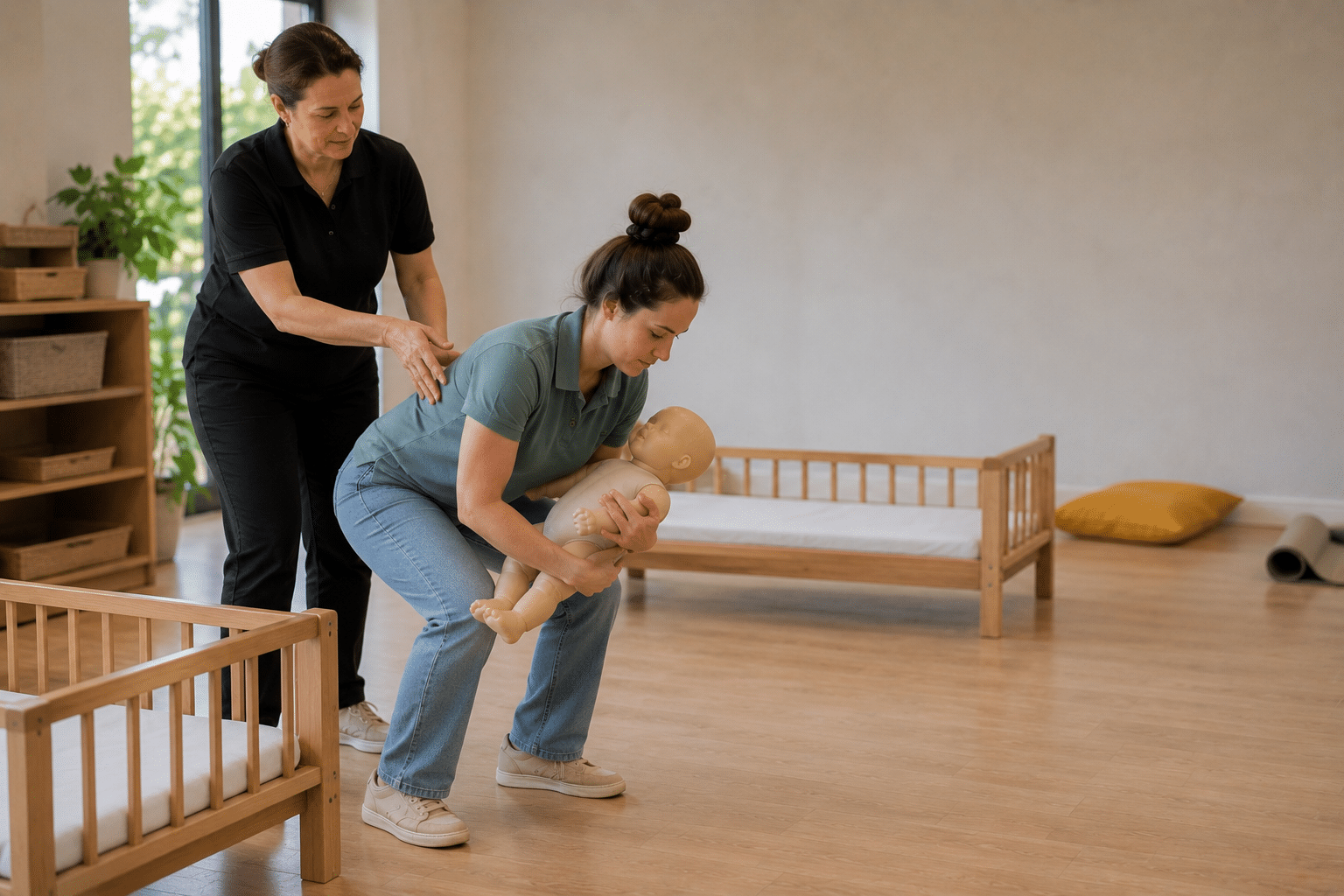
The content is paediatric-specific, which matters when the patient is a toddler rather than an adult. With our trainers, you practise:
- Infant and child CPR on manikins sized for small bodies
- AED use with child pads and correct pad placement
- Choking management for infants and children
- EpiPen administration and emergency asthma response
Completion delivers a nationally accredited Statement of Attainment for HLTAID012, valid for 3 years, with your CPR unit refreshed annually to keep it current. We issue Certificates Issued Same Day* (T&Cs Apply), so you can update your staff training register without waiting.

Renewal Timeline: Keep Your CPR Current
Track two clocks: CPR every 12 months, and your full qualification every 3 years. Here is the currency timeline at a glance.
| Unit / training | Currency period |
|---|---|
| HLTAID009 CPR | Every 12 months |
| HLTAID012 / HLTAID011 first aid | Every 3 years |
| Anaphylaxis management | Every 3 years |
| Emergency asthma management | Every 3 years |
Because currency applies per unit, your CPR lapses first. You can hold a valid HLTAID012 and still be non-compliant if the CPR unit has aged past 12 months.
The annual CPR refresh standard is well established beyond childcare too. The Safe Work Australia First Aid in the Workplace Code of Practice recommends refreshing CPR annually, and ARC Guideline 10.1 goes further, treating annual renewal as a minimum and encouraging more frequent practice to keep skills sharp.
Two habits keep you audit-ready. Keep a staff training register that records each unit’s expiry date, and book renewals a few weeks early so a booked-out week never puts you over the line.
We make renewal easy for busy educators. HLTAID012 is available in four delivery modes: 6-hour face-to-face, blended (online theory plus a 3.5-hour practical), express renewal (online theory plus a 2-hour assessment), and 100% online Zoom (a 2-hour virtual classroom). With venues Australia-wide, from Adelaide and Melbourne to Sydney, Brisbane and Perth, you can renew close to home.

Common Compliance Mistakes To Avoid
Most childcare compliance gaps come from a handful of avoidable assumptions. Check your centre against these.
- Assuming CPR lasts three years like the certificate. It doesn’t. The CPR unit must be renewed every 12 months.
- Relying on a general first aid course alone. HLTAID011 by itself doesn’t cover the education and care setting; you need HLTAID012.
- Counting a trained educator who is off the floor. On a break or with another group is not “immediately available” under Regulation 136.
- Letting the CPR unit lapse mid-cycle. The unit can expire while the rest of your qualification is still current.
- Not checking the ACECQA approved list. Confirm your qualification appears on the approved list before you rely on it.
Get these right and you protect both your assessment rating and, more importantly, the children in your care.
Frequently Asked Questions
How Often Do Childcare Educators Need To Renew CPR?
Every 12 months. Since 1 October 2023, the Education and Care Services National Regulations prescribe that CPR and emergency life support training must be completed within the previous year to be current. ACECQA confirms this shorter currency period applies specifically to the CPR component.
Is The 12-Month CPR Rule A Legal Requirement Or Just A Recommendation?
It is a legally prescribed currency period, not industry advice. The National Regulations, through Regulation 136 and the associated currency rules, require CPR to be renewed within the previous 12 months. This has been enforceable since the transitional deadline of 1 April 2024.
Does HLTAID012 Need To Be Renewed Every Year?
Not entirely. The overall HLTAID012 qualification is current for three years, but its CPR component (HLTAID009) must be refreshed every 12 months. Your certificate can be valid while the CPR unit inside it has expired, so track the CPR date separately.
What First Aid Qualification Do Childcare Workers Need?
An ACECQA-approved qualification that covers first aid, CPR, asthma and anaphylaxis for education and care settings. HLTAID012 Provide First Aid in an Education and Care Setting is the standard choice, because it bundles all these requirements into one nationally accredited course.
Does Every Educator Need First Aid, Or Just One Per Centre?
It depends on your service. For centre-based and school-based care, at least one qualified person must be in attendance and immediately available at all times. For family day care, every educator and educator assistant must hold the training. We recommend training all staff as best practice.
What Happens If My CPR Currency Lapses?
Your CPR unit is no longer current, which can breach Regulation 136 and affect your assessment under Quality Area 2. Practically, it may also leave your centre without a compliant, immediately available first aider. Renew before your 12-month expiry to avoid the gap.
The rule is straightforward once you separate the two clocks. Your CPR must be renewed every 12 months, while your broader HLTAID012 qualification lasts three years, and currency applies to each unit on its own.
HLTAID012 covers all three of your Regulation 136 obligations in one nationally accredited, paediatric-specific course. Keep a training register, renew your CPR early, and confirm your qualification sits on the ACECQA approved list.
If your CPR is due, or you’re not sure when it expires, don’t leave it to chance. Our trainers run childcare courses across Australia, 7 days, with Certificates Issued Same Day* (T&Cs Apply) and first aid from $97 / CPR from $45.
Disclaimer
This article is general information only and is not medical or legal advice. First aid guidance can change. Always confirm current requirements with ACECQA and your state or territory regulatory authority, and complete accredited training with a Registered Training Organisation (First Aid Pro, RTO 31124).