


Sharon has 21+ years of experience as a qualified Emergency Care Nurse registered with the Australian Health Practitioner Regulation Agency (APHRA) and 12+ years as a First Aid Trainer.
She takes pride in FirstAidPro making first aid training available, comprehensive and affordable to everybody.
Father’s Day 2026 in Australia falls on Sunday, 6 September, offering a chance to celebrate dads, grandfathers and father figures — and perhaps give them something more useful than another pair of socks. A nationally recognised first aid course can be a practical Father’s Day gift, teaching skills that may help Dad respond to choking, burns, bleeding, injuries, cardiac arrest and other emergencies at home, at work or out with the family.
There will always be room for the handmade card, breakfast in bed and questionable Dad jokes. But learning first aid is one Father’s Day gift that could continue giving long after 6 September has passed.
Key Takeaways
- Father’s Day 2026 falls on Sunday, 6 September in Australia.
- First aid training can help dads respond more confidently to emergencies involving children, partners, relatives, friends and the wider community.
- HLTAID011 Provide First Aid covers a broad range of common first aid emergencies and includes CPR training.
- HLTAID009 Provide Cardiopulmonary Resuscitation concentrates on CPR and responding to cardiac arrest.
- HLTAID012 Provide First Aid in an Education and Care Setting provides additional training relevant to emergencies involving children and infants and is particularly useful for people working in education and care settings.

Celebrating the Many Roles Dads Play
Being a dad has never been a particularly narrow job description.
On any given weekend, Dad might be cook, chauffeur, sports coach, bicycle mechanic, homework adviser, backyard cricket umpire, spider remover and the person expected to know why the Wi-Fi has stopped working.
He may also be the designated keeper of Dad jokes, a role traditionally undertaken with enthusiasm regardless of audience feedback.
Behind the lighter side of fatherhood, however, is something more important. Fathers and father figures can play a major part in the safety, wellbeing and development of children. They are also sons, brothers, partners, friends, colleagues, neighbours, coaches and community volunteers.
That means knowing first aid is useful well beyond Dad’s own household.
An emergency can happen while he is watching Saturday sport, visiting grandparents, helping a mate renovate, working in the garden or taking the family camping. The person needing help could be his child, partner, workmate or someone he has never met.
First aid training cannot prevent every emergency. What it can do is provide a structured approach to recognising that something is wrong and taking appropriate action until professional medical assistance is available.
And that makes it a rather different kind of Father’s Day present.
Why First Aid Training Makes a Meaningful Father’s Day Gift
Most Father’s Day presents are chosen because Dad will enjoy them.
There is nothing wrong with that. If he wants a new fishing rod, book or BBQ gadget, September may be an excellent time to oblige.
First aid training offers something else: practical knowledge that can be used in everyday life.
A recognised first aid course teaches participants how to assess emergencies and practise responses rather than relying on half-remembered advice from television, social media or something a mate once said.
That matters because first aid recommendations are specific.
Take choking as an example. Current ANZCOR guidance for a severe foreign body airway obstruction uses back blows and chest thrusts, rather than abdominal thrusts. If the obstruction is not relieved and the person remains responsive, first aid involves alternating up to five back blows with up to five chest thrusts, checking after each attempt to see whether the obstruction has cleared.
These are the sorts of skills that are better learned and practised properly than encountered for the first time during an emergency.
For dads who want broader emergency skills, HLTAID011 Provide First Aid is a natural place to start.
When Everyday Family Life Suddenly Becomes a First Aid Situation
Family life provides an impressive number of opportunities for minor mishaps.
Children run, climb, jump and occasionally appear determined to test whether gravity is still operating. Kitchens contain hot surfaces and sharp objects. Garages and sheds contain tools. Backyards contain insects, sporting equipment and enthusiastic DIY projects.
Most days, nothing serious happens. Then there are the days when something does.
When a Child Is Choking
Young children explore their environment, including by putting things into their mouths. Food and small objects can become choking hazards, making recognition of an obstructed airway an important first aid skill for parents and carers.
A child who can cough effectively should generally be encouraged to continue coughing and observed closely. A severe airway obstruction, however, requires an appropriate first aid response.
This is where practical training earns its place.
In an emergency, Dad does not need to be trying to remember a diagram he saw online three years ago. Training allows participants to learn and practise recognised techniques and understand how first aid differs for adults, children and infants.
For fathers of young children — and particularly dads who also work or volunteer in childcare, education or similar settings — HLTAID012 Provide First Aid in an Education and Care Setting provides training specifically focused on emergencies affecting children and infants.

The Great Australian BBQ: Good Food, Bad Dad Jokes and the Occasional Burn
A Father’s Day article would be incomplete without acknowledging Dad’s traditional jurisdiction over the barbecue.
There are many different approaches to BBQ technique, but most dads appear to agree on two rules: clicking the tongs together before cooking is compulsory, and unsolicited advice about the sausages will be treated with suspicion.
Unfortunately, hotplates, flames, boiling liquids and hot cooking equipment also create a risk of burns.
For a thermal burn, ANZCOR recommends removing the person from danger where it is safe to do so and cooling the burn with cool running water for at least 20 minutes as soon as practicable. Ice and ice water should not be used because they can cause further tissue damage.
Significant burns require medical attention, and an ambulance should be called when appropriate.
It sounds straightforward when written on a screen. A real burn, particularly one involving a child, can be distressing. Knowing the recommended first aid response beforehand can make those first few minutes much easier to manage.
When Dad's DIY Project Fights Back
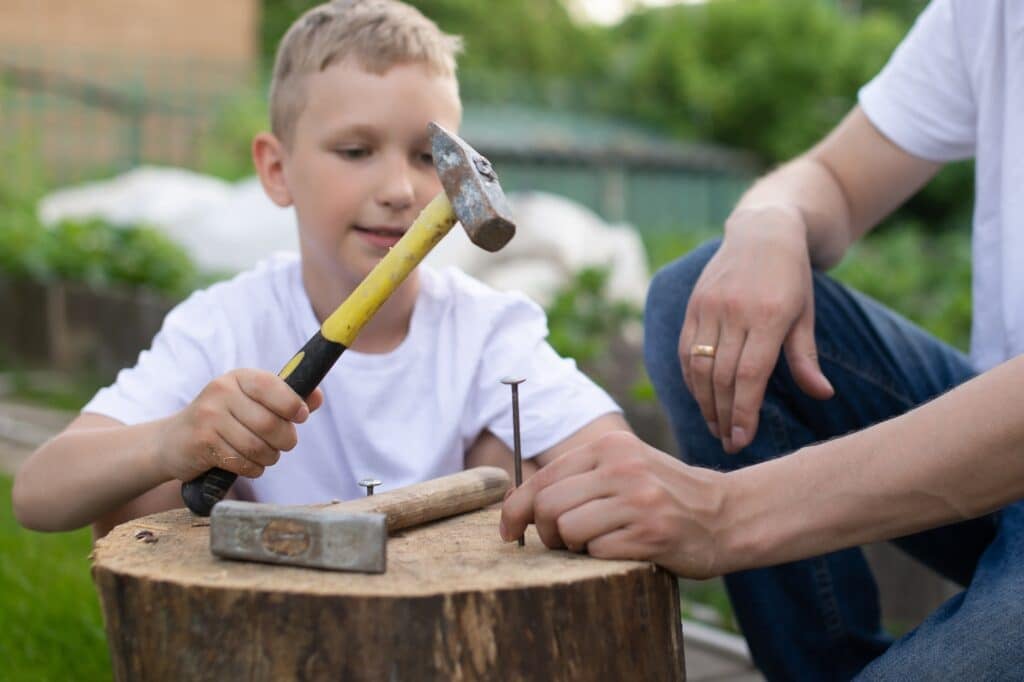
There is something admirable about the optimism with which many dads approach home repairs. Why call someone when there is a perfectly good ladder in the garage and a twelve-minute video explaining the entire job?
DIY projects can, of course, involve genuine hazards. Power tools, sharp edges, ladders, electricity, heavy objects and building materials can cause cuts, bleeding, burns, eye injuries, falls and other trauma.
Knowing first aid does not make unsafe DIY safe. Prevention comes first: use suitable equipment, follow safety instructions and recognise when a job requires a qualified professional.
But when an accident does happen, first aid skills become valuable.
A trained first aider can assess the situation, recognise when emergency assistance is required, manage bleeding and wounds appropriately, and respond to other injuries while professional care is arranged.
Perhaps the best Father’s Day safety advice is still this: first aid training is important, but it should never be regarded as permission to become more ambitious with the power tools.
CPR Is a Skill Every Dad Can Learn
Some emergencies are much more serious than the everyday cut or burn.
Cardiac arrest requires immediate action.
Under current ANZCOR guidance, CPR should be started when a person is unresponsive and not breathing normally. The recommended compression-to-ventilation ratio is 30 compressions to two breaths, with chest compressions performed at approximately 100–120 per minute. An automated external defibrillator (AED) should be used as soon as one becomes available.
Early, high-quality CPR saves lives.
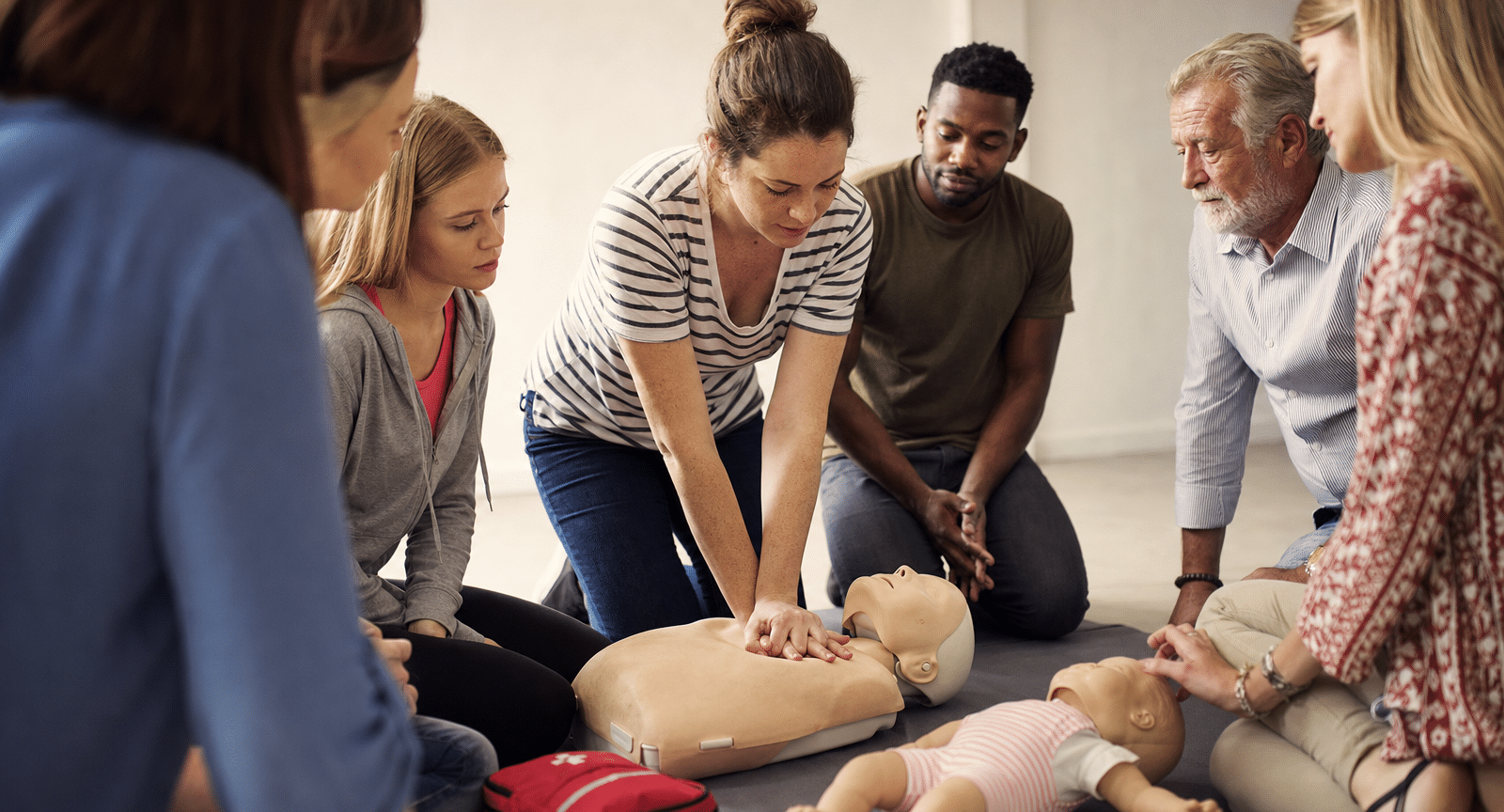
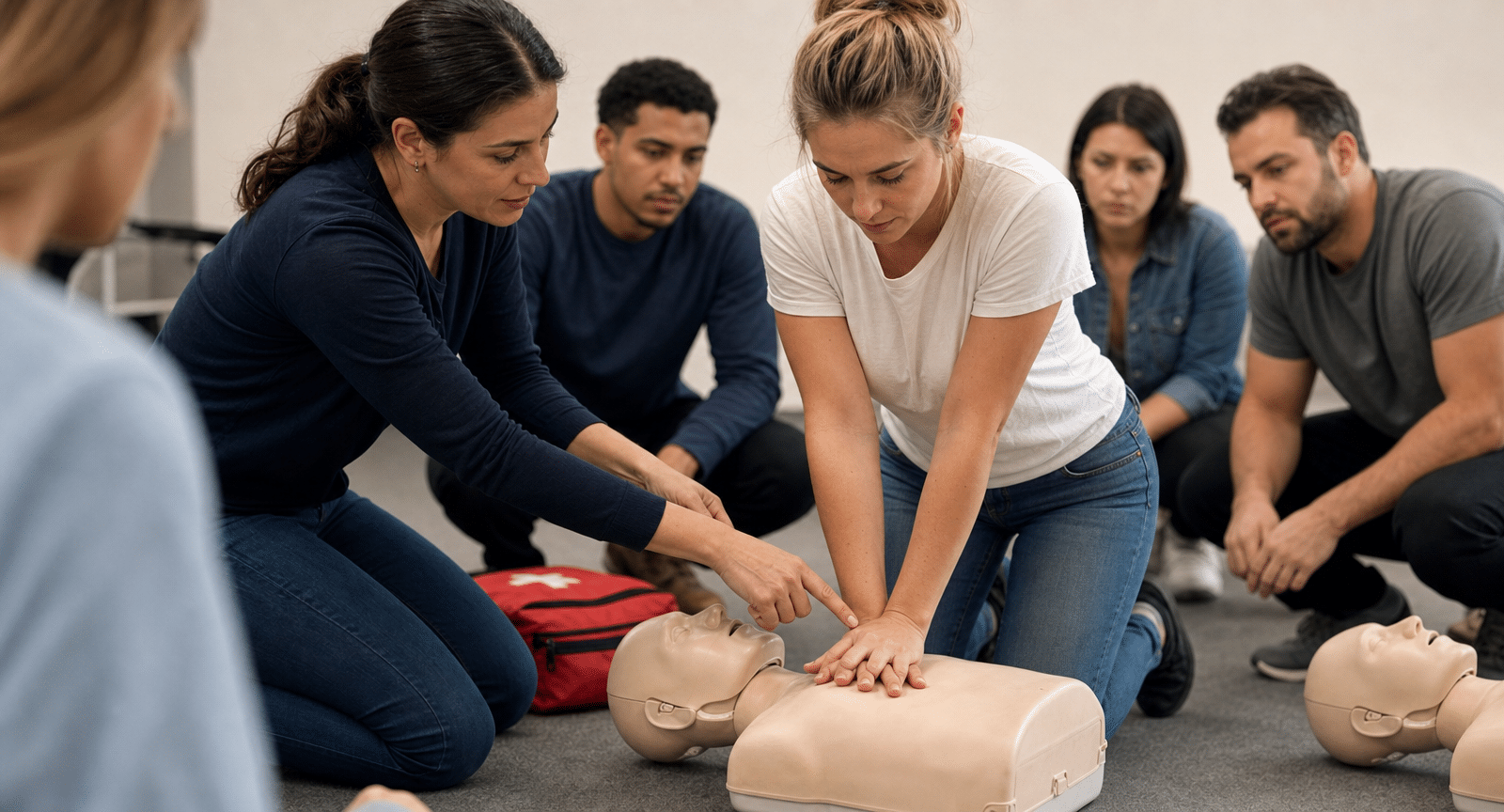
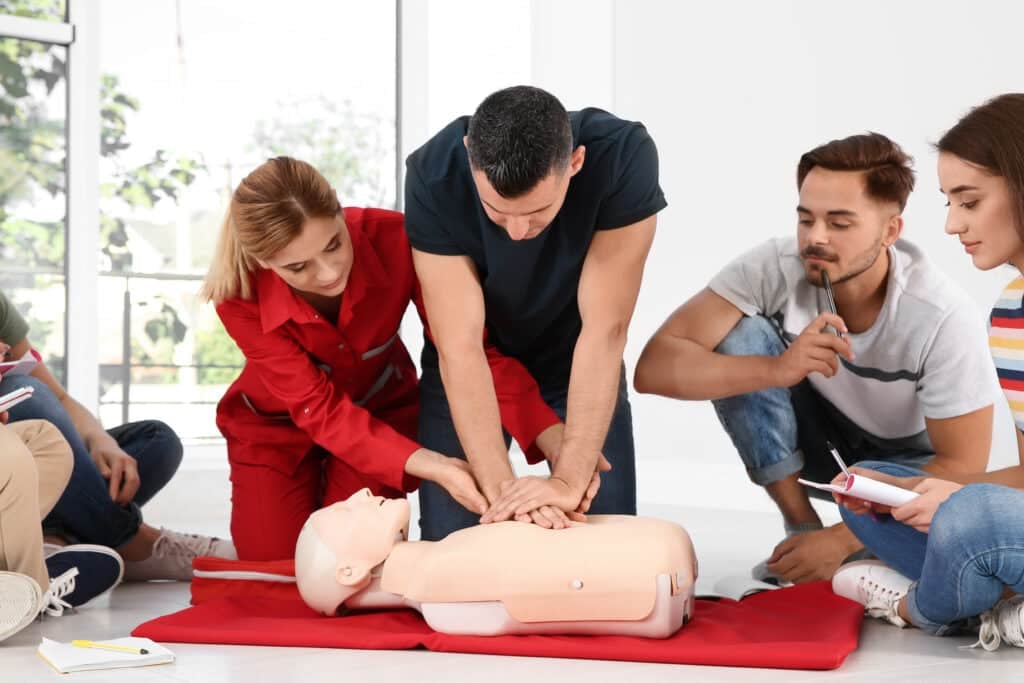
For someone who has never practised CPR, however, the thought of performing it on another person can be daunting. Training provides an opportunity to learn the sequence, practise chest compressions and rescue breaths and become familiar with AED operation in a controlled environment.
HLTAID009 Provide Cardiopulmonary Resuscitation is therefore a particularly practical option for a dad who wants to learn or refresh CPR skills.
It is a modest investment of time for a skill that could become enormously important.
Which First Aid Course Would Suit Dad?
Not every dad needs exactly the same training, so the best Father’s Day course depends on what you would like him to learn.
HLTAID009 Provide Cardiopulmonary Resuscitation
HLTAID009 Provide Cardiopulmonary Resuscitation is the focused option for learning CPR.
Training includes recognising when CPR is required, performing CPR and using an AED. It can suit dads who want this core emergency skill or who need to maintain CPR competency for employment or another role.
The Australian Resuscitation Council recommends refreshing CPR skills at least annually, making this an especially useful option for someone whose previous CPR training is due for renewal.
HLTAID011 Provide First Aid
For a broader range of skills, HLTAID011 Provide First Aid is likely to be the most versatile Father’s Day choice.
The nationally recognised course incorporates CPR and covers responses to a variety of injuries and medical emergencies. That makes it relevant not only at home but also in workplaces, sport, travel and community settings.
For a new dad, it can provide useful preparation for the unexpected. For an experienced dad whose children are now teenagers or adults, the skills remain just as relevant — emergencies do not disappear when the kids grow up.
HLTAID012 Provide First Aid in an Education and Care Setting
HLTAID012 Provide First Aid in an Education and Care Setting has a more specialised focus.
It is designed for people providing first aid in education and care environments and includes child- and infant-specific emergency response, including CPR, asthma, anaphylaxis and choking.
It is especially relevant for dads who work in childcare, schools, outside school hours care or other regulated education and care services. Parents of young children may also find the child-focused content particularly appealing, although workplace requirements should always be checked when a qualification is needed for employment.
First Aid Isn't Just About Protecting Your Own Family
There is another reason first aid training fits comfortably with the spirit of Father’s Day.
The skills travel with you.
Dad does not leave his first aid knowledge in a cupboard beside the Father’s Day card. He takes it to work, children’s sporting events, family gatherings, holidays and community activities.
A trained parent standing beside a junior football field may one day be the person who knows what to do when somebody is injured. A dad at a family gathering may recognise that a relative is experiencing a medical emergency. Someone who has practised CPR may be better prepared to act if a stranger collapses nearby.
First aid is ultimately a community skill.
The more people who know how to recognise emergencies and provide appropriate assistance, the greater the chance that someone nearby can begin helping while an ambulance is on its way.
Make First Aid Part of Family Preparedness
Training is even more useful when it forms part of broader preparation at home.
Families should know where their first aid kit is kept and ensure it remains accessible. Supplies should be checked periodically, used or expired items replaced, and contents adapted to the household’s needs.
Parents should also know where important medications and emergency action plans are kept where applicable.
Emergency preparation can extend beyond the house. A suitable first aid kit in the car can be useful during road trips, sport, camping and family outings.
Most importantly, first aid knowledge needs to remain current.
Skills fade when they are not used. The Australian Resuscitation Council recommends that CPR skills be refreshed at least annually, while First Aid – HLTAID011 and HLTAID012 qualifications – are generally renewed every three years, subject to any workplace or industry requirements.

A Father's Day Present With a Longer Shelf Life
Father’s Day gifts do not need to be profound.
Sometimes Dad really does want the socks.
But Father’s Day is also an opportunity to recognise something easy to overlook: the enormous amount of everyday care that fathers and father figures provide.
It happens in school drop-offs and late-night pickups. It happens beside sporting fields, over homework, around dinner tables and during countless ordinary weekends. It includes the new dad learning how to hold a tiny baby and the grandfather still being asked to fix things decades after his own children left home.
First aid training fits naturally into that story because it is fundamentally about being willing and able to help.
This Father’s Day, consider giving Dad something he can carry with him long after the wrapping paper has disappeared.
Explore First Aid Pro’s nationally recognised first aid courses and choose training that suits the dad, grandfather or father figure in your life.
You can still buy him the BBQ tongs. Just don’t be surprised when he clicks them twice.
Related Reading
- DadFinds – Father’s Day 2026 Gifts Ideas
- First Aid Pro – Free First Aid Resources – Charts and Posters
FAQs
When is Father’s Day 2026 in Australia?
Father’s Day falls on Sunday, 6 September 2026. In Australia, Father’s Day is observed on the first Sunday in September.
Is a first aid course a good Father’s Day gift?
A first aid course can be an especially practical gift because the skills may be useful at home, at work and in the community. Training can help dads learn how to respond to emergencies such as choking, burns, bleeding, injuries and cardiac arrest rather than relying on unverified or outdated first aid advice.
Which first aid course is best for dads?
For broad first aid knowledge, HLTAID011 Provide First Aid is a useful choice because it covers CPR along with a range of common medical emergencies and injuries. Dads primarily interested in CPR can consider HLTAID009, while HLTAID012 offers specialised training for education and care settings with an additional focus on emergencies involving children and infants.