



Sharon has 21+ years of experience as a qualified Emergency Care Nurse registered with the Australian Health Practitioner Regulation Agency (APHRA) and 12+ years as a First Aid Trainer.
She takes pride in FirstAidPro making first aid training available, comprehensive and affordable to everybody.
Key Takeaways
- Both accredited Baby CPR Courses for Parents and non-accredited workshops teach real, valuable baby CPR skills — the difference is the credential and its recognition.
- An accredited HLTAID009 Provide CPR course gives you a nationally recognised Statement of Attainment (valid 12 months) from approximately $45 — roughly half the price of a typical workshop.
- HLTAID012 Provide First Aid in an Education and Care Setting adds full childcare first aid (choking, anaphylaxis, asthma), is valid for 3 years, and is ACECQA-approved.
- Workshops (approximately $108–$130) are relaxed, baby-friendly environments great for building confidence, but they issue a certificate of attendance only — not a nationally recognised credential.
- Refresh your CPR skills every 12 months (Safe Work Australia).
Related reading: HLTAID009 Provide CPR course, our infant CPR guide
Introduction
As a new parent, you’ve probably seen both “baby CPR workshops” and “accredited CPR courses” advertised in your social feeds and local community groups. Both promise to teach you how to respond if your baby stops breathing — so which one should you actually book?
This guide helps you make that decision. We’re not here to say one teaches better skills than the other; both can be excellent, and any step toward learning baby CPR is a positive one. The real question is: what do you actually need? If you want confidence and knowledge for peace of mind, a quality workshop may suit you perfectly. If you want (or may need) a nationally recognised certificate — for work, volunteering, or simply the reassurance of a verifiable credential — an accredited course is the way to go.
We’ll walk you through exactly what each option gives you, what they cost, and how to decide which is right for your situation.
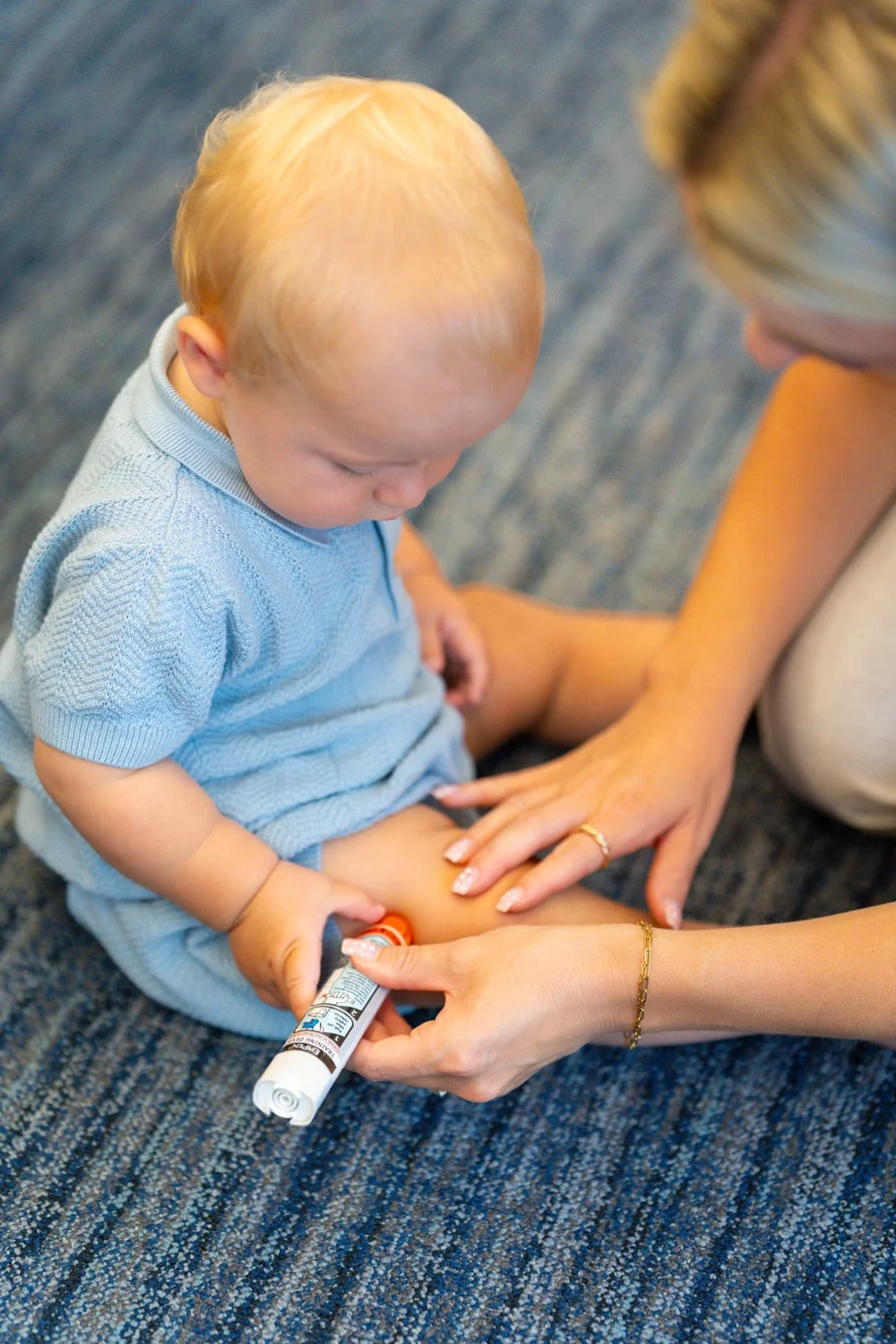
Workshop vs Accredited Course — The Quick Decision
Let’s get straight to the decision framework.
Non-accredited baby CPR workshop:
- Relaxed, baby-friendly environment (babies and breastfeeding often welcome)
- Led by experienced paediatric nurses or paramedics
- Issues a certificate of attendance (not on the national register)
- Great for building confidence and practical knowledge
- Price: approximately $108–$130
Accredited CPR course (HLTAID009):
- Nationally recognised Statement of Attainment with unit code
- Verifiable by employers and regulators (ASQA/AQF)
- Covers adult, child and infant CPR, DRSABCD, and AED use
- Price: from $45
- Valid for 12 months
The decision driver: Do you only want confidence and knowledge, or do you also need a recognised certificate? If you’re a stay-at-home parent with no workplace or volunteering requirements, a workshop may be enough. If you work with children, volunteer, employ a nanny or au pair, or simply want a credential that appears on the national register, an accredited course gives you that.
| Feature | Workshop | HLTAID009 Accredited |
|---|---|---|
| Credential | Certificate of attendance | Statement of Attainment |
| National register | No | Yes |
| Employer/regulator accepted | No | Yes |
| Typical price | $108–$130 | From $45 |
| Validity | N/A | 12 months |
What a Non-Accredited Baby CPR Workshop Gives You
Baby CPR workshops are designed with new parents in mind. They’re typically run by experienced paediatric nurses in relaxed settings — often hospitals, community centres, or even private homes. Babies are usually welcome, and the atmosphere is informal and supportive.
You’ll learn practical skills: how to perform infant CPR, what to do if your baby is choking, and how to stay calm in an emergency. Many workshops include take-home resources like wall charts and quick-reference guides.
What you receive: A certificate of attendance or completion. This confirms you attended the session, but it is not a nationally recognised qualification and does not appear on the national training register.
Market examples:
- CPR Kids: $115 + GST (approximately 3 hours 15 minutes)
- Tiny Hearts Education: $108 online; $160 per person for private in-home sessions
- Emergcare: $130 (approximately 3 hours 15 minutes)
These providers offer valuable, confidence-building training. The key point is that their parent workshops are non-accredited by design — CPR Kids’ own FAQ confirms their parent classes are “NOT Nationally Recognised Training.” This is the industry norm for parent-focused workshops, not a shortcoming.
If you want knowledge and confidence and don’t need a recognised credential, a quality workshop is a worthwhile investment.
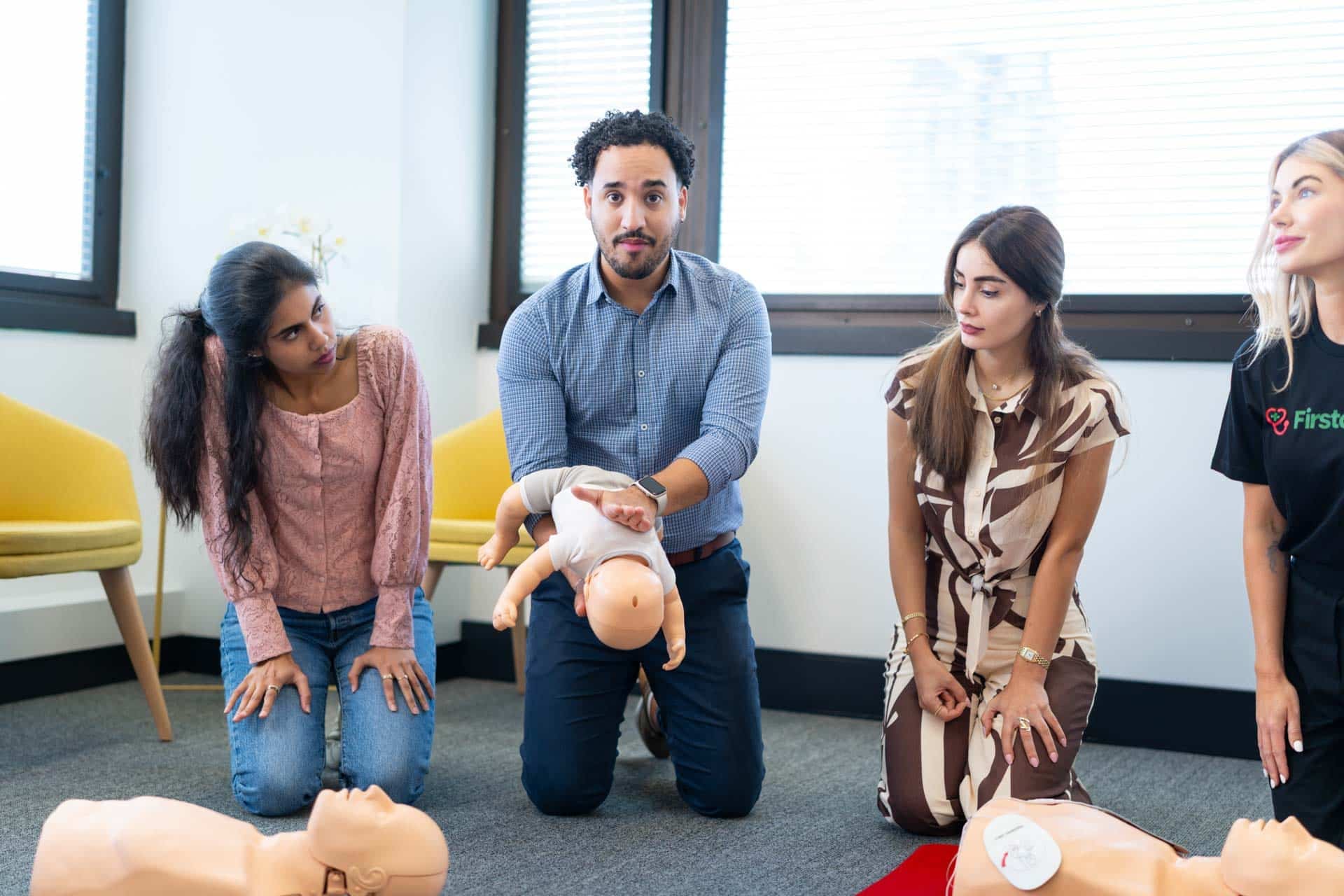
What an Accredited Baby CPR Course Gives You
An accredited course delivers a nationally recognised Statement of Attainment — a credential that employers, regulators and childcare providers can verify on the national training register.
HLTAID009 Provide CPR covers:
- Adult, child and infant CPR
- The DRSABCD action plan
- Using an automated external defibrillator (AED)
- Duration: approximately 2 hours
- Price: from $45
- Validity: 12 months
The Statement of Attainment carries the unit code (HLTAID009) and is issued by a Registered Training Organisation. This means it meets the Australian Qualifications Framework (AQF) standards and is verifiable by ASQA. A certificate of attendance from a non-accredited workshop does not have a unit code and cannot be verified in the same way.
Why does this matter? If you need to demonstrate CPR competency to an employer, a childcare centre, or a regulatory body, only a Statement of Attainment will be accepted. It’s also the credential you’ll need if you’re hiring a nanny or au pair and want proof they’re trained.
At FirstAidPro, we offer HLTAID009 in four delivery modes:
- Traditional 2-hour face-to-face
- Blended (online theory + practical)
- Express
- 100% Zoom
We run courses across 170+ locations Australia-wide. Certificates Issued Same Day* (T&Cs Apply).
Going Further — HLTAID012 Childcare First Aid for Parents
If you want the most comprehensive paediatric first aid training available, HLTAID012 Provide First Aid in an Education and Care Setting is worth considering.
This course is designed for education and care workers — childcare educators, nannies, au pairs, and school staff — but it’s open to parents who want the fullest skill set. It covers everything in HLTAID009, plus:
- Choking response for infants and children
- Anaphylaxis management
- Asthma emergency response
- Febrile convulsions
- HLTAID010 and HLTAID011 content
Validity: 3 years (compared to 12 months for HLTAID009)
ACECQA-approved: Meets the requirements for educators in early childhood education and care settings. HLTAID012 appears on the ACECQA list of approved first aid qualifications.
Price: Approximately $115–$145 — broadly comparable to a workshop, but you receive a 3-year nationally recognised credential rather than a certificate of attendance.
HLTAID012 is a strong choice if you want peace of mind that you’re prepared for a wider range of paediatric emergencies, or if you may work or volunteer with children in the future.
Price and Value Compared
Here’s an honest look at what each option costs and what you get:
| Option | Price | Credential | Validity |
|---|---|---|---|
| Workshop (e.g., CPR Kids, Tiny Hearts) | Approximately $108–$130 | Certificate of attendance | N/A |
| HLTAID009 Provide CPR | From $45 | Statement of Attainment | 12 months |
| HLTAID012 Childcare First Aid | Approximately $115–$145 | Statement of Attainment | 3 years |
The value insight:
HLTAID009 at $45 is roughly half the price of a typical workshop ($108–$130), and it gives you a nationally recognised credential.
HLTAID012 is comparable in price to workshops, but delivers a 3-year recognised credential with broader paediatric coverage. For the same investment as a workshop, you can hold a Statement of Attainment that employers and regulators will accept.
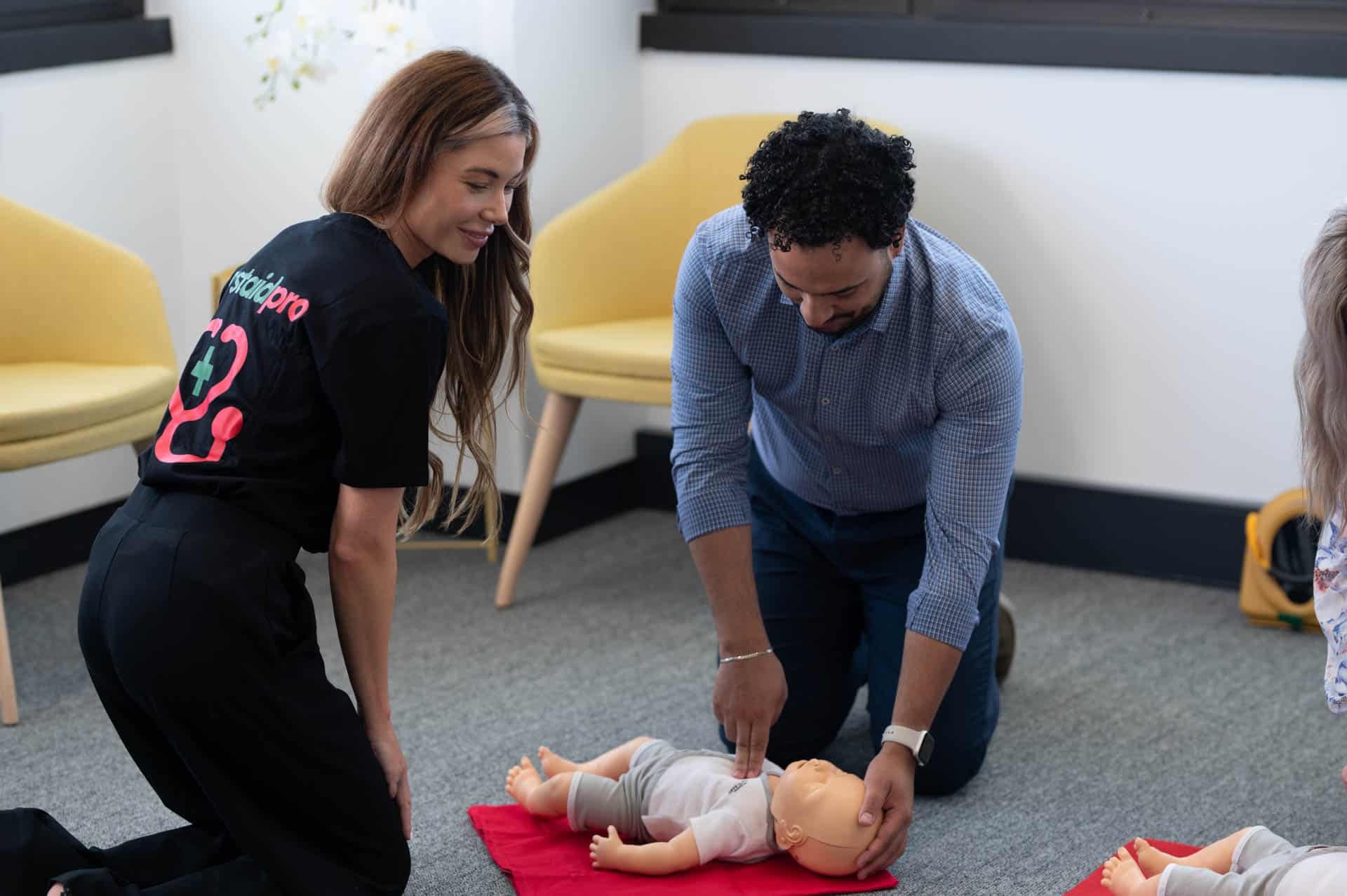
How Baby CPR Actually Works
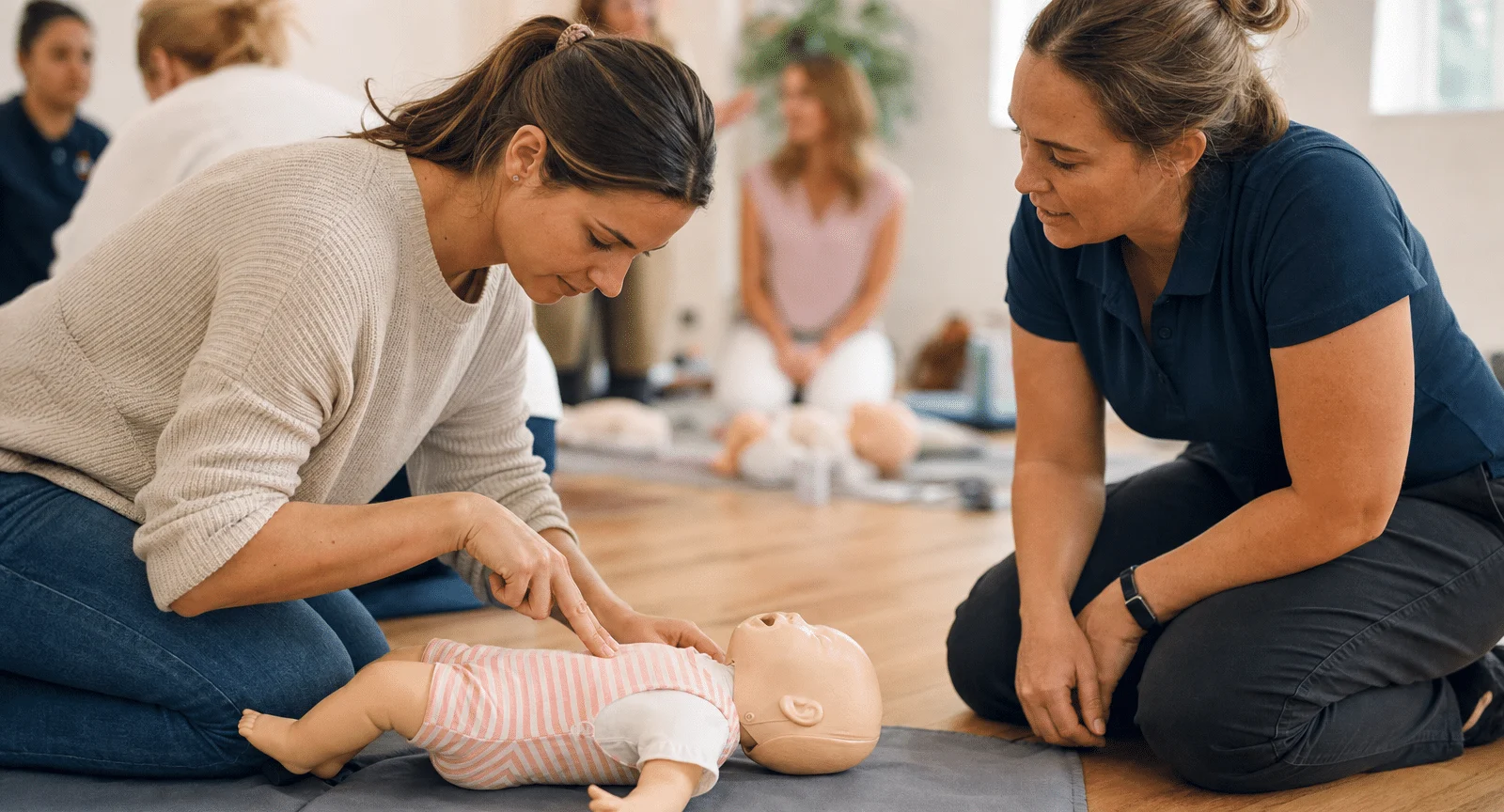
Knowing the steps matters, but reading is no substitute for hands-on training. Here’s a quick overview of infant CPR technique based on ANZCOR guidelines (lay-rescuer/basic life support):
- Check for danger — Make sure the area is safe for you and the baby.
- Check for response — Gently tap the baby’s foot and call their name. If no response, call for help.
- Call 000 — Ask someone to call emergency services, or do it yourself on speakerphone.
- Open the airway — Tilt the head back gently to a neutral position.
- Give rescue breaths — Seal your mouth over the baby’s mouth and nose. Give 2 breaths, watching for chest rise.
- Start compressions — Use the two-finger technique in the centre of the chest. Compress to one-third of chest depth (approximately 4 cm).
- Ratio and rate — 30 compressions to 2 breaths. Compress at a rate of 100–120 compressions per minute.
- Continue — Keep going until emergency services arrive or the baby responds.
This is a summary only. To build real competency, you need to practise on a manikin with a qualified trainer who can correct your technique.
For a full step-by-step guide, see our child and infant CPR guide or our CPR for babies overview. For trusted parent-facing guidance, the Raising Children Network also outlines infant CPR steps.
How Often Should You Refresh?
CPR skills fade faster than most people expect. That’s why Safe Work Australia recommends refreshing your CPR training every 12 months. First aid qualifications should be renewed every 3 years (see this Queensland Government summary).
ACECQA applies the same standard for educators in early childhood settings.
This applies whether you’ve done a workshop or an accredited course. The difference is that an accredited course gives you a dated Statement of Attainment, making it easy to track when your next refresh is due.
Regular practice matters. Even outside formal training, reviewing the steps and practising on a manikin (if you have access to one) helps keep your skills sharp.
Our Recommendation for Parents
There’s no single “right” answer — it depends on what you need.
If you want confidence and knowledge only: A quality workshop is a worthwhile step. Providers like CPR Kids, Tiny Hearts and Emergcare offer relaxed, baby-friendly sessions that teach real skills. You’ll leave feeling more prepared, even without a formal credential. We also run relaxed, non-accredited group sessions for parents.
If you want a recognised certificate at great value: Book an HLTAID009 Provide CPR course. From $45, you’ll receive a nationally recognised Statement of Attainment — valid for 12 months and verifiable by employers and regulators.
If you want the complete paediatric skill set: Consider HLTAID012 Provide First Aid in an Education and Care Setting. It’s open to parents, covers a wider range of emergencies, and is valid for 3 years. It’s especially relevant if you may work or volunteer with children.
Whatever you choose, learning baby CPR is one of the most valuable things you can do as a parent.
Book a course or find a course near you.
FAQ
Do Parents Need an Accredited Baby CPR Course?
There’s no legal requirement for parents to hold an accredited CPR certificate. A workshop will build your confidence and teach you practical skills. However, an accredited HLTAID009 course gives you a nationally recognised Statement of Attainment — a credential that is verifiable by employers and regulators through the ASQA/AQF framework. If you want proof of your training that can be independently verified, an accredited course provides that.
What’s the Difference Between a Baby CPR Workshop and an Accredited Course?
A baby CPR workshop issues a certificate of attendance or completion. This confirms you participated, but it has no unit code and does not appear on the national training register. An accredited course issues a Statement of Attainment with a nationally recognised unit code (such as HLTAID009). This credential is recorded on the national register and can be verified by employers, childcare centres and regulatory bodies.
How Much Does a Baby CPR Course Cost in Australia?
Non-accredited workshops typically cost between $108 and $130 per person. Accredited HLTAID009 Provide CPR courses start from approximately $45. HLTAID012 Provide First Aid in an Education and Care Setting ranges from approximately $115 to $145, depending on the provider and delivery mode.
How Often Should I Refresh Baby CPR?
Safe Work Australia recommends refreshing CPR skills every 12 months. First aid qualifications should be renewed every 3 years. These intervals apply whether you’ve completed a workshop or an accredited course — CPR skills fade over time, and regular practice keeps you prepared.
Is HLTAID012 Suitable for Parents?
Yes, HLTAID012 is open to parents. It is designed for education and care workers (childcare educators, nannies, teachers), but any parent who wants the fullest paediatric first aid training can enrol. It covers infant and child CPR, choking, anaphylaxis, asthma and more. The credential is valid for 3 years and is ACECQA-approved.
Can I Learn Baby CPR Online?
You can complete the theory component online through Blended or 100% Zoom delivery modes. However, to receive a nationally recognised Statement of Attainment, you must complete a trainer-assessed practical component. This ensures you can actually perform CPR correctly — not just understand the theory. Fully online courses that issue accredited certificates still require a practical assessment, either in person or via live video with a qualified assessor.
Conclusion
Choosing between a baby CPR workshop and an accredited course comes down to what you need. Workshops offer a relaxed, supportive environment to build confidence and learn practical skills. Accredited courses like HLTAID009 and HLTAID012 give you a nationally recognised credential that employers and regulators can verify.
Both options teach real, valuable skills. Any step you take toward learning baby CPR makes you better prepared to help your child in an emergency.
If you’re ready to get certified, we’d love to help. Our HLTAID009 and HLTAID012 courses run across 170+ locations Australia-wide, with flexible delivery options and same-day certificates.
Disclaimer
This article provides general information only and is not a substitute for professional medical advice or hands-on first aid training. To build real competency in CPR, you must complete practical training with a qualified trainer. In an emergency, always call 000.