




CPR For Pregnant Women
CPR For Pregnant Woman: What You Need To Know
Two lives at stake – one critical adjustment. Learn the ANZCOR-aligned technique for performing CPR on a pregnant person, including when and how to apply left lateral tilt and manual uterine displacement.
Why CPR Techniques Change For Pregnant Women
Why CPR During Pregnancy Requires a Different Approach
Pregnancy changes the body in ways that directly affect CPR. From approximately 20 weeks gestation, one anatomical change makes standard technique significantly less effective.
By around 20 weeks, the growing uterus is large enough to press on the major blood vessels running behind it — the inferior vena cava and aorta — when the person lies flat on their back. This compression reduces the blood returning to the heart, which limits how effective chest compressions can be even when performed correctly
~20
wks
ANZCOR Guideline 12.6 — Resuscitation in Pregnanc

Two adjustments address this. Every other element of CPR — compression rate, depth, rescue breathing ratio — follows the standard adult protocol.
Adjustment 1 — Position
Tilt the body 15 to 30 degrees toward the left so the uterus shifts away from the blood vessels underneath. Use a firm wedge, rolled jacket, or any stable object under the right side.
Adjustment 2 — Two rescuers
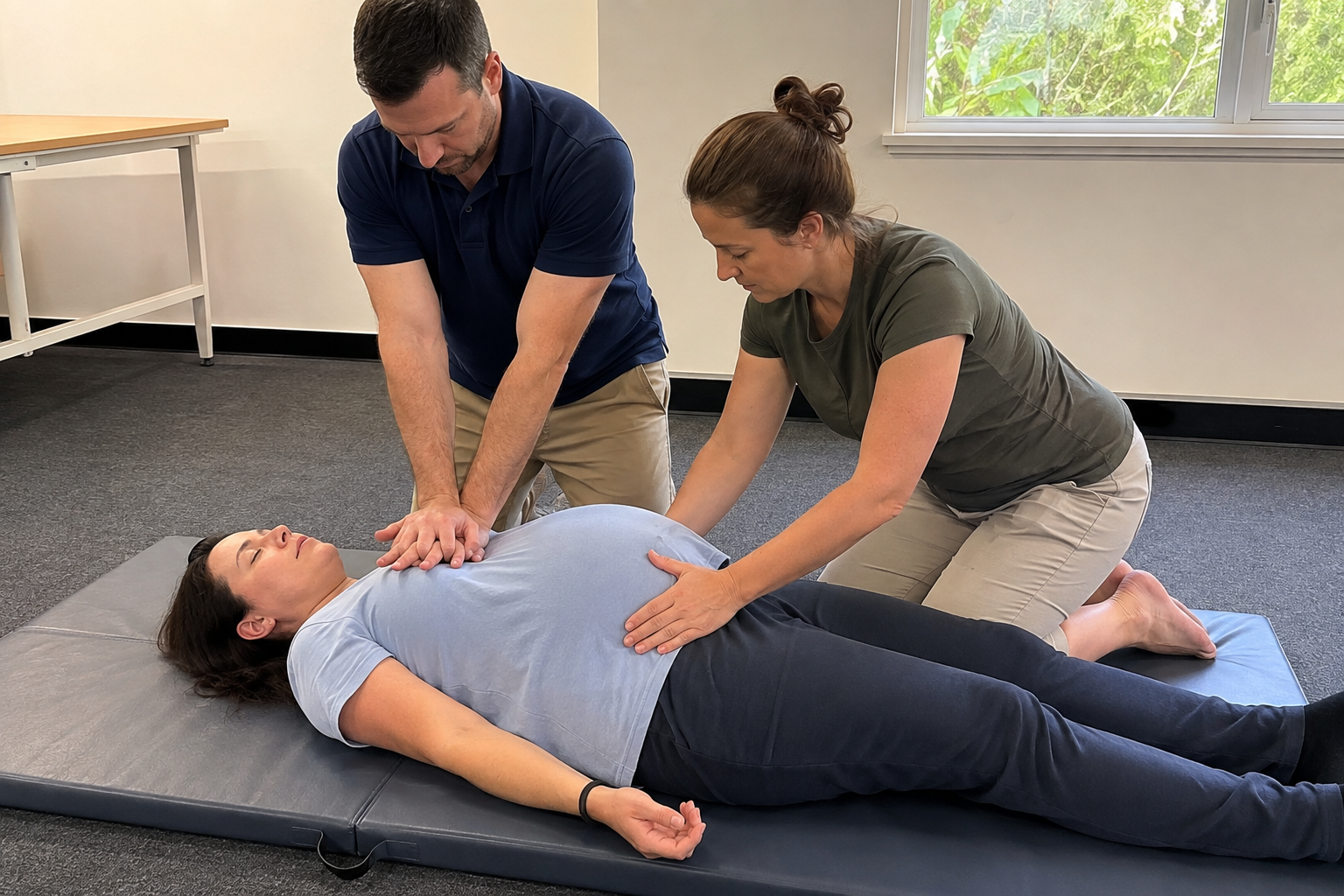
If no wedge is available, a second rescuer pushes the uterus firmly to the left while compressions continue on a flat surface. This achieves the same relief without tilting the person.
Additional consideration
Pregnancy slows gastric emptying and relaxes the lower oesophageal sphincter, increasing aspiration risk significantly. Careful airway technique and a firm mouth seal matter more than in standard CPR.
CPR Steps For Pregnant Woman
ANZCOR Guideline 11.10: Resuscitation in Special Circumstances - Pregnancy
ANZCOR publishes dedicated guidance for cardiac arrest during pregnancy. Here is what it specifies for community responders.
Tilt from
~20 wks
When uterus compresses IVC
Tilt angle
15–30°
Left lateral displacement
Compression depth
5–6 cm
Rate
100–120
Compressions per minute
Left lateral tilt or manual uterine displacement is recommended from approximately 20 weeks gestation. The angle must be between 15 and 30 degrees. Less than 15 degrees does not adequately relieve compression. More than 30 degrees makes effective chest compressions difficult.
Compression depth and rate do not change. Compressions should reach 5 to 6 cm at 100 to 120 per minute, with full chest recoil. The ratio remains 30:2. Pregnancy changes the position and the airway management priority, not the mechanics of compression.
Airway management is a higher priority due to the significantly elevated aspiration risk. A complete, airtight seal is essential for rescue breaths. If vomiting occurs, turn the person on their side, clear the airway, and resume CPR immediately.
AED use is safe in pregnancy. The shock current does not harm the fetus. Remove any fetal monitoring equipment before attaching AED pads. Do not delay or avoid defibrillation because of the pregnancy.

CPR For a Pregnant Woman Differences
CPR For Pregnancy vs Standard Adult CPR: Key Differences
Whilst most CPR steps stay the same, the CPR position for pregnant woman requires specific consideration, particularly around body position and airway priority.
| CPR in Pregnancy | Standard Adult CPR | |
|---|---|---|
|
BODY POSITION |
Left lateral tilt 15–30° or manual uterine displacement (from ~20 wks) |
Flat supine (on back) |
|
COMPRESSION DEPTH |
5–6 cm |
5–6 cm (same) |
|
COMPRESSION RATE |
100–120/min |
100–120/min (same) |
|
INITIAL BREATHS |
2 rescue breaths |
2 rescue breaths |
|
RATIO |
30:2 |
30:2 (same) |
|
AIRWAY RISK |
Elevated — higher aspiration risk, firmer seal required |
Standard |
|
HAND POSITION |
Lower half of sternum — may shift slightly higher if uterus is pressing diaphragm up |
Lower half of sternum |
|
AED USE
|
Safe — remove fetal monitors first, then apply adult pads as normal |
Standard adult pads |
|
CALL 000 |
Call first (adult protocol) — note pregnancy and gestation |
Call first, then start CPR |
Emergency Response Tips & How To Do CPR On A Pregnant Woman
DRSABCD For Pregnant Women: Step-by-Step
The standard Australian emergency framework applies — with specific adaptations at two critical steps.

Pregnant Woman CPR Techniques & Positioning
Left Lateral Tilt & Manual Uterine Displacement: How to Do Them
These two techniques are the most important adjustments in pregnancy CPR. Here is how to execute each one correctly.
Adjustment 1 — Position
What it is: Tilting the body so the right side is elevated and the left side is lower. This causes the uterus to shift to the left and off the major blood vessels running down the spine.
How much: 15 to 30 degrees. Less than 15 degrees is not enough to relieve compression. More than 30 degrees makes effective chest compressions very difficult to maintain.
- What to use: a firm wedge, rolled-up jacket, backpack, or resuscitation wedge. The object must not compress under the force of compressions. Soft pillows are not adequate.
- Where to place it: under the right side of the back, between the shoulder and hip. Support the head at the same angle.
- If compression quality drops: switch to manual uterine displacement and compress on a flat surface. Compression quality takes priority over the tilt.

Adjustment 2 — Two rescuers
What it is: A second rescuer manually pushes the uterus sideways to relieve aortocaval compression, allowing the compressing rescuer to work on a flat, stable surface with full compression quality.
How to do it: The second rescuer kneels at the person's right side. They place both hands on the right side of the abdomen and push the uterus firmly and continuously toward the left. The push must be deliberate and sustained throughout every compression cycle.
- The compressing rescuer works on a flat surface — no tilt needed when MUD is performed correctly.
- Coordinate swap-outs between compressions (during rescue breaths) to maintain continuous displacement.
- If alone, prioritise flat compressions at full depth and rate over attempting displacement by yourself.
Airway Management For Pregnant Women
Why Airway Management Is More Critical During Pregnancy
Two pregnancy-related changes significantly increase the risk of aspiration during CPR:
Change 1
Pregnancy hormones slow the movement of food through the stomach. The stomach is more likely to contain contents even if the person has not eaten recently, making vomiting during CPR a significant risk.
Change 2
The lower oesophageal sphincter — the muscle that keeps stomach contents from rising — is less effective during pregnancy. Combined with delayed emptying, aspiration risk is dramatically elevated.
What it means
Form a complete airtight seal before each breath. Breathe in gently over 1 second. If the chest does not rise, recheck head position and seal. Do not force air in quickly — this increases the chance of inflating the stomach.

Defibrillation For A Pregnant Woman
Using an AED During Pregnancy
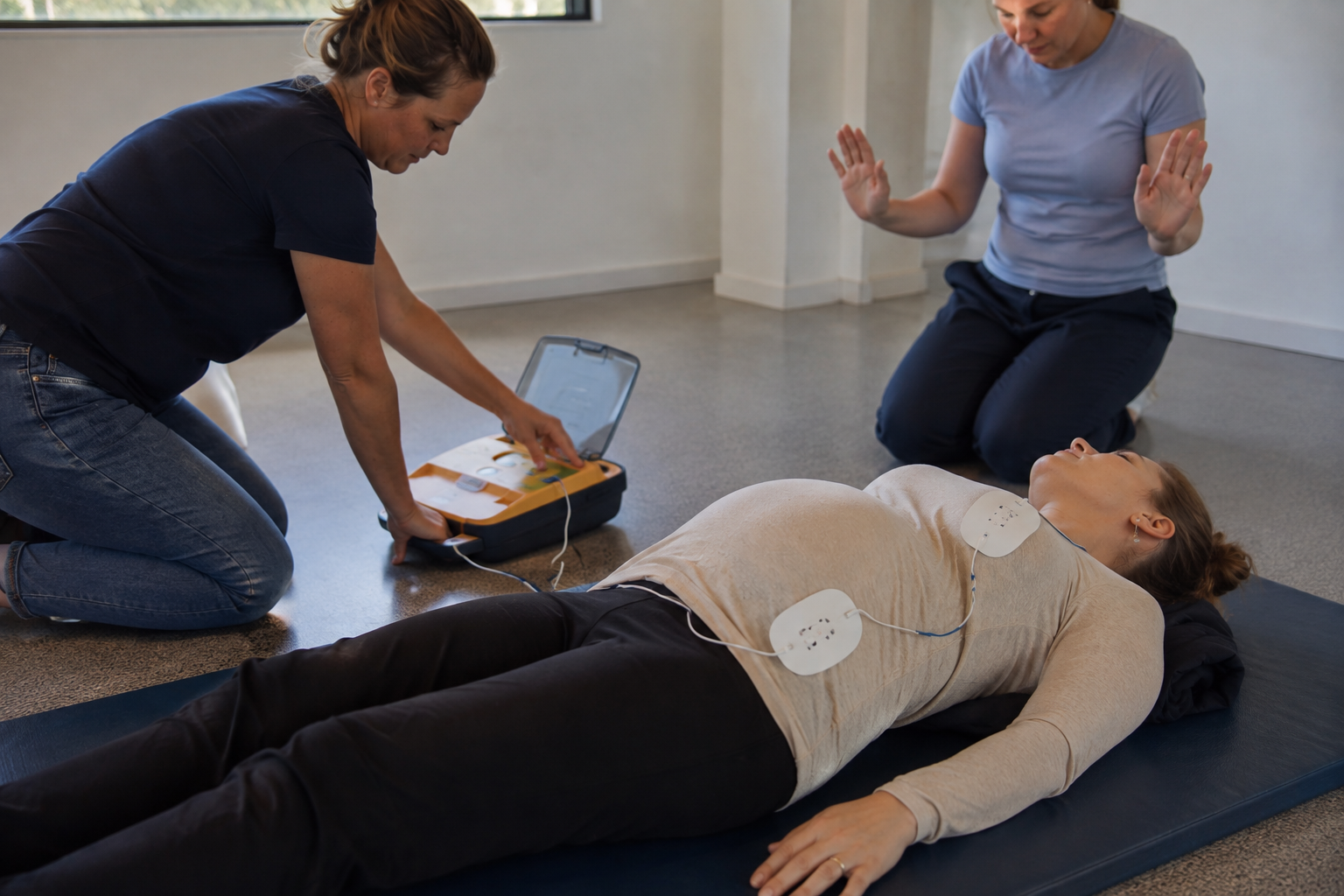
AED use is safe in pregnancy. Do not withhold or delay defibrillation because of the pregnancy. The electrical current from an AED travels through the chest and does not reach the uterus or fetus in clinically significant amounts. The only preparation required is to remove any fetal monitoring devices before attaching the AED pads.
Remove Monitors
Remove any fetal monitoring patches, CTG sensors, or leads before attaching AED pads. Do not leave them in place.
Attach Pads
Use standard adult pads in the standard positions: upper right chest and lower left side. Maintain the lateral tilt or MUD where possible.
Clear and Analyse
Make sure no one is touching the person. The AED analyses the rhythm and advises whether a shock is needed. Follow all voice prompts.
Resume CPR
After any shock, or if no shock is advised, return immediately to 30:2 CPR. Reapply the tilt or MUD and continue until EMS arrives.
Questions answered
Frequently Asked Questions
At what stage of pregnancy does the lateral tilt matter?
From approximately 20 weeks gestation, the uterus is large enough to compress the inferior vena cava when the person lies flat. If you are unsure of gestation, apply the tilt for any visibly pregnant person. It causes no harm if not needed and can be critical if it is.
Can I hurt the baby by doing CPR?
If the parent’s heart has stopped, the baby is not receiving oxygen. CPR is always the right action. An untreated cardiac arrest is fatal to both. Begin CPR immediately and do not hesitate because of the pregnancy.
Is it safe to use an AED on a pregnant person?
Yes. ANZCOR confirms that defibrillation is safe in pregnancy. The electrical current does not reach the uterus or fetus in clinically significant amounts. Remove any fetal monitoring devices before placing the pads, then use the AED as normal.
What if I cannot tilt them? Should I still do CPR?
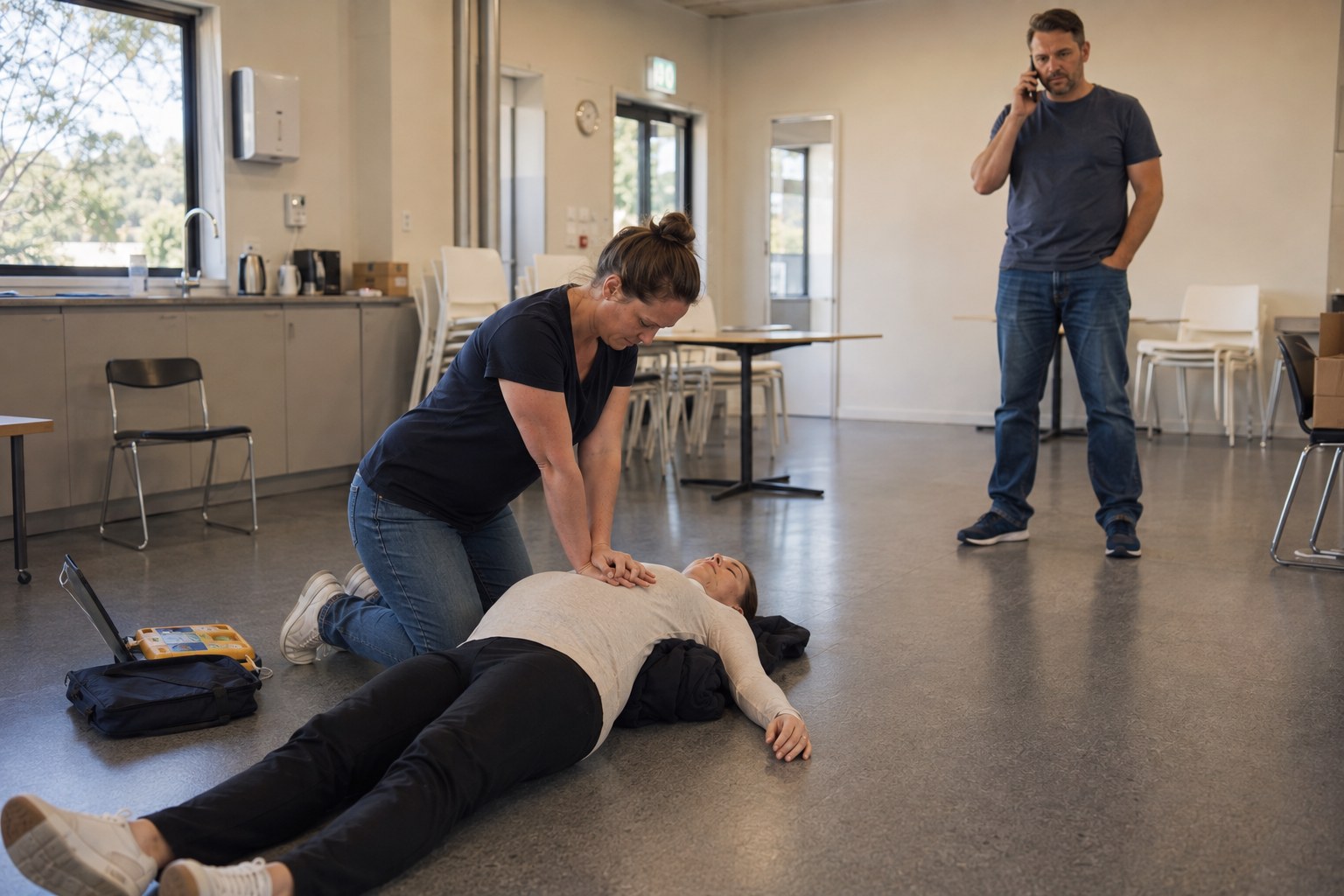
Always. If no wedge is available and no second rescuer can perform manual uterine displacement, give compressions flat on the back. Compression quality matters more than the tilt when you are alone. Call 000 immediately and do the best you can.
What is perimortem caesarean delivery?
An emergency delivery performed by trained medical personnel during maternal cardiac arrest to relieve aortocaval compression and potentially save the baby. It is a hospital-level intervention performed by advanced providers only — not a bystander action.
How does CPR in pregnancy differ from standard adult CPR?
The main differences are body position (left lateral tilt 15 to 30 degrees from approximately 20 weeks) and elevated airway risk. Compression depth (5 to 6 cm), rate (100 to 120 per minute), ratio (30:2), and initial rescue breaths (2) are the same as standard adult CPR.
Should I call 000 before or after starting CPR?
Call 000 first — this follows the adult protocol. Tell the operator the person is pregnant and your estimate of gestation. If another person is present, have them call while you begin CPR immediately.
Does CPR in pregnancy apply straight after birth?
In the hours immediately after delivery, the uterus is still present and contracted. The same precautions apply until the uterus has fully involuted, which typically takes several weeks postpartum. In the immediate postpartum period, treat as pregnancy CPR.
Nationally Accredited First Aid Training
Reading About It Builds Awareness. Practising It Builds Confidence.
Hands-on training with a qualified trainer is where the technique becomes muscle memory. Book a course and practise left lateral tilt, MUD (manual uterine displacement) & pregnancy-adapted CPR on a manikin with corrective feedback.
