




Sharon has 21+ years of experience as a qualified Emergency Care Nurse registered with the Australian Health Practitioner Regulation Agency (APHRA) and 12+ years as a First Aid Trainer.
She takes pride in FirstAidPro making first aid training available, comprehensive and affordable to everybody.
Key Takeaways
- Each university and health service sets its own rule, so check your placement portal first.
- Griffith University asks for an HLTWHS005 Statement of Attainment from a nationally recognised RTO, current for 12 months.
- Flinders University requires annual practical training arranged through an external provider.
- UQ runs its own in-person session for first-years, and UC requires annual face-to-face training.
- Online-only training often won’t meet the rule, so choose a course with a practical component.
- Manual handling is one part of a wider stack: police check, WWCC, immunisations, CPR and state deed polls.
- Our HLTWHS005 Conduct manual tasks safely manual handling course & HLTAID009 CPR course cover two common items.
Why Manual Handling For Nursing Student Placement Matters
Most nursing students need proof of manual handling training for nursing placement before their first shift. The exact rule depends on your university and the state health service you’re placed with. Miss the deadline and you can lose your spot: Flinders University says students not fully compliant by their deadline “become ineligible for placement”.
Manual handling is also a skill you’ll use every shift. Rolling, repositioning and transferring patients puts real load on your body. This guide covers what’s required, what universities accept and whether online-only courses count. You’ll also get a full pre-placement checklist and a booking countdown. We’ve built it from each university’s own requirement text (checked in October 2026).

What Manual Handling Training Do Nursing Students Need Before Placement?
There’s no single national rule to follow. In the requirement pages we reviewed, each university and state health service set its own manual handling rule, and the format varied. Check your placement portal (such as Sonia or InPlace) before you book anything.
HLTWHS005 Conduct Manual Tasks Safely
The nationally recognised unit you’ll see on placement pages is HLTWHS005 Conduct Manual Tasks Safely. According to training.gov.au, it covers the skills to recognise potentially hazardous manual tasks, then prepare for and complete them safely. The unit “applies to all workers involved in manual handling tasks”.
To be assessed competent, you must complete at least 3 different manual tasks relevant to your work role, following legally compliant procedures. You also contribute to a consultation about improving manual handling safety.
The unit on training.gov.au doesn’t set a currency period. The 12-month or annual rule comes from your university, such as Griffith, which treats certificates as current for 12 months.

Patient Handling Versus General Manual Tasks
Nursing adds a layer that warehouse work doesn’t: your load is a person who can move, resist or fall. Queensland’s Hazardous Manual Tasks Code of Practice 2021, based on Safe Work Australia’s model Code, is direct on this. It states: “No worker should fully lift a person, other than a small infant, unaided.”
What National Regulators Do and Don’t Set
National bodies handle different parts of your training. In the pages we reviewed, the manual handling rule came from universities and health services, not the NMBA, AHPRA or Safe Work Australia.
AHPRA registers students through their education provider, free of charge, so there’s nothing for you to apply for. For a wider view of workplace requirements, read our manual handling guide for healthcare workers.
What Universities Actually Ask For: Requirement Text in Their Own Words
Here’s what four universities say, quoted from their own placement pages. Each one handles manual handling differently.
Griffith University (QLD)
Griffith’s nursing placement page asks you to submit to Sonia “a current Statement of Attainment for the ‘Conduct Manual Tasks Safely’ course (course code HLTWHS005)”. It must be issued by a nationally recognised training organisation, and “certificates are current for 12 months”.
Griffith also states that “Manual handling training completed within a Cert III course is not acceptable.” The page carries a review date of 2027.
Flinders University (SA/NT)
Flinders’ nursing compliance page, last updated 19 August 2026, says “Manual handling training is conducted annually”. It adds that “Students are responsible for organising their training through an external provider.”
Flinders accepts three routes. These are HLTWHS005-accredited courses, SA Health or ACN-endorsed manual handling courses, or workplace training that includes a practical component. Its activity table tells you to “Book and attend a practical training session.”
The University of Queensland
UQ’s patient handling page, modified 27 August 2025, sets the rule for first-years. “From Semester 1 2024, all first-year nursing and midwifery students will be required to complete mandatory patient handling training before starting placements.”
The training has two parts: an in-person UQ session and 2 Queensland Health e-learning modules. If you miss your session, you must “self-source your patient handling competency” before placement. The page doesn’t say which external courses qualify, so ask UQ before you book.
University of Canberra (ACT)
UC’s manual handling page, modified 9 December 2025, lists nursing and midwifery among courses requiring face-to-face training. It states: “This training will need to be completed annually to ensure your skills remain current.”
You book a session through the Faculty of Health Manual Handling Canvas site. The page doesn’t state whether external certificates are accepted.
Australian College of Nursing (ACN Programs)
If you study through the ACN, its clinical placement information applies. Manual handling “must be updated annually and must be nursing-specific”, with theory and practical components. ACN states that “Fully online courses will not be accepted.”
University Requirements at a Glance
| University | Who delivers | How often | External HLTWHS005 accepted? |
|---|---|---|---|
| Griffith | Nationally recognised RTO | Current for 12 months | Yes |
| Flinders | External provider | Annually | Yes, one of three routes |
| UQ | UQ session plus Queensland Health e-learning | Before first-year placements | Not stated |
| UC | Faculty of Health session | Annually | Not stated |
*Please Note: Requirements change. We checked these pages in October 2026, so confirm the current rule in your placement portal.
Does an Online-Only Manual Handling Course Count?
In most of the requirement pages we reviewed, an online-only course won’t meet the rule. Each one stresses hands-on training in its own words:
- Flinders asks you to attend a practical training session.
- UC requires face-to-face training every year.
- ACN states that fully online courses won’t be accepted for its programs.
The unit points the same way. HLTWHS005’s performance evidence on training.gov.au requires you to complete at least 3 real manual tasks. You can’t show that by clicking through slides.
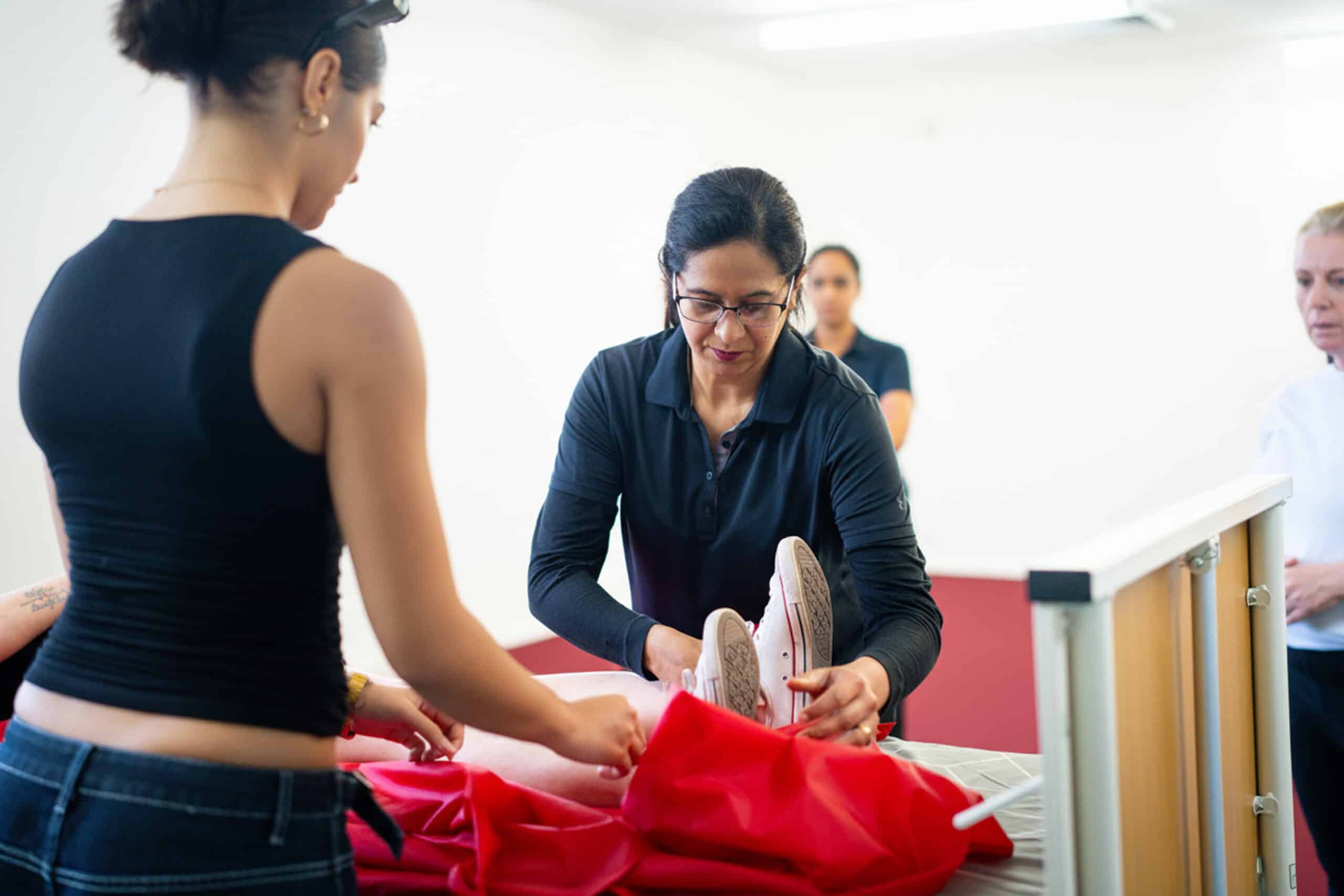
Our HLTWHS005 Conduct Manual Tasks Safely course uses a blended format. You complete self-paced online theory at home, then attend a 3-hour face-to-face practical session with one of our experienced trainers. The course costs $125. You receive a nationally recognised Statement of Attainment the same day* (T&Cs apply), ready to upload to your portal.
What You’ll Practise in a Healthcare-Focused Manual Handling Course
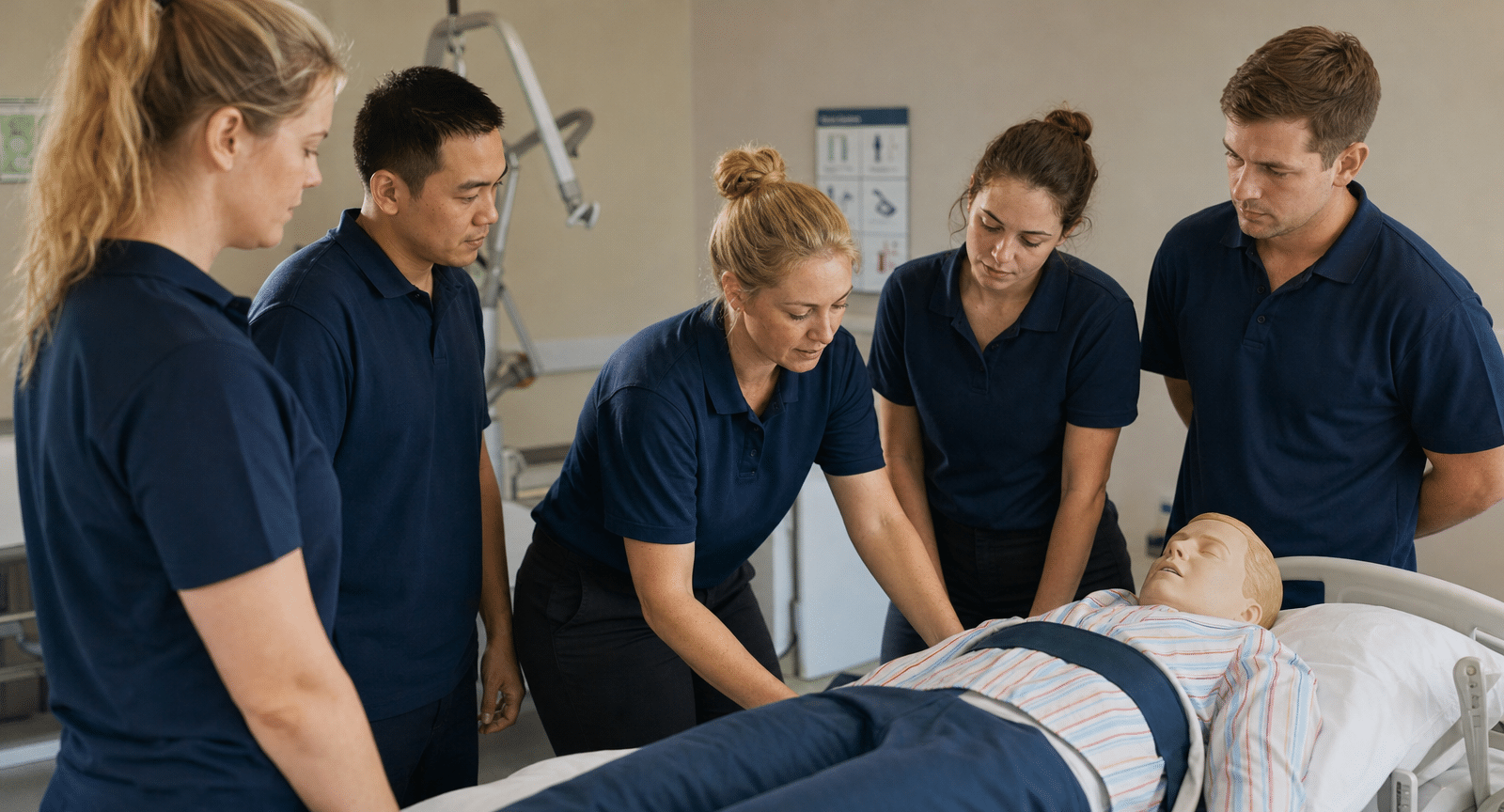
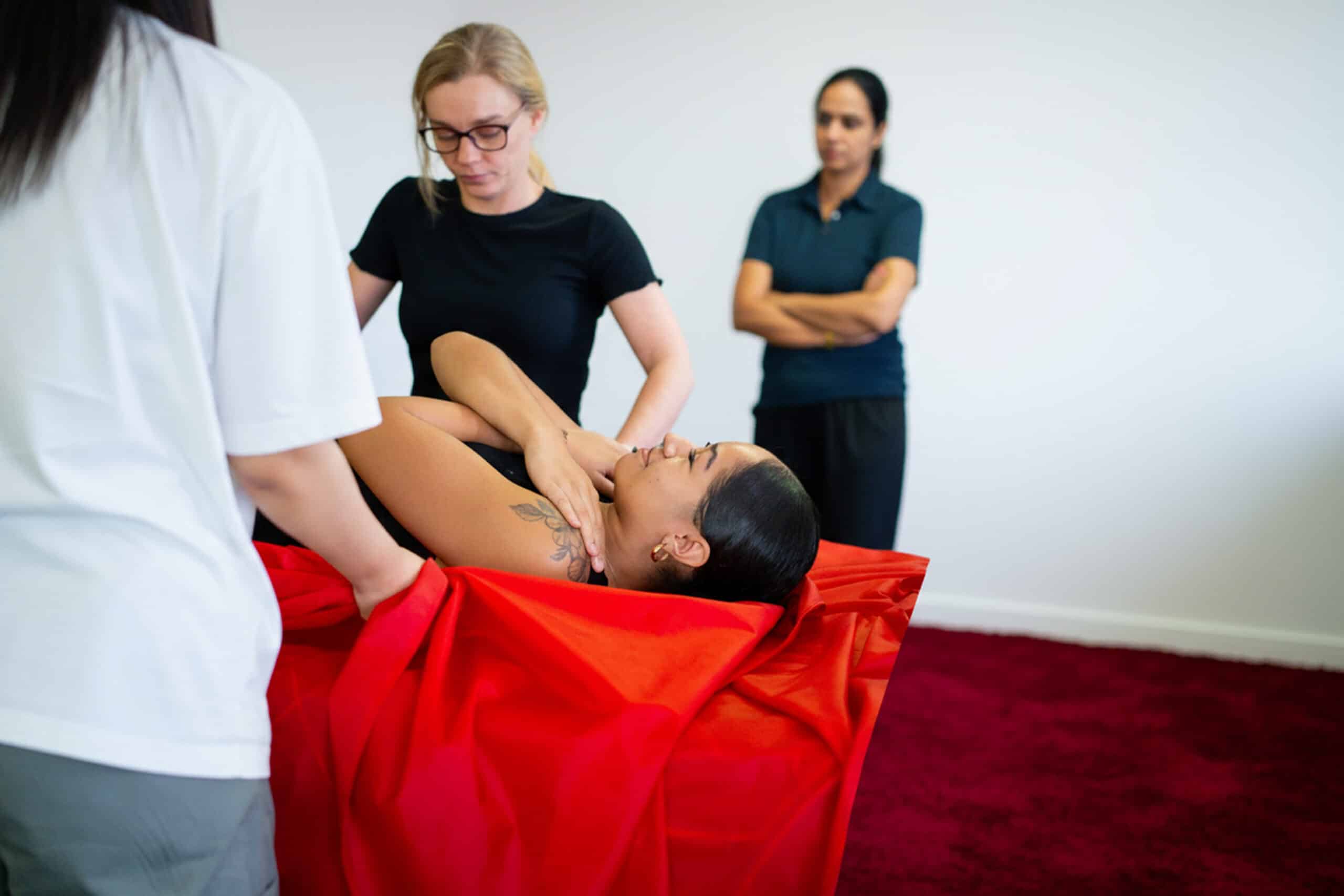
A comprehensive manual handling training session puts you through the moves you’ll make on the ward. In our HLTWHS005 practical, you’ll work through realistic simulations that cover:
- identifying hazardous manual tasks and completing a risk assessment before you move anyone
- safe body mechanics
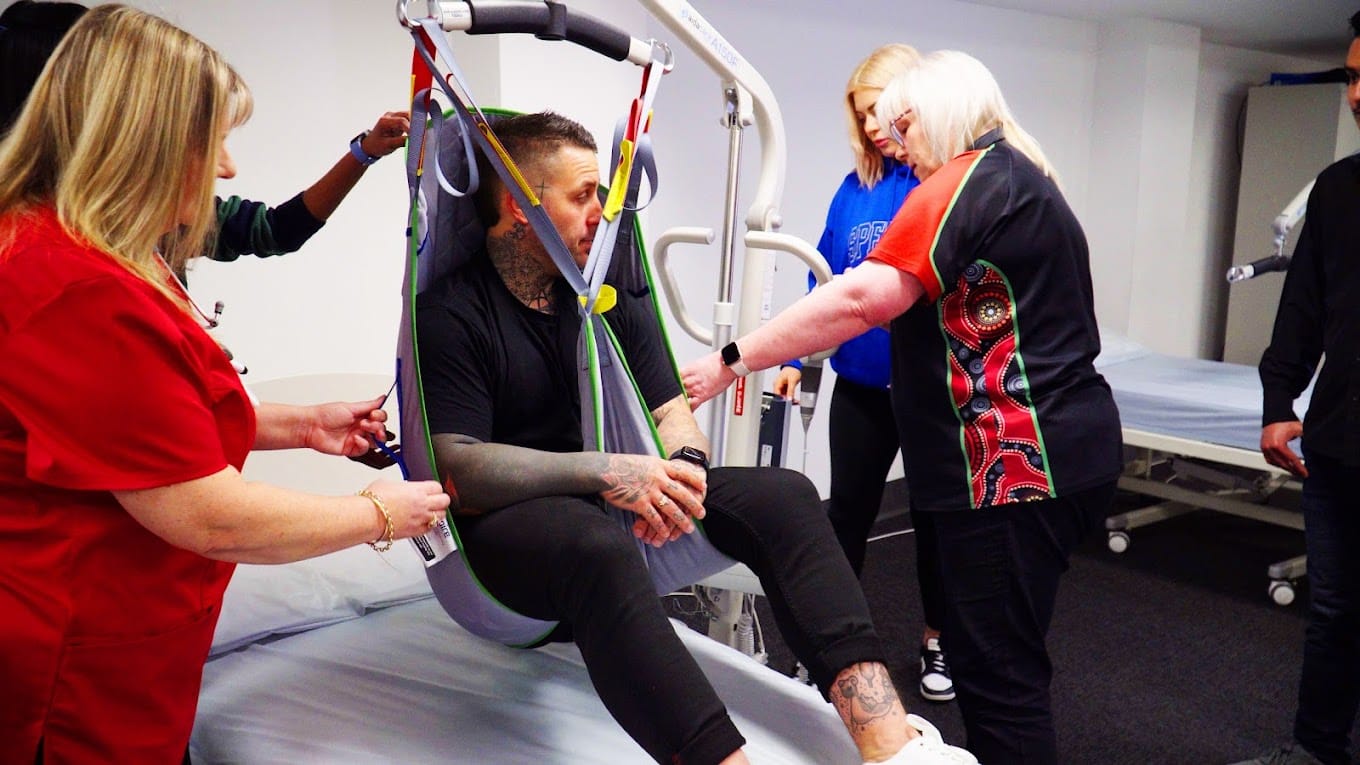
- mechanical aids such as hoists, slide sheets and trolleys
- team lifting, with clear communication before and during each move
- sudden-force scenarios, such as a patient who resists or stops assisting mid-transfer
That last scenario comes straight from the Queensland Code of Practice. It lists “handling patients who suddenly resist or no longer assist during the handling procedure” as a source of sudden force. The Code also says “There is no safe weight set for all workers in all circumstances”, because risk depends on many factors.
Training Supports Equipment and Systems
Training is one control among several. Safe Work Australia’s model Code of Practice for hazardous manual tasks sets out a hierarchy of controls. Queensland’s version says administrative controls “used on their own tend to be the least effective” in minimising risk. So your training works alongside hoists, slide sheets, staffing and safe systems of work. Use the equipment your ward provides, every time.
WorkSafe Victoria’s disability services guidance, reviewed 7 September 2026, tells employers to “Eliminate manual lifting of patients, except in life-threatening situations.” It also calls for mechanical aids and patient handling training for all employees. For a technique refresher, read our guide to patient manual handling basics.
Your Pre-Placement Compliance Checklist
Manual handling is one item on a longer list. Work through each one, then upload every document to your placement portal and keep copies.
- Complete manual handling training. Follow your university’s format and currency rule from the table above.
- Complete CPR or first aid, as your university requires. Griffith wants in-person HLTAID011 including HLTAID009, while Flinders asks for HLTAID009 annually. We run our HLTAID011 Provide First Aid course face to face, as well as other delivery options to suit you.
- Get a national police check. NSW Health accepts checks for five years (HETI), while some universities set three.
- Get a working with children check. You need the check for your placement state, such as a Queensland Blue Card (see the State Snapshot below).
- Get NDIS or disability worker screening, where listed. Monash University requires NDIS Worker Screening; the State Snapshot covers Queensland and SA.
- Bring your immunisations up to date. NSW Health applies PD2026_004, including mandatory flu vaccination for placements between 1 June and 30 September.
- Agree to the NSW Health Code of Conduct. Read and agree to it before any NSW Health placement.
- Complete the Queensland Health Student Deed Poll. Complete it before each placement, along with the Orientation Checklist.
- Sign the SA Health Deed Poll. South Australian placements need the SA Health Better Placed Deed Poll.
State Snapshot: NSW, Queensland, South Australia and Victoria
In NSW, the HETI student compliance page, modified 29 April 2026, covers the police check, Code of Conduct and immunisations. It doesn’t list a manual handling or CPR certificate, so your university’s rule decides those.
In Queensland, Griffith’s placement page explains that the Student Deed Poll must be completed before each placement. Your Orientation Checklist follows your Blue Card, police check (valid three years), vaccinations and Queensland Health iLearn training. Griffith also lists Disability Worker Screening.
In South Australia, Flinders lists a DHS Working With Children Check, NDIS Worker Check and criminal history check (valid three years). The same list includes the SA Health Better Placed Deed Poll, hand hygiene, CPR and manual handling.
Victoria is indicative only, because we couldn’t read every source in full. Victoria University lists yearly requirements including mask fit testing, a police check, vaccinations and a WWCC. Confirm the full list with your university.
When to Book: A Placement Countdown
Use this countdown to stay ahead of your deadline:
- Six to eight weeks before placement, check your portal and book your practical session.
- Four weeks before placement, finish the online theory.
- Two to three weeks before placement, attend the practical and upload your Statement of Attainment.
In our trainers’ experience, sessions fill quickly in the weeks before each semester’s placements. We run sessions 7 days a week across our Australia-wide venues, and certificates are issued the same day* (T&Cs apply).
This timing is our guidance, not a university rule. Your portal deadline always comes first.

Your Next Step: Check Your Portal, Then Book
Manual handling training for nursing placement depends on your university, so start with your portal. Some universities accept HLTWHS005 completed with an RTO, while others run their own sessions. Most stress a practical component, and the same list also needs your police check, WWCC, immunisations and CPR.
Once you know your rule, book your HLTWHS005 course six to eight weeks out. Find a course near you on our calendar and get certified the same day* (T&Cs apply).
Disclaimer
This article is general information only and isn’t medical, legal or compliance advice. Placement requirements change and differ between universities and health services. Always confirm current requirements with your university placement office before you book or upload documents.
Frequently Asked Questions
Do Nursing Students Need Manual Handling Training Before Placement?
Most do, but the rule is set by your university and health service. Flinders University requires annual manual handling training, and students who miss the compliance deadline become ineligible for placement. Check your placement portal for your exact requirement.
Is HLTWHS005 Accepted for Nursing Placement?
At some universities, yes. Griffith University asks for an HLTWHS005 Statement of Attainment from a nationally recognised RTO, and Flinders accepts it as one of three routes. UQ and UC run their own sessions and don’t state whether external certificates count, so confirm before you book.
How Long Is a Manual Handling Certificate Valid for Nursing Placement?
The HLTWHS005 unit on training.gov.au doesn’t set a currency period, so the 12-month or annual rule comes from your university. Griffith University treats certificates as current for 12 months, while the University of Canberra requires training every year.
Can I Do Manual Handling Training Online for Nursing Placement?
Usually not on its own. The Australian College of Nursing states that fully online courses won’t be accepted for its programs. A blended course with online theory and an in-person practical is the safer choice.
Does Manual Handling Training Count If It Was in My Cert III?
Not at Griffith. Griffith University states that manual handling training completed within a Cert III course is not acceptable. Other universities may differ, so check your placement portal.
Do I Need CPR as Well as Manual Handling for Placement?
At many universities, yes, though the course varies. Griffith University requires an in-person HLTAID011 certificate including HLTAID009, while Flinders accepts HLTAID009 CPR completed annually. The NSW Health compliance page doesn’t list CPR, so your university’s rule applies.
Do I Need to Register with AHPRA Before Placement?
No. AHPRA states that students don’t need to apply, because the education provider registers enrolled students. There are no fees for student registration.