




Learn CPR For Children
CPR For Kids: How to Do It Right When It Matters Most
Children aged 1 to puberty need a specific CPR technique. Learn the ANZCOR-aligned steps every parent and carer should know.
CPR For Kids
Who Does Child CPR Apply To?
Before starting CPR, knowing which technique to use matters. ANZCOR Guideline 12.1 defines three distinct groups — each with its own technique:
Infant
Under 1
Under 12 months of age
Child
1 yr – Puberty
Adult
Post-puberty
Visible signs of puberty
If unsure
Use adult
Under-resuscitation is the greater risk

The onset of puberty — not a fixed age — is the trigger for switching to adult CPR. If you’re uncertain, ANZCOR advises defaulting to adult technique. The risk of under-resuscitating outweighs the risk of injury from a slightly firmer compression on a larger child.
Key differences
How Child CPR Differs from Infant and Adult CPR
Child CPR sits between the two — it shares the respiratory focus of infant resuscitation, but uses a closer-to-adult approach for airway, hand position, and compression force. Understanding the differences prevents the two most common errors: applying infant technique to a child (too gentle, wrong hand position) or adult technique (too much force, wrong airway angle).
| Child (1 yr – Puberty) | Infant (Under 1 yr) | Adult (Post-puberty) | |
|---|---|---|---|
|
PRIMARY CAUSE |
Respiratory / asphyxia |
Respiratory / asphyxia |
Cardiac event |
|
HEAD POSITION |
Slight extension |
Neutral (face straight up) |
Full head tilt–chin lift |
|
AIRWAY SEAL |
Mouth over mouth only |
Mouth over mouth only |
Mouth over mouth only |
|
INITIAL BREATHS |
5 rescue breaths first |
5 rescue breaths first |
2 rescue breaths first |
|
HAND TECHNIQUE |
Heel of 1 hand (2 for larger child) |
2-thumb encircling (preferred) or 2 fingers |
2 hands interlocked |
|
DEPTH |
~5 cm (⅓ chest) |
~4 cm (⅓ chest) |
5–6 cm |
|
RATE |
100–120/min |
100–120/min |
100–120/min |
|
RATIO (1 RESCUER) |
30:2 |
30:2 |
30:2 |
|
RATIO (2 TRAINED) |
15:2 |
15:2 |
15:2 |
|
RESCUE BREATHS |
Always required |
Always required |
Optional (compression-only acceptable) |
|
AED PADS |
Paediatric preferred (under 8 yrs) |
Paediatric pads — chest + back |
Adult pads |
|
ALONE — CALL 000 |
Give 1 min CPR first, then call |
Call 000 first, then start
|
Give 1 min CPR first, then call |

Official guidelines
ANZCOR Child CPR Guidelines: What Community Responders Need to Know
ANZCOR — the Australian and New Zealand Council on Resuscitation — sets the evidence-based standards used to train first aid providers across Australia. For children aged 1 to puberty, the applicable framework is the ANZCOR Basic Life Support Guidelines (2 to 8), not the clinical paediatric advanced life support guidelines used in hospital settings.
Initial breaths
5
Before compressions begin
Ratio
100–120
Rate
100–120
Compressions per minute
Depth
~5 cm
⅓ of chest depth
Why 5 initial rescue breaths? Children — like infants — most commonly arrest due to a respiratory event: airway obstruction, choking, drowning, asthma, or a similar cause. ANZCOR guidelines specify 5 initial rescue breaths before compressions to rapidly restore oxygen in the bloodstream before circulation is prioritised. This differs from adult CPR, where 2 breaths are given because the arrest is typically cardiac in origin.
When two trained rescuers are present, ANZCOR Guideline 12.1 specifies a ratio of 15:2 for children — compared to 30:2 for two-rescuer adult CPR. This higher ventilation rate reflects the respiratory priority in paediatric resuscitation.
Emergency response
DRSABCD for Children: Step-by-Step Emergency Response
The standard Australian emergency framework applies — with specific adaptations at each step for children aged 1 to puberty.

Child CPR Compressions
How to Perform Child CPR Chest Compressions
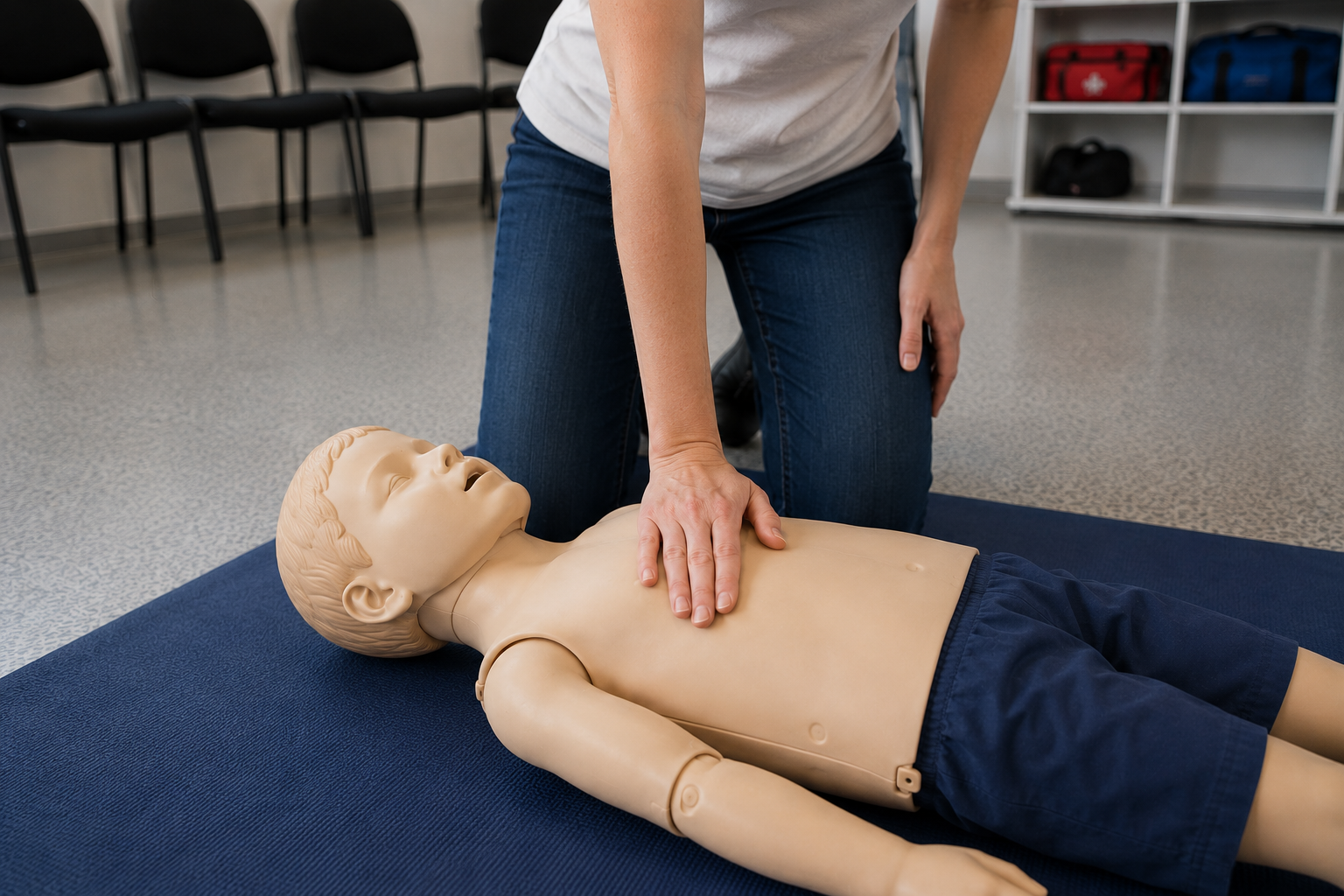
After the 5 initial rescue breaths, begin compressions immediately. Place the child on a firm, flat surface. Find the landmark & correct CPR compression depth for a child: the centre of the chest on the lower half of the sternum (breastbone). Avoid the very tip of the sternum (xiphoid process).
Standard — most children
Place the heel of your dominant hand on the lower half of the sternum. Keep fingers raised off the chest. Compress with a straight arm, using body weight. This is the standard technique for most children aged 1 to puberty.
Larger or older child
For a larger child close to puberty, use two hands interlocked — heel of the dominant hand on the sternum, second hand on top. The size of the child determines which technique is appropriate, not age alone.
What changes from infants
The two-thumb encircling and two-finger techniques used for infants are not appropriate for children over 12 months. The chest is larger and more force is required to achieve adequate depth.
Compress the chest by at least one third of its depth — approximately 5 cm for most children. Compress at 100–120 per minute. Allow full chest recoil between compressions without leaning on the chest. After every 30 compressions, deliver 2 rescue breaths and return to compressions immediately.
CPR Metronome — Practise Your Compression Rate
ANZCOR specifies 100–120 compressions per minute for child CPR. Start the beat and compress in time with each pulse.
Ventilation
How to Give Rescue Breaths During Child CPR
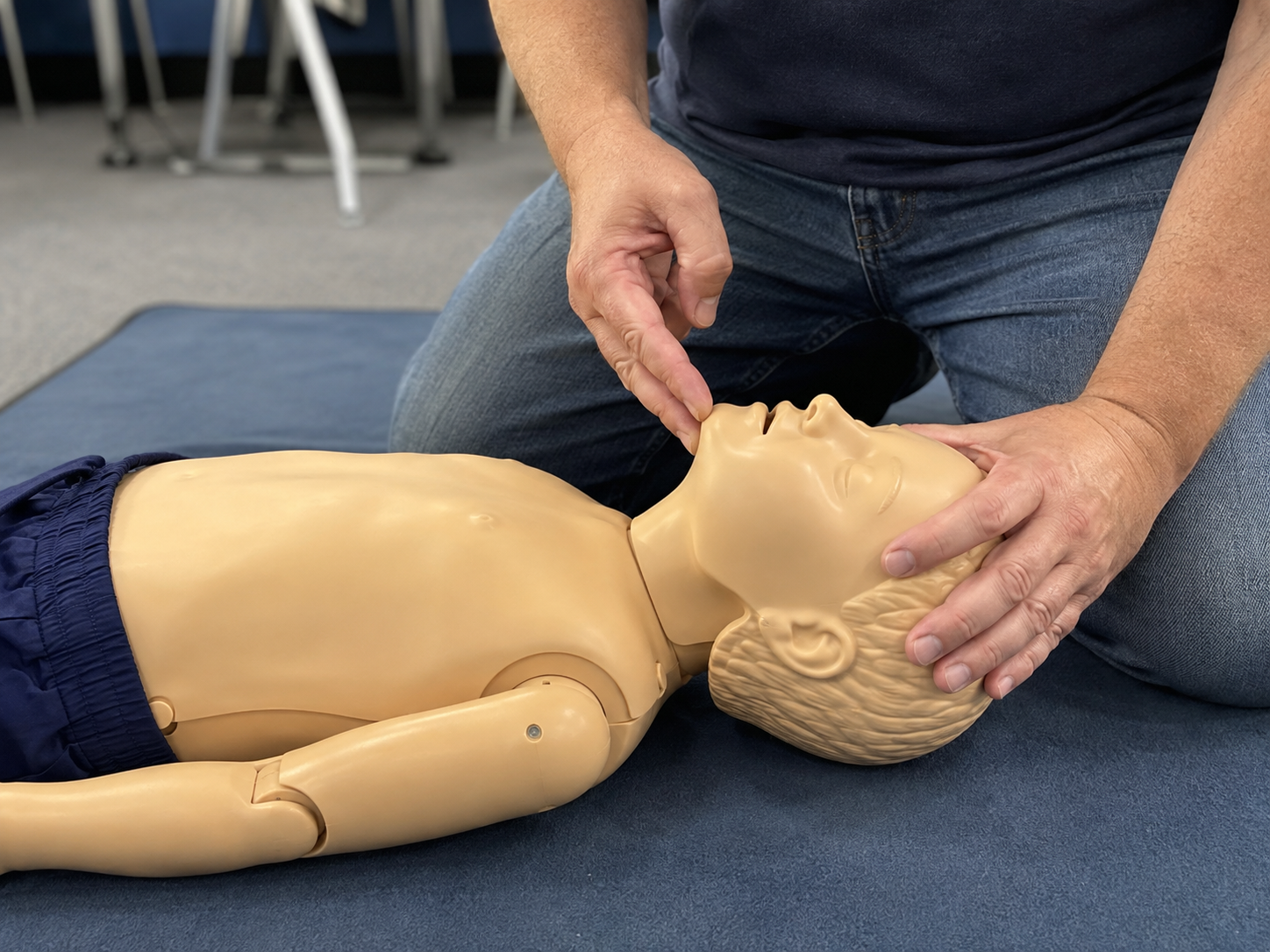
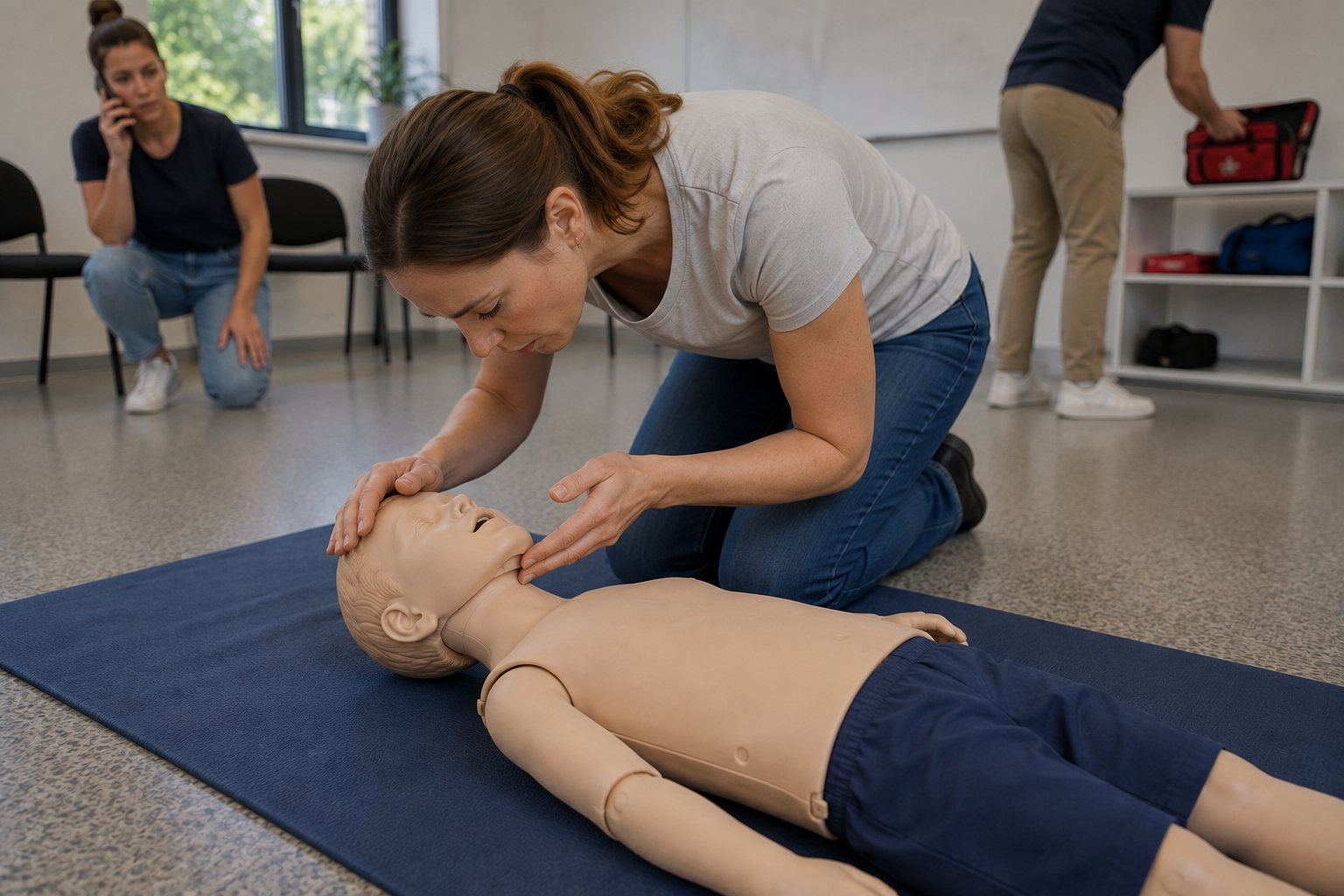
Rescue breaths are essential for child CPR — children arrest from oxygen deprivation far more often than from a cardiac event. Skipping breaths significantly reduces the chance of survival. After 5 initial rescue breaths, give 2 breaths after every 30 compressions.
Common errors
Child CPR Mistakes — and How Training Helps You Avoid Them
Knowing the theory helps. Practising the physical technique under supervision is what builds the muscle memory to act correctly under pressure.
- Give 5 rescue breaths first. Before you start compressions — every single time.
- Include rescue breaths every cycle. 30 compressions, then 2 breaths, without exception.
- Use the heel of one hand on the lower sternum. Scale up to two hands for a larger child.
- Compress to ~5 cm — at least one third of the chest depth. Commit to the depth.
- Allow full chest recoil after each compression without lifting your hand.
- If alone, give 1 minute of CPR before calling 000. Then return to CPR immediately.
- Skipping rescue breaths. Compression-only CPR is not appropriate for children — oxygen delivery is the priority.
- Using infant technique. Two fingers or two-thumb encircling won't achieve adequate depth for a child's chest.
- Over-tilting the head. A slight extension is correct — the full adult head tilt can be too aggressive for a young child.
- Blowing too hard. Gentle breaths are enough to raise the chest. Over-inflation pushes air to the stomach.
- Stopping to check for a pulse. Minimise all interruptions. Keep cycling until EMS takes over.
- Compressing too softly. Fear of injury leads to ineffective CPR. Full depth is required every compression.
Defibrillation
Using an AED During a Child First Aid Emergency
AEDs analyse heart rhythm automatically and only deliver a shock when one is needed. For children, paediatric pads and an attenuator are preferred for children under 8 — they reduce the energy of the shock to a safe level for a smaller body. If paediatric pads are not available, use adult pads. Do not delay defibrillation.
Turn it on
Open the AED and switch it on. Follow the voice prompts at every step — they guide you through the whole process.
Attach Pads
Paediatric pads preferred for children under 8. Place one on the upper right chest, one on the lower left side. If pads risk overlapping, place one front, one back.
Clear & Analyse
Make sure nobody is touching the child while the AED analyses the rhythm. Stand clear when prompted before a shock.
Resume CPR
Return to 30:2 immediately after a shock, or if no shock is advised. Don't stop to check — keep cycling until EMS arrives.
Questions answered
Frequently Asked Questions
What is the correct CPR ratio for a child?
For a single community rescuer, ANZCOR guidelines specify 30 compressions to 2 rescue breaths (30:2). For healthcare professionals trained in paediatric basic life support, the compression-to-ventilation ratio is 15:2 for children, reflecting the importance of ventilation in paediatric resuscitation.
Do children need rescue breaths in CPR?
Yes, always. Children most commonly arrest due to a respiratory cause — airway obstruction, drowning, choking, or asthma — not a cardiac event. Compression-only CPR is not appropriate for children. ANZCOR specifies 5 initial rescue breaths before compressions begin, then 2 breaths after every 30 compressions.
How deep should chest compressions be for a child?
ANZCOR guidelines specify approximately one third of the chest’s depth — around 5 cm for most children. Use the heel of one hand on the lower half of the sternum. For a larger child close to puberty, use two hands as you would for an adult. Allow full chest recoil between every compression.
How is child CPR different from adult CPR?
Key differences between child CPR & adult CPR include the way compressions and rescue breaths are performed, with adjustments made for a child’s size and age. However, for standard Australian basic life support, the CPR cycle remains 30 compressions followed by 2 rescue breaths for both children and adults
At what age do I switch from child CPR to adult CPR?
ANZCOR defines the switch as the onset of puberty, not a fixed age — typically around 8–12 years depending on the child. If you can see visible signs of puberty, use adult CPR. If unsure, use adult CPR. The risk of under-resuscitation is greater than the risk of any injury from firmer compressions.
Can I use an AED on a child?
Yes. Use paediatric pads for children under 8 where available. Place one pad on the upper right chest and one on the lower left side. If pads may overlap, place one on the centre of the chest and one on the centre of the back. If only adult pads are available, use them — do not delay defibrillation.
Should I call 000 before or after starting CPR on a child?
If another person is present, have them call 000 immediately while you begin CPR. If you are alone, ANZCOR recommends giving 1 minute of CPR first, then calling 000. This differs from adult CPR, where you call 000 first. Children’s arrests are usually caused by oxygen loss, so immediate CPR takes priority.
Nationally Accredited Training
Reading About Child CPR Builds Awareness. Practising It Builds Confidence.
Real competency under pressure comes from hands-on practice with corrective feedback on a manikin — not from reading alone. Book a course and practise the real thing.
